What's inside
As an Amazon Associate I earn from qualifying purchases. This post may contain affiliate links at no extra cost to you.
Contents
Best Workbench Clamps for Secure, Flexible Hold-Downs
The best workbench clamps depend on what you’re holding: choose bench dogs or holdfasts for quick work on a hole-equipped bench, low-profile clamps for routing, and parallel or F-style clamps for glue-ups and assembly. Before buying, match the clamp’s opening capacity and throat depth to your workpiece, then confirm it fits your bench’s holes or edges.
Compare the main clamp types
“Workbench clamp” can mean a clamp built into or mounted to a bench, or a portable clamp used at the bench. The useful distinction is how each type reacts to force: hold-downs secure a workpiece to the surface, while edge clamps draw parts together or hold them against a fence.
As an Amazon Associate we earn from qualifying purchases at no extra cost to you.


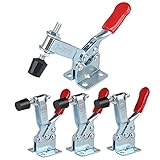

| Clamp type | Typical capacity | Typical throat depth | Bench compatibility | Best suited to |
|---|---|---|---|---|
| Bench dogs and surface clamps | Depends on dog spacing; commonly 3/4 in. (19 mm) holes | Limited by the clamp’s reach across the workpiece | Round-hole benches, often 3/4 in. or 20 mm | Planing, sanding, and general hold-downs |
| Holdfasts | Often about 4–8 in. (100–200 mm) of usable reach | Typically about 4–8 in. (100–200 mm) | Hole diameter must match the holdfast shank; many are made for 3/4 in. or 20 mm holes | Fast, adjustable workholding on a thick bench |
| F-style clamps | Commonly 6–24 in. (150–600 mm) | Often about 2–4 in. (50–100 mm) | No holes needed; clamp over an edge | Small assemblies and edge-to-edge glue-ups |
| Parallel clamps | Commonly 12–50 in. (300–1,270 mm) | Often about 3–4 in. (75–100 mm) | No holes needed; clamp over an edge | Cabinet boxes, panels, and square assemblies |
| Low-profile track or bench clamps | Often about 2–6 in. (50–150 mm) of gripping range | Varies by track and clamp design | Requires a compatible T-track, dog hole, or mounting slot | Routing, template work, and keeping clamps below the cutter path |
These are common ranges, not guarantees for every model. Check the manufacturer’s stated capacity and the dimensions of your particular bench. Hole diameter alone is not enough: bench thickness, hole spacing, and whether the holes are through-holes also affect compatibility.
Choose by the job
For routing or surface work
Use bench dogs with a planing stop or a low-profile clamp that sits below the work surface. The low profile matters because a router base or bit can strike a tall clamp. Position clamps outside the tool’s travel, and test the full routing path with the tool unplugged before switching it on. A holdfast can be fast for hand-tool work, but its arm may obstruct a router or sanding pass.
For glue-ups
For narrow stock or small frames, F-style clamps are economical and easy to reposition. For wider panels and cabinet cases, parallel clamps are easier to keep aligned because their jaws are designed to remain parallel under pressure. Long clamps can sag or bow a panel if placed carelessly; alternate clamps above and below the assembly and use cauls to distribute pressure. More clamping force is not automatically better: excessive pressure can squeeze out too much glue or distort the work.
For quick, flexible hold-downs
On a hole-equipped bench, holdfasts are among the quickest options: insert, tap to seat, and tap the arm to release. They’re useful for irregular pieces that don’t suit a straight fence. A bench-dog setup is more repeatable for straight boards and can be paired with a tail vise. If your bench has no holes, an edge-clamping F-style clamp or a purpose-made track clamp avoids drilling—but check that the bench edge is thick and strong enough to resist the load.
Check fit before you buy
- Opening capacity: Measure the assembled workpiece at its widest point, then add clearance for pads, cauls, or uneven edges. For a 4 in. (102 mm) thick assembly, a clamp with exactly 4 in. of capacity may be too tight in practice.
- Throat depth: Measure from the clamp bar or body to the center of the jaw pad. A clamp can open wide enough but still fail to reach the gripping point on a broad panel.
- Hole fit: Measure your actual bench holes, not just their nominal size. A 20 mm dog will not fit a 3/4 in. hole (19.05 mm), and a tight fit can jam as wood swells with humidity.
- Bench edge and clearance: For clamps that hook over an edge, confirm the jaw clears the apron or vise hardware and that the edge won’t crush under pressure.
- Clamp reach and count: For a panel glue-up, plan clamp positions along its length rather than buying only one long clamp. Even spacing helps maintain even pressure.
A practical starter set by workshop situation
| Situation | Good starting choice | Why | Trade-off |
|---|---|---|---|
| Small shop, occasional repairs | Two or four 6–12 in. (150–300 mm) F-style clamps | Versatile for edge clamping and small assemblies; no bench holes required | Limited reach and throat depth |
| Hand-tool work on a dog-hole bench | Bench dogs plus one or two compatible holdfasts | Fast repositioning without a large clamp collection | Requires correctly sized holes and adequate bench thickness |
| Frequent cabinet or panel work | Several 24–50 in. (600–1,270 mm) parallel clamps | Useful reach and more consistent jaw alignment for larger assemblies | Bulkier to store and generally more costly than F-style clamps |
| Router-table or track-based work | Clamps made for the installed T-track or bench system | Can secure stock while keeping hardware clear of the tool path | System-specific; verify the clamp fits the track profile |
For larger projects, add clamps in pairs as your work demands rather than buying a full set before you know the sizes you use. General market prices vary by brand, length, and materials: basic F-style clamps are often in the low tens of dollars each, while long, heavy-duty parallel clamps can cost several times more. Holdfasts and bench-dog hardware usually fall between those categories, depending on design and finish.
Keeping clamps reliable
Glue is the main enemy of smooth operation. Wipe fresh squeeze-out off bars and pads with a damp cloth; dried glue can scrape away with a plastic or wooden scraper. Avoid leaving wet glue on bare steel, since it can encourage rust. Keep screw threads clean, and apply a small amount of suitable lubricant if the manufacturer permits it. On wooden bench holes, clear dust and chips so dogs and holdfasts seat consistently.
Inspect pads, handles, and moving jaws periodically. Worn or loose pads can mark a workpiece or tilt under load; replace them when possible, or use scrap cauls to protect the surface. Don’t use a clamp as a hammer, force a mismatched holdfast into a hole, or overtighten a small clamp to compensate for insufficient reach. Choosing the right geometry is safer and usually holds the work more evenly.
Bottom line
For a bench with compatible holes, bench dogs and holdfasts make quick, adaptable clamps for workbench tasks. For edge-to-edge glue-ups, start with F-style clamps for smaller pieces or parallel clamps for larger assemblies. For routing, prioritize low-profile hardware and unobstructed tool travel. The best set is the one whose capacity, throat depth, and mounting method fit the jobs you actually do—and your bench.