Our Top Picks
What's inside
- Table of Contents
- Why Use a Marking Knife Instead of a Pencil?
- 1. Narex Thin Blade Dual Double Bevel Striking Marking Knife 822302
- 2. Aeglemana Woodworking Marking Knife with Leather Sheath
- 3. Clarke Brothers Marking Knife with Leather Sheath
- 4. Malomke Double Bevel Marking Knife
- 5. Qianying 5CR15 Marking Knife with Leather Sheath
- How to Choose the Best Marking Knife
- Frequently Asked Questions
- Conclusion
As an Amazon Associate I earn from qualifying purchases. This post may contain affiliate links at no extra cost to you.
If you want the short answer, start here: for most woodworkers, the best marking knife is a thin dual-bevel striking knife such as the Narex 822302, because its hardened Mn-V steel blade, spear-style tip, and flat registration faces scribe a line that a saw or chisel can follow exactly. If you prefer a handled knife with a sheath for bench and site work, the Aeglemana double-beveled marking knife is a strong mid-range alternative, while the Clarke Brothers knife suits anyone who wants a compact, lightweight marker for fine joinery. The Malomke double bevel knife covers the budget tier with chromium-vanadium steel and a beech handle, and the Qianying 5CR15 knife rounds out the list with a Japanese-style profile and an included leather sheath.
A marking knife does one job that a pencil cannot. Instead of drawing a graphite line with width and ambiguity, it severs wood fibers along a straightedge and leaves a physical groove. That groove registers the edge of a square, guides a chisel when you pare to a line, and gives a saw a starting track that resists wandering. For dovetails, mortises, tenons, and hinge gains, that difference is the difference between a joint that closes cleanly and one that needs persuasion.
As an Amazon Associate, we earn from qualifying purchases.
Contents
- Table of Contents
- Why Use a Marking Knife Instead of a Pencil?
- 1. Narex Thin Blade Dual Double Bevel Striking Marking Knife 822302
- 2. Aeglemana Woodworking Marking Knife with Leather Sheath
- 3. Clarke Brothers Marking Knife with Leather Sheath
- 4. Malomke Double Bevel Marking Knife
- 5. Qianying 5CR15 Marking Knife with Leather Sheath
- How to Choose the Best Marking Knife
- Frequently Asked Questions
- Conclusion
Table of Contents
- Why Use a Marking Knife Instead of a Pencil?
-
- Narex Thin Blade Dual Double Bevel Striking Marking Knife 822302
-
- Aeglemana Woodworking Marking Knife with Leather Sheath
-
- Clarke Brothers Marking Knife with Leather Sheath
-
- Malomke Double Bevel Marking Knife
-
- Qianying 5CR15 Marking Knife with Leather Sheath
- How to Choose the Best Marking Knife
- Frequently Asked Questions
- Conclusion
- Product and ASIN Reference
Why Use a Marking Knife Instead of a Pencil?
A pencil line is a suggestion. Its width changes with pressure, the lead wears as you draw, and you are always left deciding which side of the line is the waste side. A knife line has no width to argue about. The cut itself becomes the reference: drop a chisel into the groove and it sits in exactly one place, every time.
Knife lines also survive handling better than graphite. They do not smudge when you plane an adjacent surface, they stay visible under raking light, and on end grain — where pencils skate and tear — a sharp spear point or dual-bevel edge still cuts a clean, readable mark. That is why layout for hand-cut joinery is traditionally done with a knife against a square, a marking gauge, or the mating part itself.
The five knives below cover the main shapes you will meet: dual-bevel striking knives with spear-style tips, double-beveled scribing knives with sheaths, and compact single-purpose markers. They span budget, mid-range, and premium tiers, so you can match the tool to how much layout work you actually do.
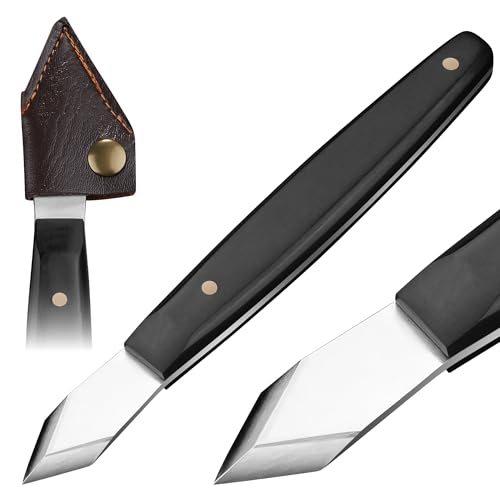
1. Narex Thin Blade Dual Double Bevel Striking Marking Knife 822302

The Narex 822302 is the reference point in this category, and it earns that position on blade geometry and steel. The blade is made from high-alloy manganese-vanadium steel heat treated to HRc 61, a hardness that holds a fine edge through repeated scoring in hardwoods while still responding to a fine stone or strop. At just 0.055 inches thick, the blade slips along a square or rule with minimal friction, which reduces the tendency to drift off the line mid-stroke.
The dual double-bevel grind is the other half of the design. Both faces carry bevels that meet at a spear-style tip ground to 55 degrees, so the knife marks equally well running left-to-right or right-to-left, and it registers flat against a straightedge from either side. That symmetry matters when you transfer dovetail pins to a tail board or knife around a tenon shoulder, where flipping the knife is faster than flipping the workpiece. The maker describes it as a striking knife, meaning the layout line can be deepened with controlled pressure for a groove a chisel can locate by feel.
The handle is European hornbeam with a solid brass ferrule, shaped to stay put in the hand and flat enough on one side to resist rolling off the bench. With a 2-inch blade and a 6.75-inch overall length, it is sized for joinery layout rather than rough work, and it suits anyone whose marking is mostly dovetails, mortises, and tenon shoulders in furniture-scale stock.
Specs
- Blade material: Mn-V alloy steel, heat treated to HRc 61
- Blade thickness: 0.055 in
- Blade length: 2 in
- Overall length: 6.75 in
- Bevel: dual double bevel, 55-degree tip
- Handle: European hornbeam with solid brass ferrule
- Model: 822302
- Tier: premium
2. Aeglemana Woodworking Marking Knife with Leather Sheath
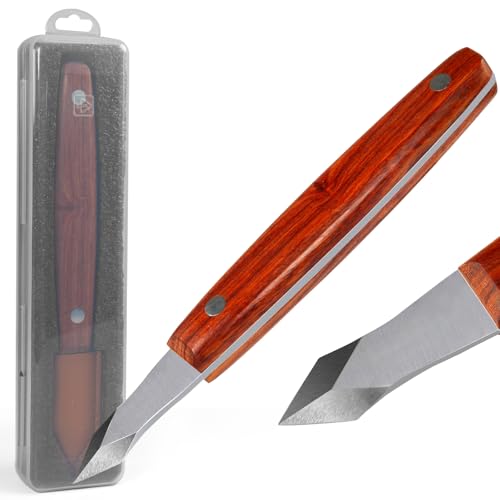
The Aeglemana marking knife takes the double-beveled scribing format and packages it for woodworkers who want one tool that lives on the bench and travels to the site. Its high-carbon steel blade uses a double-bevel geometry, so it cuts a balanced V-groove in either direction and works for left- or right-handed marking without changing grip. The published description emphasizes edge retention and resistance to chipping, which is what you want from a blade that will be run along metal rules all day.
At 8.7 inches long, this is the largest knife in the roundup. The extra length comes from a full solid-wood handle shaped to fill the palm, which gives you leverage for deeper layout cuts in dense stock and a secure hold when you are marking across end grain. The handle is described as sustainably sourced hardwood with a warm grain that stays grippy in humid conditions.
The included leather sheath is a practical differentiator. It has reinforced seams, a deep pouch that covers the edge completely, and a belt loop, so the knife can hang at your side during installation or fitting work instead of rattling around in a tool bag where the tip would suffer. If your marking alternates between the bench and the jobsite, this is the most carry-friendly option here.
Specs
- Blade material: high-carbon steel
- Bevel: double-beveled scribing blade
- Handle material: solid wood, ergonomic profile
- Overall length: 8.7 in
- Weight: 5.6 oz
- Included: leather sheath with belt loop, storage box
- Part number: RDA-008
- Tier: mid-range
3. Clarke Brothers Marking Knife with Leather Sheath
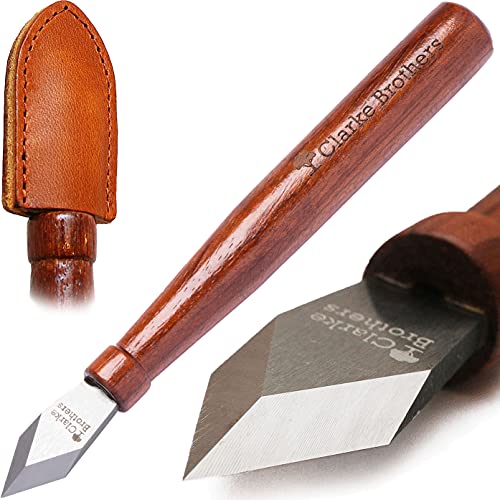
Clarke Brothers builds its marking knife around a high-carbon steel blade with a compound bevel edge, paired with a cherry-finished wooden handle. The blade is 5.5 centimeters long, and the whole tool measures 160 millimeters — a compact format that favors control over leverage. For marking dovetails, small box joints, and inlay work, that shorter blade keeps your fingers close to the point and makes the line easier to steer around a template or the end of a mating board.
At 1.76 ounces, it is also the lightest knife in this group by a wide margin. A light knife is easier to draw along a rule with fingertip pressure, which is exactly the touch you want when the first pass should barely score the surface before you deepen it. The compound bevel gives the edge a defined cutting geometry while keeping a flat reference face for registering against squares and straightedges.
The knife ships with a real leather sheath, which protects the edge in a drawer or apron pocket and protects everything else from the edge. Choose this one if your layout work is fine and frequent — small joinery, model-scale parts, and detail scribing — and you value a light, nimble tool over a heavy striking knife.
Specs
- Blade material: high-carbon steel
- Blade length: 5.5 cm
- Blade edge: chisel, compound bevel
- Handle material: wood, cherry finish
- Overall length: 160 mm
- Weight: 1.76 oz
- Included: real leather sheath
- Part number: WMK by CB
- Tier: mid-range
4. Malomke Double Bevel Marking Knife

The Malomke marking knife is the straightforward budget-tier entry: a double bevel blade in chromium-vanadium steel with a beech wood handle. Chromium-vanadium is a sensible steel for a layout tool because it takes a keen edge, resists corrosion better than plain carbon steel, and hones quickly on common stones — useful if this is a first marking knife and your sharpening setup is basic.
The double bevel format means there is no wrong way to pick it up. Mark toward you or away, from the left side of the square or the right, and the geometry behaves the same. For general layout — crosscut lines, rip marks transferred from a story stick, hinge positions, and shelf-pin references — that ambidextrous behavior removes a small but real friction from the work.
The beech handle keeps the tool light at 2.08 ounces, and the 6.06-inch overall length sits comfortably between the compact Clarke Brothers knife and the full-size Aeglemana. If you are moving from pencil layout to knife layout and want to learn the technique on a proper double-bevel tool without stepping into the premium tier, this is the sensible place to start.
Specs
- Blade material: chromium-vanadium steel
- Bevel: double bevel
- Handle material: beech wood
- Overall length: 6.06 in
- Weight: 2.08 oz
- Style: classic
- Tier: budget
5. Qianying 5CR15 Marking Knife with Leather Sheath
The Qianying marking knife uses a Japanese-style profile with a double-beveled blade in 5CR15 high-carbon steel. 5CR15 is a stainless-leaning steel, so this is a good match for shops where tools sit in damp conditions or where you simply do not want to oil a blade after every session. The double bevel keeps the marking behavior symmetrical, and the listing positions the knife for carving-adjacent layout as well as standard joinery marking.
The handle is composite wood, shaped for a secure grip, and the knife comes with a leather blade-protective sheath. That combination — corrosion-resistant blade, protective sheath, general-purpose geometry — makes it a practical second knife: the one that lives in the site kit, the apron, or the drawer by the assembly bench while your primary striking knife stays at the main bench.
Pick the Qianying if you want a low-maintenance marker for everyday layout, light carving layout, and gift-worthy presentation, since the sheath and Japanese styling make it the most presentable package in the budget-to-mid-range part of this list.
Specs
- Blade material: 5CR15 high-carbon steel
- Bevel: double-beveled blade
- Handle material: composite wood
- Style: Japanese
- Included: leather blade-protective sheath
- Tier: budget
How to Choose the Best Marking Knife
Start with bevel geometry. A dual-bevel or double-bevel knife, like every model in this roundup, cuts a centered V-groove and works from either side of a guide. That versatility suits general layout and dovetail transfer work. The trade-off is that neither face is a dead-flat reference, so press the bevel itself against your square and let the edge ride in the bevel’s register. Spear-point tips add the ability to start a line in a corner and to mark around curves and into tight joinery where a straight edge cannot reach.
Match blade thickness to the work. Thin blades around 0.055 inches, like the Narex, slide along rules with little friction and excel at striking deep, precise lines for joinery. Thicker, longer blades, like the Aeglemana, give you leverage and durability for site work and repeated scoring in dense material. For fine, small-scale layout, a short blade like the Clarke Brothers’ 5.5-centimeter edge keeps your hand close to the point.
Consider the steel and your sharpening habits. Hard Mn-V steel at HRc 61 holds an edge longest but rewards a light touch on fine stones. Chromium-vanadium and high-carbon steels hone fast and forgive beginner technique. A stainless-leaning steel such as 5CR15 asks the least maintenance in a damp shop. Whichever you choose, a marking knife only works when it is sharp: a dull edge crushes fibers instead of severing them and wanders with the grain.
Think about carry and storage. An exposed marking knife edge is fragile and unforgiving. Sheaths — included with the Aeglemana, Clarke Brothers, and Qianying knives — protect both the edge and your other tools. If your pick has no sheath, store it in a tool roll or a dedicated slot, never loose in a drawer.
Buy for the layout you actually do. One good dual-bevel knife covers most bench work. Add a compact knife for detail work or a sheathed knife for site work only when your projects call for them.
Frequently Asked Questions
What is the difference between a spear-point and a dual-bevel marking knife?
The terms describe different things. Spear point describes the tip shape: the blade narrows to a centered point, which lets you start lines in corners and mark in either direction. Dual bevel describes the edge grind: bevels on both faces that meet at the edge, producing a centered groove. Many knives, including the Narex in this roundup, combine both — a spear-style tip with dual-bevel faces.
Can a marking knife replace a pencil for all layout?
For joinery layout, yes — knife lines are more accurate and double as chisel and saw guides. Pencils still earn their place for rough dimensioning, labeling parts, and marking surfaces you plan to plane away, where a cut line would be wasteful or confusing. Most woodworkers keep both and reach for the knife whenever the line defines a finished surface.
How do I keep a marking knife sharp?
Hone little and often on a fine waterstone, diamond plate, or strop, working both bevels evenly to keep the edge centered. Avoid grinding unless the edge is damaged, and use light pressure on very hard steels to protect the thin edge. Store the knife sheathed or in a tool roll so the edge never contacts other tools.
Which marking knife is best for dovetails?
A thin dual-bevel striking knife is the usual choice, because you must mark both faces of a joint and transfer tails to pins from both directions. The Narex 822302 fits that role with its 0.055-inch blade and symmetrical grind. For very small dovetails in thin stock, a compact knife like the Clarke Brothers gives finer fingertip control.
Conclusion
The best marking knife is the one whose geometry matches your layout work. Choose the Narex 822302 for serious joinery: hardened Mn-V steel, a thin dual-bevel blade, and striking-knife manners. Choose the Aeglemana for a full-size, sheathed marker that moves between bench and site. The Clarke Brothers is the fine-work specialist, the Malomke is the honest budget starting point, and the Qianying adds low-maintenance stainless-leaning steel with a sheath. Any of them will leave a line your saw and chisel can trust — which is the entire point of the tool.
Related guides
More from Amazon
Programs that pair well with the guide above. Offers and eligibility are set by Amazon and may change.
A free business account with business pricing and bulk-buying tools for work, shop or home office.
Create a business accountFree shipping on eligible items, Prime Video and more. Eligible new members can start with a free trial.
Start a Prime free trialAudiobooks and podcasts to listen to on the go. Eligible new members can start with a free trial.
Try Audible freeAd-free music streaming. Eligible new subscribers can start with a free trial.
Try Music Unlimited freeAs an Amazon Associate we earn from qualifying purchases.