Our Top Picks
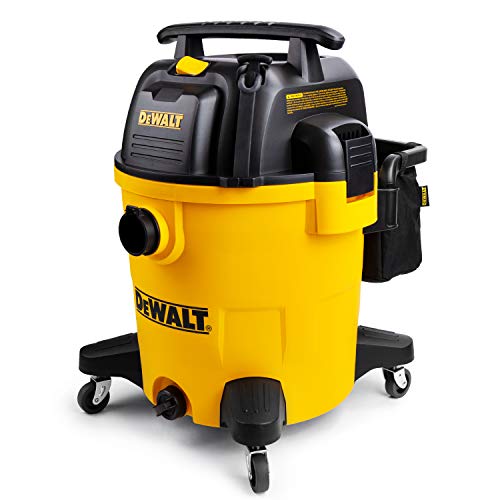 DEWALT 12 Gal. 5.5 HP Poly Wet/Dry Vacuum12 gallon18 x 25.4 x 17.5 inches23.15 poundsCheck on Amazon
 Vacmaster Professional Beast Series VFB511H 0201 5-Gal 5.55 Gallons18.6 x 13.4 x 16.5 inches15.4 poundsCheck on Amazon
What's inside
- Table of Contents
- How the Two Machines Differ
- Airflow vs Suction: The Number That Matters
- Filtration and Hose Size
- Shop Fox W1685 1.5 HP Dust Collector
- Grizzly G1028Z2 1.5 HP Portable Dust Collector
- CRAFTSMAN CMXEVBE17595 16 Gallon Wet/Dry Vac
- DEWALT DXV12P 12 Gallon Wet/Dry Vac
- Vacmaster Professional Beast VFB511H 0201 Wet/Dry Vac
- How to Choose Between a Dust Collector and a Shop Vacuum
- Who Should Skip Each Type
- FAQ
- Conclusion
As an Amazon Associate I earn from qualifying purchases. This post may contain affiliate links at no extra cost to you.
- Top Pick: Shop Fox W1685 1.5 HP Dust Collector
- Runner-up: Grizzly G1028Z2 1.5 HP Portable Dust Collector
- Also consider: CRAFTSMAN CMXEVBE17595 16 Gallon Wet/Dry Vac
A dust collector and a shop vacuum both move air through a hose, and both end up connected to woodworking machines, which is why so many home shops try to make one machine do both jobs. They are built on opposite priorities, though. A dust collector moves a very large volume of air at low pressure through wide hose, which is what stationary machines with 4-inch ports need to clear chips at the source. A shop vacuum moves far less air but pulls with much higher suction through a narrow hose, which is what makes it good at lifting settled debris, powering small-tool dust ports, and handling wet messes.
Choosing between them comes down to the work you actually do. If your shop centers on a table saw, planer, and jointer, the dust collector is the machine that keeps up with the chip load those tools produce. If your cleanup is mostly floors, benches, car interiors, and a random orbit sander, the shop vacuum is the more versatile tool. Many woodworkers eventually run both, but the five picks below cover the strongest starting point on each side, from full-size single-stage collectors to a compact wet/dry vac that doubles as a fine-dust extractor for small tools.
As an Amazon Associate, we earn from qualifying purchases.
Contents
- Table of Contents
- How the Two Machines Differ
- Airflow vs Suction: The Number That Matters
- Filtration and Hose Size
- Shop Fox W1685 1.5 HP Dust Collector
- Grizzly G1028Z2 1.5 HP Portable Dust Collector
- CRAFTSMAN CMXEVBE17595 16 Gallon Wet/Dry Vac
- DEWALT DXV12P 12 Gallon Wet/Dry Vac
- Vacmaster Professional Beast VFB511H 0201 Wet/Dry Vac
- How to Choose Between a Dust Collector and a Shop Vacuum
- Who Should Skip Each Type
- FAQ
- Conclusion
Table of Contents
- How the Two Machines Differ
- Airflow vs Suction: The Number That Matters
- Filtration and Hose Size
- Shop Fox W1685 1.5 HP Dust Collector
- Grizzly G1028Z2 1.5 HP Portable Dust Collector
- CRAFTSMAN CMXEVBE17595 16 Gallon Wet/Dry Vac
- DEWALT DXV12P 12 Gallon Wet/Dry Vac
- Vacmaster Professional Beast VFB511H 0201 Wet/Dry Vac
- How to Choose Between a Dust Collector and a Shop Vacuum
- Who Should Skip Each Type
- FAQ
- Conclusion
- Product and ASIN Reference
How the Two Machines Differ
A single-stage dust collector uses a large impeller driven by an induction motor to pull air through 4-inch or larger hose. Chips and dust travel into a lower collection bag while the air passes out through an upper filter bag. The design goal is volume: a typical 1.5 HP collector is rated around 1,200 to 1,300 CFM, enough to keep a planer chute clear and capture the stream of chips a table saw throws off its blade. Because the pressure behind that airflow is modest, a dust collector is poor at picking up a pile of screws from the floor or pulling debris through a long run of narrow hose.
A shop vacuum is a sealed canister with a universal motor that generates high static suction, often rated in inches of water lift. That suction is delivered through a hose around 2.5 inches or smaller, so total airflow is a fraction of a dust collector’s, commonly in the 150 to 200 CFM range for large models. In exchange, the vacuum lifts heavy debris, pulls dust out of the small ports on sanders and routers, handles liquid spills, and works as a general cleanup tool anywhere in the house or garage. Neither machine is a failed version of the other; they solve different halves of the same mess.
Airflow vs Suction: The Number That Matters
Spec sheets make the two machines look confusingly similar because both advertise horsepower. Peak horsepower on a shop vacuum is a laboratory figure for the motor alone, while a dust collector’s horsepower rating describes a continuous-duty induction motor, so the numbers are not directly comparable. The figures that predict real performance are CFM for a dust collector and water lift plus CFM for a vacuum. A planer can overwhelm a shop vacuum in seconds because the vacuum simply cannot move enough air to carry the chip volume, no matter how strong its suction feels at the hose end. Conversely, a dust collector connected to a sander’s 1.25-inch port chokes down to a trickle, because its low-pressure airflow collapses when the opening shrinks.
Filtration separates the two further. Dust collectors ship with filter bags commonly rated at 2.5 microns on current models, and canister upgrades filter finer still. Shop vacuums rely on a cartridge filter, and the better ones add a fine-dust bag that captures particles down to around 1 micron and keeps the cartridge from clogging. For the finest airborne dust, neither machine replaces good respiratory protection, but a collector capturing chips at the machine plus a vacuum with a fine-dust bag on the sander covers most of what a home shop produces.
Filtration and Hose Size
Hose diameter is the quickest way to see which machine a tool was designed for. Table saws, planers, jointers, and band saws ship with 4-inch ports because their chip volume demands it, and that is dust collector territory. Sanders, routers, biscuit joiners, and track saws use ports between 1 and 2.5 inches, which need vacuum suction to work at all. Adapters can physically connect either machine to either port, but the performance mismatch remains: the tool performs as though it has the wrong machine attached, because it does.
Capacity works differently too. A dust collector’s bag volume is measured in cubic feet and fills with fluffy chips, while a shop vacuum’s tank is measured in gallons and fills with everything from sawdust to flood water. Shops that plane a lot of lumber can fill a collector bag in an afternoon, which is why many owners add a separator lid or cyclone stage later. Vacuum owners empty far less often but deal with filters loading up with fine dust, which the disposable bag largely prevents.
Shop Fox W1685 1.5 HP Dust Collector

The Shop Fox W1685 is the classic small-shop collector format: a 1.5 HP motor spinning a 12-inch steel impeller, rated at 1,280 CFM with enough static pressure to serve a short duct run or a hose moved between machines. Its main inlet splits through a wye into two 4-inch ports, so it can sit between two machines with blast gates or simply roll to whichever tool is running. Current production ships with a 2.5-micron felt upper bag and a clear plastic lower bag, so you can see the fill level at a glance. This is the premium pick on the collector side for a one- or two-machine home shop that wants real chip capacity without stepping up to a 220V unit.
Specs
- Motor: 1.5 HP, 110V single-phase, 3,450 RPM
- Airflow: 1,280 CFM
- Impeller: 12-inch balanced steel
- Maximum static pressure: 10.1 inches
- Filtration: 2.5-micron felt upper bag, plastic lower collection bag
- Inlets: 6-inch main inlet with wye to two 4-inch ports
- Bag volume: 5.4 cubic feet
- Tier: Premium
Grizzly G1028Z2 1.5 HP Portable Dust Collector
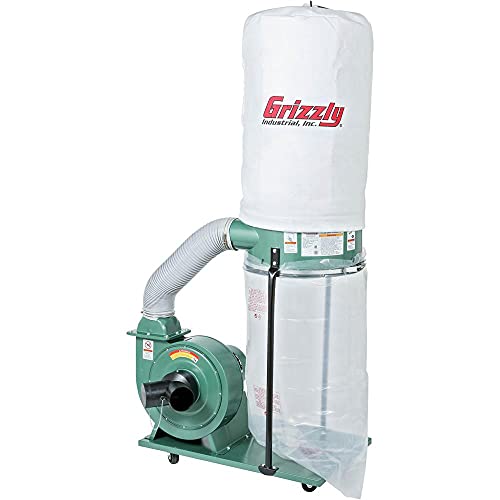
Grizzly’s G1028Z2 matches the Shop Fox on motor size and slightly edges it on paper with a 1,300 CFM maximum airflow rating, in a portable single-stage frame that weighs 95 pounds and rolls to the machine in use. Filtration is a 2.5-micron bag setup, the long-standing standard for this class. It is a mid-range route into genuine dust collection for shops that run one stationary machine at a time, and Grizzly’s deep catalog of hose, fittings, and replacement bags makes it easy to build out a simple one-hose system around it. Like every single-stage collector, it is a wood-dust machine only; nails, screws, and floor sweepings belong in the vacuum instead.
Specs
- Motor: 1.5 HP
- Airflow: 1,300 CFM maximum
- Static pressure: 9 inches
- Filtration: 2.5-micron bag
- Design: Single-stage, portable
- Weight: 95 lb
- Tier: Mid-range
CRAFTSMAN CMXEVBE17595 16 Gallon Wet/Dry Vac

On the vacuum side, capacity is the headline here. The CMXEVBE17595 pairs a 16-gallon tank with a 6.5 peak HP motor and a full-size 2.5-inch hose, which makes it the cleanup anchor for a shop that also handles garage and renovation messes. It ships with a fine-dust cartridge filter and a dust bag, the combination you want if the vac will spend time connected to a sander or miter saw, and a rear blowing port plus a large drain round out the wet/dry utility. A 20-foot cord reduces outlet hunting in a larger space. This is the premium vacuum pick for buyers who want one big canister that rarely needs emptying.
Specs
- Tank capacity: 16 gallons
- Motor: 6.5 peak HP
- Hose: 2.5-inch diameter
- Filtration: Qwik Lock fine-dust cartridge filter, dust bag included
- Extras: Rear blowing port, large drain, onboard accessory storage
- Power cord: 20 feet
- Tier: Premium
DEWALT DXV12P 12 Gallon Wet/Dry Vac

The DXV12P is the balanced mid-range option: a 12-gallon poly tank, a 5.5 peak HP motor, and the cartridge filtration and blower function that define this class. The tank’s large drain port makes wet pickup practical rather than theoretical, and four swivel casters keep it tracking straight when you drag it around the shop by the hose. Twelve gallons is the size most home shops find easiest to live with: big enough for a full cleanup session, light enough to carry up a step when it is full of water. For dust extraction duty, adding fine-dust bags keeps the cartridge cleaner and suction consistent between filter changes.
Specs
- Tank capacity: 12 gallons, poly tank
- Motor: 5.5 peak HP
- Hose: 7-foot, crush resistant
- Filtration: Cartridge filter, fine-dust bags available
- Extras: Blower function, large drain port, four swivel casters
- Tier: Mid-range
Vacmaster Professional Beast VFB511H 0201 Wet/Dry Vac
The Beast VFB511H is the budget pick and the most interesting vacuum here for woodworkers specifically, because its high-efficiency cartridge filter and dust bag combination is rated to capture fine dust particles down to 1 micron. The 5-gallon tank and 5.5 peak HP motor with 320 air watts of suction suit it to dedicated small-tool duty: park it under the bench connected to a sander or router table, where its compact footprint beats a full-size canister. It still handles wet pickup and general cleanup, but its natural role is as the second vacuum in a shop whose big collector cannot serve small ports well.
Specs
- Tank capacity: 5 gallons
- Motor: 5.5 peak HP
- Suction: 320 air watts
- Filtration: High-efficiency cartridge filter and dust bag, rated to 1 micron
- Design: Compact Beast Series canister with top handle
- Tier: Budget
How to Choose Between a Dust Collector and a Shop Vacuum
Start with your biggest chip producer. If you own or plan to buy a thickness planer, jointer, or a table saw with a 4-inch port, a dust collector is not optional equipment; it is the only one of the two that can move the required air volume. Check the collector’s CFM rating against the machine’s requirement, keep hose runs short, and confirm your circuit can handle a 1.5 HP motor’s draw alongside the tool itself.
If your tools are mostly handheld, the vacuum is the right first purchase. Look at filtration before horsepower: a cartridge filter paired with fine-dust bags protects both your lungs and the motor, and it keeps suction from fading as the tank fills. Tank size is a convenience decision, not a performance one; 12 gallons suits most shops, 16 gallons suits cleanup-heavy work, and a compact 5-gallon model makes the best dedicated sander extractor.
Finally, consider noise and space. Dust collectors run at a lower, steadier pitch and live in a corner or roll between two machines. Shop vacuums are louder per minute of use but run in short bursts. A growing shop usually ends with the collector on the stationary machines and a vacuum reserved for small tools and cleanup, which is exactly the division of labor each design was built for.
Who Should Skip Each Type
Skip the dust collector if your shop is entirely handheld tools and a jobsite saw with a small port; you would pay for airflow you cannot use, and a vacuum with fine-dust bags will serve you better. Skip the shop vacuum as your only machine if you run a planer or jointer regularly, because no canister vac moves enough air to keep those machines clear, and the overload shows up as clogged ports and dust thrown back into the room. Skip both upgrades if your current setup already captures chips at the source and your cleanup takes minutes; spend on ducting, gates, and better filtration for the machine you own instead.
FAQ
Can a shop vacuum replace a dust collector for a table saw or planer?
Not effectively. Those machines produce chip volumes that require several hundred CFM of airflow to clear, and a shop vacuum’s narrow hose and low total airflow let chips pack into the port and cabinet. A vacuum works fine on a small benchtop saw used occasionally, but a planer will overwhelm it almost immediately.
Why does CFM matter more than suction for dust collection?
Chips need moving air to carry them; a large volume of air flowing through a 4-inch hose transports material that strong suction through a small hose cannot. Suction, measured as water lift, matters when the opening is small or the debris is heavy, which is why vacuums excel at floor cleanup and small-tool ports instead.
Can a dust collector pick up floor debris or liquids?
No. A dust collector is a wood-dust machine: metal hardware can damage the impeller, dense debris settles out in the hose because the air pressure is low, and the bag system has no provision for liquid. Floor sweepings, spills, and wet cleanup are exactly what the shop vacuum exists for.
Do I need both machines in a small shop?
Many small shops do end up with both, because the two cover non-overlapping jobs: the collector serves stationary machines, and the vacuum serves sanders, routers, and cleanup. If the budget forces one purchase, buy for the tools you use most, and add the second machine when a specific job starts defeating the first.
Conclusion
The dust collector versus shop vacuum question resolves once you look at hose sizes and chip volume instead of horsepower badges. Stationary machines with 4-inch ports need the airflow of a collector like the Shop Fox W1685 or Grizzly G1028Z2. Handheld tools, floor cleanup, and wet messes need the suction and versatility of a wet/dry vac, whether that is the high-capacity CRAFTSMAN, the balanced DEWALT, or the compact fine-dust Vacmaster Beast. Match the machine to the mess, and either purchase will feel right.
Related guides
More from Amazon
Programs that pair well with the guide above. Offers and eligibility are set by Amazon and may change.
A free business account with business pricing and bulk-buying tools for work, shop or home office.
Create a business accountFree shipping on eligible items, Prime Video and more. Eligible new members can start with a free trial.
Start a Prime free trialAudiobooks and podcasts to listen to on the go. Eligible new members can start with a free trial.
Try Audible freeAd-free music streaming. Eligible new subscribers can start with a free trial.
Try Music Unlimited freeAs an Amazon Associate we earn from qualifying purchases.