Our Top Picks
 Howard Products Butcher Block Conditioner and Food Grade7.9"L x 1.8"W1.85 x 3 x 7.9 inches0.6 poundsCheck on Amazon
What's inside
As an Amazon Associate I earn from qualifying purchases. This post may contain affiliate links at no extra cost to you.
- Top Pick: Minwax Paste Finishing Wax, Natural
- Runner-up: Howard Butcher Block Conditioner
- Also consider: John Boos Board Cream
Wood wax is a maintenance product, not a full finishing system. On furniture it refreshes a surface that already carries a finish. On cutting boards and butcher blocks it is one step in a regular care routine. The right pick depends on where the product will live, because a dining table wax does not belong on a food board.
This guide walks through the main formats — paste wax, liquid conditioners, board creams, and paired oil and wax sets — then covers five products sold on Amazon. Two are furniture products with no food-contact claim in their listings; three are kitchen products whose makers state food-contact use in their own wording.
As an Amazon Associate, we earn from qualifying purchases.
Contents
Quick answer
Match the wax to the surface first. Finished furniture suits a paste wax or a beeswax and carnauba conditioner. A board that touches food needs a product whose maker states food-contact use, such as a mineral oil and beeswax cream. Apply a thin coat, let it sit as the label directs, then buff away the excess.
How to choose
Begin with the surface, not the brand. A wax that suits a varnished sideboard may be wrong for a board that holds dinner. The listings here split into two camps: furniture products whose makers name tables, cabinets, and antiques, and kitchen products whose makers print a food-contact statement. Only credit food-contact use when the maker claims it in the listing.
Next, pick a format that matches your routine. Paste wax is firm in the can, goes on thin with a cloth, and buffs to a soft sheen once it hazes. A board cream is thicker and sits on the wood longer — Boos directs an overnight rest — so it suits a monthly rhythm. An oil and wax set splits the job in two: oil to soak in, wax to sit on top.
Then check the surface you already have: paste finishing wax is a layer over an existing finish, and Minwax frames its wax for projects that do not need a hard protective coat of polyurethane. Board products suit oil-finished or unfinished kitchen wood that gets washed often.
Finally, read the label directions before buying: coat thickness, waiting time, and reapplication rhythm all come from the maker. In general terms — thin coats, time to sit, a clean buff, and a fresh coat when the surface looks dry.
Minwax Paste Finishing Wax, Natural

Minwax sells this paste finishing wax in a one-pound can in a Natural color, and the listing recommends it for furniture, antiques, woodwork, cabinets, doors, paneling, and accessories. The maker describes the job plainly: the wax protects and adds a hand-rubbed luster to any wood surface, and it suits projects that do not need a hard protective coat of polyurethane. It is a top-up layer for already-finished wood, applied thin and buffed once it hazes, per the directions on the can. Nothing in the listing presents it as a food-contact product, so keep it on furniture and choose a board-specific product for food surfaces.
Specs:
– Type: Paste finishing wax
– Size: 1 lb can (16 oz)
– Color: Natural
– Model number: 785004444
– Maker-recommended uses: Furniture, antiques, woodwork, cabinets, doors, paneling, and accessories
– Maker description: Protects and adds hand-rubbed luster; for projects that do not need a hard protective coat of polyurethane
– Food-contact wording: None in the listing
Howard Feed-N-Wax Wood Polish & Conditioner
Feed-N-Wax is a liquid polish and conditioner rather than a firm paste. Howard says the formula introduces natural oils into the wood and leaves a protective coating of beeswax and Brazilian carnauba wax, enhancing the natural depth of grain while providing added protection and luster to wood furniture. The maker names furniture, antiques, and cabinets as the intended surfaces. As a liquid, it follows the bottle directions as a wipe-on routine, quicker than buffing a hard paste. The listing makes no food-contact statement, so it belongs on dining tables, dressers, and cabinets rather than on cutting boards. Choose it when a finished piece looks dry and dull and you want richer-looking grain after one session.
Specs:
– Type: Liquid wood polish and conditioner
– Size: 16 fl oz
– Model number: FW0016
– Ingredients as the maker states: Natural oils with beeswax and Brazilian carnauba wax; orange oil
– Maker-recommended uses: Furniture, antiques, and cabinets
– Maker description: Enhances the natural depth of grain while providing added protection and luster
– Food-contact wording: None in the listing
Howard Butcher Block Conditioner
This conditioner blends pure USP food grade mineral oil with genuine beeswax and Brazilian carnauba wax in a single bottle. Howard describes the blend as tasteless and odorless and says it will never go rancid. The maker states that the conditioner exceeds US FDA regulations for food contact, and names butcher blocks, cutting boards, wooden bowls, and utensils as the intended surfaces, with salad bowls, spoons, and toys also mentioned by the maker. The routine follows the label: wipe it on, give the oil time to soak in, and wipe away what the wood does not take. Reapply when the surface looks or feels dry.
Specs:
– Type: Oil and wax conditioner
– Size: 12 fl oz
– Model number: BBC012
– Ingredients as the maker states: Pure USP food grade mineral oil, genuine beeswax, Brazilian carnauba wax
– Food-contact wording: Maker states the conditioner exceeds US FDA regulations for food contact
– Maker-recommended uses: Butcher blocks, cutting boards, wooden bowls, and utensils
– Maker description: Tasteless, odorless, and will never go rancid
John Boos Board Cream
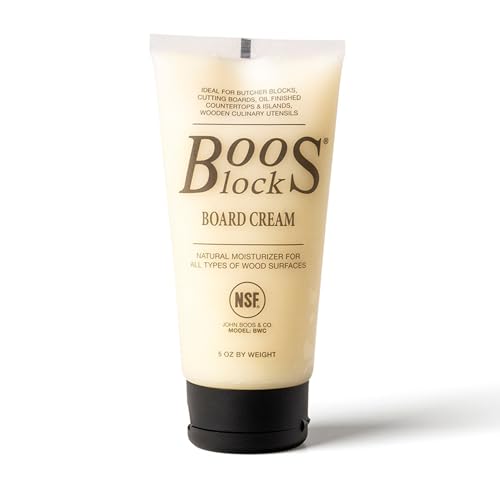
Boos Block Board Cream is a thick cream in a five-ounce tube, built around food-grade mineral oil and natural unbleached beeswax. John Boos describes the formula as safe for food-preparation surfaces and says the cream penetrates into the grain to protect and revitalize the wood fibers, guarding against drying and cracking from repeated washing. The maker’s directions are specific: apply an even coat to all surfaces, let it penetrate overnight, and repeat at least once per month, or more often in dry or arid climates. The tube suits a household with one or two good boards in steady use. Boos suggests pairing it with its Mystery Oil, sold separately, used first as the oil step.
Specs:
– Type: Board cream (mineral oil and beeswax)
– Size: 5 oz tube
– Model number: BWCB
– Ingredients as the maker states: Food-grade mineral oil and natural unbleached beeswax
– Food-contact wording: Maker describes the formula as safe for food-preparation surfaces
– Directions as the maker states: Apply an even coat, let it penetrate overnight; at least once per month, more often in dry or arid climates
– Maker-recommended uses: Butcher blocks, cutting boards, bowls, and kitchen utensils
Walrus Oil Cutting Board Oil and Wood Wax Set

Walrus Oil packages the two-step routine in one box: a bottle of cutting board oil paired with a three-ounce can of wood wax. The listing title calls the set 100 percent Food-Safe, and the maker describes the oil as a 100 percent food-contact safe conditioner for cutting boards, butcher blocks, wooden spoons, and bowls. Per the maker’s listing copy, the oil blends coconut oil, mineral oil, beeswax, and vitamin E, while the wax is built on coconut oil, beeswax, and vitamin E without mineral oil. The routine: oil first so the wood takes in moisture, then a thin layer of wax, buffed after it sets, per the directions on each container. One note from the maker’s materials: use the oil within one year after opening.
Specs:
– Type: Cutting board oil and wood wax set
– Contents as listed: 8 oz cutting board oil and 3 oz wood wax
– Model number: WO-B1
– Ingredients as the maker states: Oil — coconut oil, mineral oil, beeswax, vitamin E; Wax — coconut oil, beeswax, vitamin E
– Food-contact wording: Maker labels the set “100 percent Food-Safe” and the oil “100 percent food-contact safe”
– Maker-recommended uses: Cutting boards, butcher blocks, wooden spoons, and bowls
Who should skip
Skip wood wax if you want a hard, film-forming finish. Wax is a maintenance layer that wears and renews, not the sealed shell that a polyurethane or lacquer provides.
Skip it if you are finishing bare wood from scratch and expect one product to do the whole job. These waxes sit at the end of a finishing schedule or inside a care routine, not as a complete finish on their own.
Skip board blends if the maker of your cutting board directs plain mineral oil only; a blend with coconut oil or other additions can fall outside that maker’s narrow care rule.
And skip the category if you know you will not reapply. A wax routine only works as a routine; a board that never gets a second coat ends up back where it began.
FAQ
Can I use furniture paste wax on a cutting board?
Only when its maker states food-contact use in the listing. The Minwax paste wax and Howard Feed-N-Wax listings name furniture, antiques, and cabinets and make no food-contact claim, so keep them on furniture. For boards, pick the Howard Butcher Block Conditioner, John Boos Board Cream, or the Walrus Oil set, where the maker prints that wording itself.
How often should I reapply board cream or wax?
Follow the label on the product you own. John Boos directs at least one coat per month for its board cream, and more often in dry or arid climates. In general terms, a board that looks pale and dry and feels rough under your palm is ready for another coat, and daily-use boards need coats more often than weekend ones.
Does wax make wood waterproof?
No. Makers describe wax as adding water-resistant traits and a protective layer, and Howard calls carnauba the hardest natural wax, but a wax coat is thin and wears with use. It slows moisture down rather than sealing wood like a film finish. Expect to renew it.
What is the difference between board oil and board wax?
Oil is the soak-in step: it enters the wood fibers and replaces moisture that washing removes. Wax and cream sit closer to the surface and add a thin protective layer on top. John Boos and Walrus Oil sell the two as a sequence — oil first, cream or wax after — and each listing states which step it covers.
Final verdict
For finished furniture, the Minwax paste wax is the traditional pick, and Howard Feed-N-Wax suits anyone who prefers a wipe-on liquid. For kitchen wood, choose by the maker’s own food-contact wording: Howard Butcher Block Conditioner for a one-bottle routine, John Boos Board Cream for a monthly cream coat, and the Walrus Oil set for oil and wax in one box. Whichever you pick, thin coats and regular reapplication matter more than the name on the can.

Related guides
More from Amazon
Programs that pair well with the guide above. Offers and eligibility are set by Amazon and may change.
A free business account with business pricing and bulk-buying tools for work, shop or home office.
Create a business accountFree shipping on eligible items, Prime Video and more. Eligible new members can start with a free trial.
Start a Prime free trialAudiobooks and podcasts to listen to on the go. Eligible new members can start with a free trial.
Try Audible freeAd-free music streaming. Eligible new subscribers can start with a free trial.
Try Music Unlimited freeAs an Amazon Associate we earn from qualifying purchases.