Our Top Picks
What's inside
As an Amazon Associate I earn from qualifying purchases. This post may contain affiliate links at no extra cost to you.
- Top Pick: eQualle 60 Grit Sandpaper Sheets, 25-Pack
- Runner-up: eQualle 120 Grit Sandpaper Sheets, 100-Pack
- Also consider: 3M Sandpaper, 220 Grit, 5 Sheets (9000NA)
Sandpaper looks simple until a project stalls halfway through. A board leveled with a coarse sheet can still show deep scratches under a finish, while a fine sheet used too early polishes the high spots and leaves the surface uneven. The gap between a smooth result and a disappointing one usually comes down to picking the right grit for each stage and moving through them in a sensible order.
This guide explains how grit numbers work, how far apart the steps in a sequence can be, and how to match a grit to the job: shaping, smoothing, or preparing for finish. Five real packs anchor the ladder, from a coarse 60 grit sheet pack to an extra-fine wet and dry assortment that runs to 3000 grit.
As an Amazon Associate, we earn from qualifying purchases.
Contents
Quick answer
Grit numbers describe abrasive size: low numbers cut fast and leave deeper marks, high numbers cut slowly and leave finer marks. Work through a sequence such as 80, 120, 180, and 220, moving up in small steps so each grit reduces the marks from the one before it. Match grit to the stage: coarse for shaping, medium for smoothing, fine for finish prep, and extra-fine wet sheets between coats.
How to choose
How grit numbers work
The grit number on the back of a sheet or disc describes the size of its abrasive particles. A low number, such as 60 or 80, means large, widely spaced particles that bite deeply, remove material quickly, and leave a scratch pattern easy to see and feel. A high number, such as 220 or 400, means smaller particles packed closely together; those cut slowly and leave a finer, shallower pattern. Aluminum oxide is the common general-purpose grain on sheet and disc packs and suits bare wood well, while silicon carbide is a sharper grain often used on wet and dry sheets, whose waterproof backing lets them work with water as well as dry.
Moving through a sequence
Sanding works because each grit reduces the marks left by the grit before it. The coarse sheet shapes quickly but leaves deep scratches, and the next grit up cannot erase them unless the step is small enough for its finer particles to reach the bottom of the grooves. A common rule of thumb is to move up by roughly half again the current number: 80 to 120, 120 to 180, then 180 to 220 or 240. Jumping from 80 straight to 220 asks the fine sheet to do heavy work it is not built for, and the deep marks often survive, hidden until a finish makes them obvious.
A stage is done when the surface shows an even pattern from that grit, with no leftover lines. Low, angled light reveals stray marks before moving on, and sanding with the grain keeps the pattern aligned with the wood figure.
Matching grit to the stage
Coarse grits in the 60 to 100 range do the shaping and leveling: flattening a glued-up panel, easing a rough edge, or removing an old surface layer. The medium band from 120 to 180 is the workhorse range for general smoothing, refining the surface after shaping and handling most bare-wood preparation on furniture and cabinet parts. Fine grits from 220 to 320 handle finish prep, leaving the surface ready for many film and oil finishes, and they also scuff between coats once a finish has cured. Extra-fine wet and dry grits, from 400 up into the thousands, belong mainly to cured finishes and resin rather than raw wood. Bare wood rarely needs more than 220 or 320 before a first coat, since sanding far finer can polish the surface and make some finishes sit unevenly.
Sheets, discs, and belts
Format follows the tool. Full sheets, commonly 9 by 11 inches, fold around a sanding block, wrap onto a quarter-sheet or half-sheet sander, or work by hand on edges and profiles. Smaller pre-cut sheets suit detail work and wet sanding. Discs in 5 inch and 6 inch sizes fit random orbital sanders, with hook and loop backing and dust holes that must match the pad. Belts fit belt sanders and cover large flat areas quickly, suiting early shaping on big panels but demanding a careful hand near edges. A dust mask and eye protection belong in the routine as one layer of care alongside dust collection and ventilation.
eQualle 60 Grit Sandpaper Sheets, 25-Pack

This pack anchors the coarse end of the ladder. Sixty grit is a shaping tool: it levels high spots on rough boards, knocks down hardened glue squeeze-out, and takes a worn surface layer back toward bare wood. The silicon carbide sheets come in a 9 by 11 inch format. Because the cut is aggressive, this grit belongs at the opening of a sequence and hands off to 100 or 120 grit once the surface is level; used late in a project, it would undo finer work.
Specs
- Brand: eQualle
- Grit: 60
- Grit type: Extra coarse
- Abrasive: Silicon carbide
- Sheet size: 9 x 11 inches
- Pack count: 25 sheets
eQualle 120 Grit Sandpaper Sheets, 100-Pack

At 120 grit, this pack sits in the middle of the ladder, where most general smoothing happens. It follows coarse shaping and prepares the surface for finer grits, and it can also open the sequence on wood that is already fairly smooth. The listing describes a C-weight kraft paper backing with silicon carbide abrasive, made for wet or dry use. The 100-sheet count makes it a bulk pack for ongoing work, such as cabinet builds, furniture parts, and repeated panel prep, rather than a single small job.
Specs
- Brand: eQualle
- Grit: 120
- Grit type: Medium
- Abrasive: Silicon carbide
- Backing: C-weight kraft paper
- Sheet size: 9 x 11 inches
- Pack count: 100 sheets
- Use: Wet or dry
3M Sandpaper, 220 Grit, 5 Sheets (9000NA)

Two hundred twenty grit is the classic finish-prep step for bare wood, and this small 3M pack covers that role. The aluminum oxide sheets, 9 by 11 inches on paper backing, can be cut to size for hand use, a sanding block, or a power tool sander, per the listing. The maker frames them for paint, bare wood, and metal. Five sheets suits one project or a top-up of a grit drawer; earlier grits must do the leveling, since this pack will not flatten a rough board alone.
Specs
- Brand: 3M
- Model: 9000NA
- Grit: 220
- Grit type: Very fine
- Abrasive: Aluminum oxide
- Backing: Paper
- Sheet size: 9 x 11 inches
- Pack count: 5 sheets
BAISDY Wet Dry Sandpaper Assortment, 45 Pieces (400 to 3000 Grit)
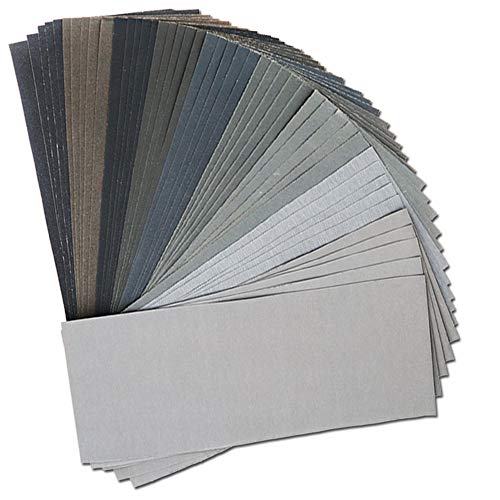
This assortment covers the extra-fine territory above the usual wood range. Nine grits run from 400 through 600, 800, 1000, 1200, 1500, 2000, and 2500 up to 3000, with five sheets of each for 45 total. The 9 by 3.6 inch sheets suit hand work and are made for wet or dry sanding. On wood projects, these grits come into play after a finish has cured: leveling a coat and refining between coats. These sheets refine surfaces; raw wood shaping does not happen up here.
Specs
- Brand: BAISDY
- Model: TL001
- Grits included: 400, 600, 800, 1000, 1200, 1500, 2000, 2500, 3000
- Pack count: 45 sheets
- Sheet size: 9 x 3.6 inches
- Use: Wet or dry
WORKPRO 150-Piece Sanding Discs Set, 5 Inch

This set spans the ladder in disc form for a 5 inch random orbital sander. Ten grits run from 60 through 80, 100, 120, 150, 180, 240, 320, and 400 up to 600, with 150 discs in the box. The 5 inch, 8-hole hook and loop pads fit random orbital sanders only, per the listing, not oscillating tools or mouse sanders, so hole pattern and pad size must match the tool. One box holds the whole sequence, from shaping at 60 to pre-finish work at 400.
Specs
- Brand: WORKPRO
- Model: W124095
- Disc size: 5 inch, 8-hole
- Backing: Hook and loop
- Grits included: 60, 80, 100, 120, 150, 180, 240, 320, 400, 600
- Pack count: 150 discs
Who should skip
Anyone whose project lives at one end of the ladder can skip the full spread. A woodworker who only flattens rough stock needs coarse and medium packs, not a 3000 grit assortment, and someone who only scuffs between finish coats needs fine and extra-fine sheets rather than a box of discs. Owners of 6 inch sanders should skip the 5 inch disc set, since pad size and hole pattern must match the tool. And no single grit carries a project from rough board to finish-ready surface; the sequence is the method, not any one sheet.
FAQ
Which grit should come first on a rough board?
Begin with a coarse grit in the 60 to 80 range when the board is rough, uneven, or carrying an old surface layer, then move to 120 once it is level. On wood already planed smooth, beginning at 120 is usually enough; dropping to 60 only adds deep marks for later grits to reduce.
Can a step be skipped in the sequence?
Small steps are the safer route. Moving from 120 to 180 or from 180 to 220 asks each grit to reduce marks only slightly deeper than its own. A long jump, such as 80 straight to 220, leaves the fine sheet struggling against deep grooves, and those marks can reappear under finish.
When does wet sanding make sense on a wood project?
Wet sanding belongs mostly to the finish stages: leveling a cured coat, easing dust nibs, and refining between coats with sheets made for wet use. On bare wood, dry sanding is the norm, since water raises the grain and can leave the surface uneven. Let a wet-sanded coat dry fully before judging it.
How can you tell when a sheet is worn out?
A worn sheet cuts slowly, feels smooth to the touch, and loads up with dust that no longer brushes off. It tends to polish rather than level, leaving shiny patches. Swapping to a fresh sheet of the same grit is the fix; pressing harder only builds heat and can leave swirl marks.
Final verdict
Choosing sandpaper grits is mostly about order: coarse grits shape, medium grits smooth, fine grits prepare for finish, and extra-fine wet sheets refine cured coats. Build a sequence in modest steps, give each grit time to reduce the marks before it, and let the stage of the project pick the number. The five packs above cover that ladder in sheet and disc form, so a sensible sequence can be assembled for hand sanding, block work, or an orbital sander.
Related guides
More from Amazon
Programs that pair well with the guide above. Offers and eligibility are set by Amazon and may change.
A free business account with business pricing and bulk-buying tools for work, shop or home office.
Create a business accountFree shipping on eligible items, Prime Video and more. Eligible new members can start with a free trial.
Start a Prime free trialAudiobooks and podcasts to listen to on the go. Eligible new members can start with a free trial.
Try Audible freeAd-free music streaming. Eligible new subscribers can start with a free trial.
Try Music Unlimited freeAs an Amazon Associate we earn from qualifying purchases.