Our Top Picks
 KAKURI Wood Marking Gauge for Woodworking 3.5"1 Count (Pack of 1)2.3 x 4.3 x 5.9 inches0.2 poundsCheck on Amazon
What's inside
As an Amazon Associate I earn from qualifying purchases. This post may contain affiliate links at no extra cost to you.
- Top Pick: Clarke Brothers Wheel Marking Gauge Kit
- Runner-up: RED OAK TOOLS Wheel Marking Gauge Set ROT-105
- Also consider: VISLONE Wood Scribe Tool Wheel Marking Gauge
A marking gauge scribes one line at a set distance from a reference edge, and that single job sits underneath a large share of bench joinery. Tenon shoulders, mortise walls, rabbet depths and rip widths all begin as gauge lines, because a scribed line is far thinner than a pencil line and gives a saw or chisel a track to follow. The tool itself is simple: a fence that rides the edge, a beam that sets the distance, a lock that holds it, and a cutter that scores the wood.
Gauges differ mainly in the cutter. A wheel rolls as it cuts and stays calm across the grain, a blade severs fibers cleanly on cross-grain shoulders, and a pin scratches a fine line that behaves best along the grain. This guide compares five real gauges sold on Amazon.com: three wheel gauges with reaches from 150 mm to 180 mm, a compact Japanese blade gauge from KAKURI, and a plain beech pin gauge from Crown. Each entry sticks to facts from its own listing.
As an Amazon Associate, we earn from qualifying purchases.
Contents
Quick answer
For most layout work, choose a wheel gauge with a solid brass fence, a dual inch and millimeter scale, and spare cutters in the box; the Clarke Brothers kit below covers all three. Pick the KAKURI kebiki if you prefer a blade for cross-grain lines, and the Crown 135 if you want a plain pin gauge for lines along the grain.
How to choose
Choose the cutter first. Wheel gauges suit most layout because the rolling disc severs fibers instead of tearing them, and it tracks a line across the grain without following it. Blade gauges, including the kebiki below, cut a crisp shoulder line across the grain and are a classic choice for tenons and dovetail baselines. Pin gauges are the oldest form: simple and light, happiest along the grain, and prone to wander across uneven grain.
Check the fence and the lock next. The fence face should be wide enough to register firmly on the edge, and flat spots on a round head keep the tool from rolling off the bench. Whatever the lock style, confirm the setting before marking good wood: set it from a steel rule or from the mating part, then check the setting against a known edge on scrap.
Match reach and scale to your work. A graduated beam in inches and millimeters makes repeat settings quick, while an unmarked beam is set from a rule each time. Small joinery needs little reach, so a 90 mm gauge is plenty for box work, while casework calls for 150 mm to 180 mm beams. If you creep up on fine fits often, a micro-adjust head helps; if you mark rough dimensions all day, a plain sliding fence is quicker. Spare cutters in the box and a retractable cutter both save trouble later; follow maker guidance on honing and swaps, with fingers kept clear of the edge.
Clarke Brothers Wheel Marking Gauge Kit

The Clarke Brothers kit is the most fully equipped wheel gauge in this group. The body is solid brass and the steel rod carries a V-shaped slot, with a graduated scale in inches and millimeters for setting repeat distances. Its fence adjusts with a micro-adjuster and dual thumbscrews, flat spots on the head keep it from rolling when set down, and the cutter retracts so the tool stands upright in storage. Two extra hardened steel wheel cutters and two extra bolts come in the kit, so a dull wheel is a quick swap. It suits furniture joinery, where the same shoulder line repeats across many pieces. Skip it if your lines run farther from the edge than its frame allows, or if you prefer an unmarked beam you set from a rule every time.
Specs:
– Type: Wheel marking gauge kit
– Body: Solid brass
– Rod: Steel, with a V-shaped slot
– Overall size: 7 in (180 mm) long, 1.6 in (40 mm) wide
– Scale: Graduated inch and millimeter
– Fence: Micro-adjustable, dual thumbscrews, flat spots on the head
– Included: 2 extra hardened steel wheel cutters, 2 extra bolts
– Storage: Cutter retracts for upright storage
RED OAK TOOLS Wheel Marking Gauge Set ROT-105

RED OAK TOOLS keeps its wheel gauge set plain: a 6 inch, 150 mm gauge with two spare steel cutters in the box. That pairing covers everyday layout, from drawer parts to frame and panel work, and the spares keep the gauge in service when the fitted wheel dulls. The listing record for this set is brief, so buyers who want micro-adjust details should look at the Clarke Brothers kit instead. As a first wheel gauge, or as a second gauge kept set to a common width, the ROT-105 set is an easy tool to justify in the drawer. Follow the maker guidance for cutter swaps, and keep fingers clear of the wheel edge during changes.
Specs:
– Type: Wheel marking gauge set
– Maker: Red Oak Tools
– Model: ROT-105
– Size: 6 in (150 mm)
– Included: 2 spare steel cutters
– UPC: 792773678363
VISLONE Wood Scribe Tool Wheel Marking Gauge
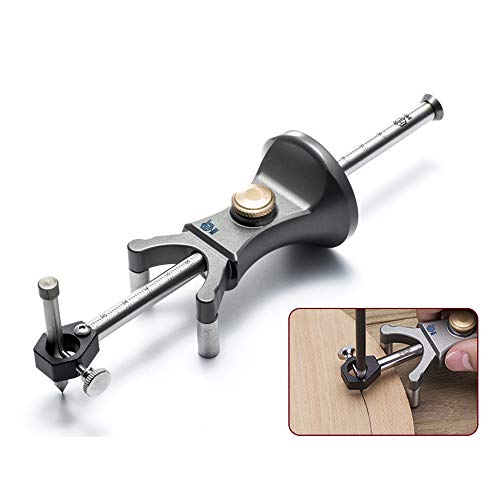
The VISLONE scriber is the long reach option here, a 180 mm wheel gauge the listing describes as a dual-purpose tool for parallel line drawing and arc work. That second role sets it apart here: one tool marks the rip line and swings the arc for a curved layout. The listing names carpentry, drawing and marking out as its recommended uses, and it is sold by ZHengHUiXin with shipping from Amazon. The listing does not publish a micro-adjust feature or spare cutters, so fine-fit creep and long term cutter supply are weaker points than the Clarke Brothers kit. Choose it when reach and occasional arcs matter more than a graduated brass build.
Specs:
– Type: Wheel marking gauge, dual-purpose scriber
– Model: VISLONE-E5190
– Size: 180 mm
– Listed materials: Aluminum, glass, stainless steel, wood
– Recommended uses, as listed: Carpentry, drawing, marking out
– UPC: 791310420489
KAKURI Wood Marking Gauge 3.5 in (90 mm)
The KAKURI gauge is a suji kebiki, the Japanese cutting gauge form, with a laminated bamboo body and a carbon steel blade that severs fibers rather than scratching them. At 3.17 ounces it is far lighter than the brass wheel gauges above, and the blade draws back into the body for storage. The marking width runs up to 90 mm, which covers small joinery, box work and drawer parts well. It will not reach wide casework lines, and the blade form asks for a short learning curve if you have only used wheels or pins. For cross-grain shoulder lines on smaller work, it is the most traditional tool here, made in Japan.
Specs:
– Type: Cutting gauge (suji kebiki)
– Model: 40947
– Body: Bamboo
– Blade: Japanese carbon steel
– Marking width: Up to 90 mm (3.5 in)
– Item weight: 3.17 oz
– Product dimensions: 2.32 x 4.33 x 5.91 in
– Origin: Made in Japan
Crown 135 Marking Gauge, Beech

The Crown 135 is the plain pin gauge of the group, made in Sheffield, England by Crown Tools. The beech body carries a single hardened steel pin, the fence has brass wear strips inlaid on its face, and a plastic thumbscrew locks the setting. There is nothing to adjust beyond sliding the fence and locking it, which makes the tool quick for rough layout and for lines run along the grain. Across the grain a pin can wander in uneven figure, so for crisp shoulders on show faces a wheel or blade gauge is the better tool. As a first gauge or a dedicated gauge for one repeated width, the 135 covers the basics plainly and well.
Specs:
– Type: Pin marking gauge
– Maker: Crown Tools, Sheffield, England
– Body: Beechwood
– Cutter: Single hardened steel pin
– Fence: Brass wear strips inlaid
– Lock: Plastic thumbscrew
Who should skip
Skip this whole group if your layout is mostly curves: every gauge here follows a straight edge, so curved work belongs to a compass or a trammel. Skip them if your lines regularly fall farther than 180 mm from an edge, where a panel gauge or a long rule and a marking knife do the job better. Skip the pin gauge if most of your lines cross the grain on show faces, and skip the short KAKURI if you mark wide casework parts. If you never cut joinery and mark only rough dimensions, a pencil and a combination square may be all the layout kit you need.
FAQ
Wheel, blade or pin: which cutter should I choose?
Pick by the line you mark most. A wheel rolls and severs fibers, so it stays calm across the grain and along it. A blade cuts the crispest cross-grain shoulder lines. A pin scratches a fine line that behaves best along the grain.
How do I set a gauge so the line lands in the right place?
Set the fence from a steel rule, or better, directly from the mating part or the chisel the joint must fit. Lock the fence, then check the setting against a known edge on scrap and adjust until the line sits where you want it. Mark with a light first pass and deepen it in further passes, keeping the fence pressed to the edge.
How far from an edge can these gauges mark?
Reach follows beam length. Among these picks the KAKURI marks up to 90 mm from the edge, the RED OAK TOOLS set covers 150 mm, and the Clarke Brothers and VISLONE gauges reach 180 mm. Very wide boards need a panel gauge instead.
How do I look after the cutter?
Follow the maker guidance. Keep the cutter clean, hone or swap it as the maker directs when lines turn fuzzy, and use any spare cutters the kit includes before ordering more. Retract the cutter or cover the pin for storage, and keep fingers clear of the edge during swaps and cleaning.
Final verdict
For most readers the Clarke Brothers kit is the pick: a graduated brass wheel gauge with micro-adjust, flat spots that stop it rolling, and spare cutters and bolts in the box. The RED OAK TOOLS set is the simpler route to the same wheel layout, with spares included. The VISLONE adds reach and arc work. The KAKURI kebiki is the choice for blade fans and small joinery, and the Crown 135 remains a sound plain pin gauge for lines along the grain. Whichever you choose, set it from the part itself, check the setting against a known edge, and let the cutter do the work in light passes.
Related guides
More from Amazon
Programs that pair well with the guide above. Offers and eligibility are set by Amazon and may change.
A free business account with business pricing and bulk-buying tools for work, shop or home office.
Create a business accountFree shipping on eligible items, Prime Video and more. Eligible new members can start with a free trial.
Start a Prime free trialAudiobooks and podcasts to listen to on the go. Eligible new members can start with a free trial.
Try Audible freeAd-free music streaming. Eligible new subscribers can start with a free trial.
Try Music Unlimited freeAs an Amazon Associate we earn from qualifying purchases.