Our Top Picks
 Orion® 950 Pinless Wood Moisture Meter by WagnerStandard Calibrator5.75 x 3 x 1 inches1.5 poundsCheck on Amazon
What's inside
As an Amazon Associate I earn from qualifying purchases. This post may contain affiliate links at no extra cost to you.
- Top Pick: Wagner Orion 950 Pinless Wood Moisture Meter
- Runner-up: Klein Tools ET140 Pinless Moisture Meter
- Also consider: General Tools MMD4E Digital Moisture Meter
For lumber, the best wood moisture meter for most shops is a pinless model with species settings, because it reads below the surface without leaving holes in furniture stock. For firewood, a simple pin meter is the better tool, because the pins reach the damp core of a split log where the number actually matters. The five meters below cover both jobs: the Wagner Orion 950 is the premium pinless pick for serious lumber work, the Klein Tools ET140 is a rugged mid-range scanner, the Neoteck 2-in-1 combines pin and pinless sensing in one rechargeable body, the General Tools MMD4E is the proven budget pin meter, and the Proster PST050 is a firewood-first pin meter with species groups.
As an Amazon Associate, we earn from qualifying purchases.
Contents
Table of Contents
- Quick Picks
- Wagner Orion 950 Pinless Wood Moisture Meter
- Klein Tools ET140 Pinless Moisture Meter
- Neoteck 2-in-1 Pin and Pinless Moisture Meter
- General Tools MMD4E Digital Moisture Meter
- Proster Wood Moisture Meter PST050
- How to Choose a Wood Moisture Meter
- FAQ
- Conclusion
- Product and ASIN Reference
Quick Picks
- Best overall for lumber: Wagner Orion 950 — dual-depth pinless scanning, automatic EMC calculation, and field calibration.
- Best pinless value: Klein Tools ET140 — non-destructive scanning to three quarters of an inch with modes for hardwood and softwood.
- Best pin and pinless combo: Neoteck 2-in-1 — both sensor types, six material modes, and a rechargeable battery.
- Best budget pin meter: General Tools MMD4E — separate wood and building material ranges with audible and visual alerts.
- Best for firewood: Proster PST050 — four wood groups covering more than 50 species and a very wide reading range.
Wagner Orion 950 Pinless Wood Moisture Meter
The Orion 950 sits at the premium tier and is built for woodworkers and flooring professionals who measure lumber every day. It is a pinless meter, so the sensor plate reads moisture inside the board without driving pins into the surface, which keeps finished and furniture-grade stock unmarked. Its dual-depth sensor reads at a shallow depth of about a quarter inch and a deep depth of about three quarters of an inch, so the same meter can check thin veneered panels and thick rough-sawn boards.
The published moisture range runs from 4 to 32 percent, covering the band that matters for lumber, from kiln-dried stock ready for glue-ups to air-dried boards still drying. A built-in species setting system adjusts for specific gravity across a wide range of woods, and IntelliSense technology is designed to read moisture in the wood rather than on a damp surface. The 950 also carries a temperature and relative humidity sensor, so it calculates equilibrium moisture content, dew point, and grains per pound automatically. Readings can be stored on the meter and sent by Bluetooth to the companion apps. Every Orion ships with an On-Demand Calibrator for true field calibration and is backed by a seven-year warranty.
Specs
- Type: Pinless, electromagnetic sensor
- Reading depths: About 0.25 inch shallow and 0.75 inch deep
- Moisture range: 4 to 32 percent for wood
- Species adjustment: Specific gravity settings from 0.20 to 1.50
- Extra sensors: Temperature and relative humidity with EMC, dew point, and grains per pound calculations
- Data: Onboard storage for up to 100 readings, Bluetooth app connection
- Calibration: On-Demand Calibrator included
- Power: 9V battery
- Warranty: Seven years
Klein Tools ET140 Pinless Moisture Meter

The ET140 is a mid-range pinless meter from a brand known for job-site tools, and it is built to survive them: Klein rates the housing for drops of about two meters. The electromagnetic sensor detects relative moisture up to three quarters of an inch below the surface without any pins, so it can sweep a stack of boards or a finished tabletop quickly and leave no marks behind.
Four material modes cover drywall, masonry, hardwood, and softwood, so the same tool that checks softwood lumber can also scan a wall for a leak. Readings appear on a reverse-contrast display backed by a bar of nine LED indicators that show the moisture level at a glance, and an audible alert sounds as levels rise. Hold and auto-power-off functions round out the feature set. Because it reports relative moisture calibrated to the selected material rather than species-corrected percentages, it suits lumber screening and comparison work best: sorting boards, finding the wet ones in a stack, and confirming firewood splits are trending dry.
Specs
- Type: Pinless, electromagnetic field sensor
- Detection depth: Up to 0.75 inch (19 mm)
- Material modes: Drywall, masonry, hardwood, softwood
- Display: Reverse-contrast LCD with nine LED moisture indicators
- Alerts: Audible alert, hold function, low battery indication
- Durability: Drop protection rated to about 2 meters (6.6 feet)
- Power: 9V battery, included
- Weight: About 7 ounces
Neoteck 2-in-1 Pin and Pinless Moisture Meter
The Neoteck 2-in-1 is the flexible mid-range option: one body carries both a pinless scanning plate and a pair of pin probes, so a single purchase covers finished surfaces and deep spot checks. In pinless mode the sensor scans non-destructively to a depth of 19 millimeters, which suits wide lumber, flooring, and panels. Switching to the pins gives a direct contact reading in firewood, rough lumber, and any spot where a small pair of holes does not matter.
Six material modes cover soft wood, hard wood, drywall, plaster, screed, and concrete, and the published accuracy is plus or minus 2 percent. That mode list makes the meter useful beyond the woodpile, but for this guide the lumber and firewood roles are the point: scan a board face with the plate, then confirm the reading with the pins at the end grain. Instead of disposable batteries, the Neoteck uses a built-in rechargeable pack charged over USB-C, a practical touch for a tool that lives in a truck or a damp woodshed where spare 9V batteries are rarely at hand.
Specs
- Type: Pin and pinless combination
- Pinless depth: Up to 19 mm
- Material modes: Six, including soft wood, hard wood, drywall, plaster, screed, and concrete
- Published accuracy: Plus or minus 2 percent
- Power: Built-in rechargeable battery, USB-C charging, 1200 mAh capacity
- Model: MT35
General Tools MMD4E Digital Moisture Meter
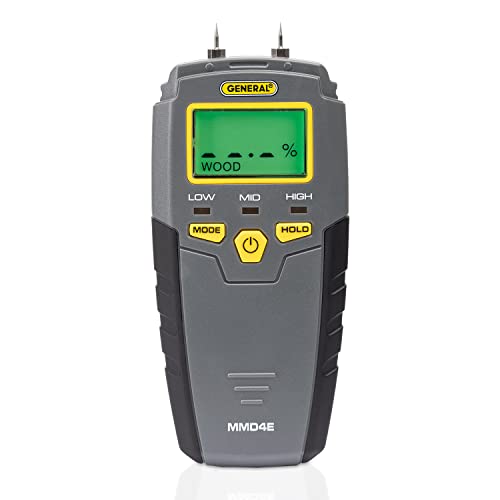
The MMD4E is the budget pin meter that has been a workshop staple for years. Two replaceable stainless pins press into the wood and read moisture at the contact point, which is exactly what firewood checking calls for: split a log, push the pins into the fresh face, and read the core moisture directly. Separate ranges cover wood from 5 to 50 percent and building materials from 1.5 to 33 percent, so the meter also handles drywall, concrete, and plaster checks around the house.
The backlit LCD shows readings with a tenth of a percent resolution, and the meter adds audible tones plus visual high, medium, and low moisture alerts, so a quick pass over a woodpile sorts itself into burn-now and keep-seasoning piles without studying the screen. A hold button freezes a reading taken in an awkward spot. Published accuracy is plus or minus 2 percent, and the cap that protects the pins doubles as a calibration check point. Spare pins and a 9V battery are included in the box.
Specs
- Type: Pin type, two replaceable pins, 8 mm pin length
- Wood range: 5 to 50 percent
- Building material range: 1.5 to 33 percent
- Resolution: 0.1 percent
- Published accuracy: Plus or minus 2 percent
- Display: Backlit LCD with audible and visual high, medium, and low alerts
- Power: 9V battery, included
- Included: Spare pins and protective cap
Proster Wood Moisture Meter PST050

The Proster PST050 is a budget pin meter aimed squarely at wood rather than walls. Its published range runs from 0 to 99.9 percent with a tenth of a percent resolution, and the manufacturer states an accuracy of plus or minus 0.5 percent. Four wood groups together cover more than 50 species, so the reading can be corrected for the difference between a light softwood and a dense hardwood instead of relying on one generic scale.
For firewood duty, that species correction matters: oak and pine dry at different rates and read differently at the same true moisture level, and the group settings keep the comparison honest across a mixed woodpile. The large LCD is easy to read outdoors, the housing is a simple sturdy plastic shell, and an automatic shutoff preserves the 9V battery between trips to the woodpile. The trade-off is scope: this is a wood-only instrument, with no modes for concrete, gypsum, or drywall, so it earns its place as the dedicated lumber and firewood meter rather than a whole-house leak hunter.
Specs
- Type: Pin type, two test probe pins
- Range: 0 to 99.9 percent
- Resolution: 0.1 percent
- Published accuracy: Plus or minus 0.5 percent
- Wood groups: Four groups covering more than 50 species
- Display: Large LCD
- Power: 9V battery, included, with automatic shutoff
- Dimensions: About 5.9 by 3.3 by 1.6 inches
- Model: PST050
How to Choose a Wood Moisture Meter
Start with the pin versus pinless decision. Pin meters measure at the contact point between two probes, reach the core of a split log, and are the natural choice for firewood and rough lumber. Pinless meters scan a volume of wood below the surface without leaving marks, read much faster across wide boards, and are the natural choice for furniture stock, flooring, and finished pieces. A combination meter like the Neoteck covers both workflows in one tool.
Next, match the range to the job. Furniture and cabinet lumber is worked between roughly 6 and 12 percent, firewood burns cleanly below about 20 percent, and green lumber can start far above both. A meter that tops out at 32 percent, like the Orion 950, is tuned for the lumber band, while wide-range pin meters like the Proster and MMD4E follow firewood all the way from fresh-cut to seasoned.
Species correction is the third factor. Wood density changes how every sensor responds, so meters with species or specific gravity settings, like the Orion line, the Proster’s wood groups, or density grades on similar models, produce readings that can be compared across oak, maple, pine, and walnut. Material modes for hardwood and softwood, as on the Klein ET140, are a simpler version of the same idea.
Finally, consider depth. Thick slabs and 8/4 stock need a deep reading mode around three quarters of an inch; thin stock needs a shallow mode so the sensor does not read the bench or the board beneath.
FAQ
What moisture level should lumber be before woodworking?
Interior furniture lumber is typically worked between about 6 and 12 percent moisture content, which matches the equilibrium level of heated indoor spaces. Stock above that band can shrink, warp, or open glue joints after a project is finished. A pinless meter with species settings gives the most reliable check on wide boards, because it reads below the surface without leaving pin holes in show faces.
What moisture level should firewood be before burning?
Firewood burns efficiently and with less creosote buildup when its moisture content is below about 20 percent. To measure it correctly, split a log and push a pin meter into the freshly split face, since the outside of a log dries long before the core. Readings taken on bark or on an old split face will read low and mislead, which is why pin meters suit firewood better than surface scanners.
Are pin or pinless moisture meters more accurate?
Neither type is automatically more accurate; they measure differently. Pin meters read the exact spot between the probes and can reach a chosen depth by driving the pins in, which makes them dependable for firewood and rough lumber. Pinless meters average moisture over a scanned volume and depend on correct species or density settings, which makes them fast and consistent for lumber once the right setting is selected. Published accuracy figures and correct species correction matter more than the sensor style.
Why do readings differ between two spots on the same board?
Moisture is rarely uniform in wood. End grain dries faster than faces, the core of a thick board lags behind the shell, and a board stored on a damp floor picks up moisture from below. Take several readings along the length and across the width, and treat the highest reading as the one that decides whether the board is ready. Consistent technique, the same meter, and the same species setting make readings comparable over time.
Conclusion
Match the meter to the material: the Wagner Orion 950 for serious lumber work with species-corrected, dual-depth pinless readings; the Klein Tools ET140 for fast, rugged pinless screening of hardwood and softwood; the Neoteck 2-in-1 when one tool must scan finished boards and probe firewood; the General Tools MMD4E as the dependable budget pin meter for wood and building materials; and the Proster PST050 as the wood-only specialist for firewood piles and species-group readings. Any of the five replaces guesswork with a number, and that number keeps joints tight and fires clean.
Related guides
More from Amazon
Programs that pair well with the guide above. Offers and eligibility are set by Amazon and may change.
A free business account with business pricing and bulk-buying tools for work, shop or home office.
Create a business accountFree shipping on eligible items, Prime Video and more. Eligible new members can start with a free trial.
Start a Prime free trialAudiobooks and podcasts to listen to on the go. Eligible new members can start with a free trial.
Try Audible freeAd-free music streaming. Eligible new subscribers can start with a free trial.
Try Music Unlimited freeAs an Amazon Associate we earn from qualifying purchases.