What's inside
- How to Judge Grizzly Machines: The Three Specs That Matter
- Table Saws: Grizzly’s Strongest Category
- Bandsaws: Buy the 14″ Only If You Won’t Resaw
- Jointers: Worth It If You Have 220V and the Floor Space
- Dust Collectors: The Weakest Value Proposition
- Decision Matrix: Which Grizzly Machine for Your Situation
- Ownership Realities Nobody Puts in the Listing
- Bottom Line
- Related Guides
- How to Judge Grizzly Machines: The Three Specs That Matter
- Table Saws: Grizzly’s Strongest Category
- Bandsaws: Buy the 14″ Only If You Won’t Resaw
- Jointers: Worth It If You Have 220V and the Floor Space
- Dust Collectors: The Weakest Value Proposition
- Decision Matrix: Which Grizzly Machine for Your Situation
- Ownership Realities Nobody Puts in the Listing
- Bottom Line
- Related Guides
As an Amazon Associate I earn from qualifying purchases. This post may contain affiliate links at no extra cost to you.
Grizzly woodworking tools are worth the money if you prioritize motor size and cast-iron mass over polish — their table saws and jointers beat most competitors dollar-for-dollar at the $1,500–$3,000 price point, while their budget bandsaws and entry-level dust collectors face stiffer competition. Below is a breakdown by machine category, with the specs that actually matter when you’re comparing against Laguna, Powermatic, Jet, and Harvey at the same price.
As an Amazon Associate we earn from qualifying purchases at no extra cost to you.


Contents
- How to Judge Grizzly Machines: The Three Specs That Matter
- Table Saws: Grizzly’s Strongest Category
- Bandsaws: Buy the 14″ Only If You Won’t Resaw
- Jointers: Worth It If You Have 220V and the Floor Space
- Dust Collectors: The Weakest Value Proposition
- Decision Matrix: Which Grizzly Machine for Your Situation
- Ownership Realities Nobody Puts in the Listing
- Bottom Line
- Related Guides
How to Judge Grizzly Machines: The Three Specs That Matter
Before comparing models, it helps to know where Grizzly wins and loses. Grizzly Industrial sells direct, skipping dealer markup — that’s why a Grizzly machine typically gives you 15–25% more motor and mass than a similarly priced Jet or Laguna. The trade-offs are fit and finish (sometimes rough castings, more assembly time) and resale value (Grizzly holds value worse than Powermatic). Judge each category on:
- Motor power: Real amperage and voltage, not “peak HP.” A true 3 HP motor runs on 220–230V and draws around 13–14 amps.
- Resaw capacity (bandsaws): Distance from blade to the upper guide at max height — 12″+ is needed for serious resawing.
- Fence quality: A flexing fence ruins rip accuracy on a saw and makes jointer edge-jointing frustrating. This is where budget machines cut corners first.
Table Saws: Grizzly’s Strongest Category
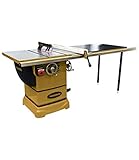
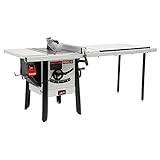
Grizzly’s cabinet saws are the best argument for the brand. The G1023 series (3 HP) has been a hobby-shop staple for decades, and the higher-end models with a riving knife and the Shop Fox Classic-style fence compete directly with the SawStop PCS and Powermatic PM1000 territory — often $600–$1,000 cheaper for equivalent cutting power.
| Model (class) | Motor | Rip Capacity | Fence Type | Table Weight (approx.) | Typical Price Range |
|---|---|---|---|---|---|
| Grizzly G0833P hybrid | 2 HP, 220V | 30″ | Camlock, aluminum | ~400 lbs | $1,200–$1,500 |
| Grizzly G1023RL cabinet | 3 HP, 220V | 36″ | Shop Fox Classic (Biesemeyer-style) | ~500 lbs | $1,900–$2,300 |
| Powermatic PM1000 (competitor) | 1.75 HP, 115V | 30″ | Accu-Fence | ~330 lbs | $2,300–$2,600 |
| SawStop PCS175 (competitor) | 1.75 HP, 110V | 36″ | T-Glide | ~340 lbs | $2,900–$3,300 |
The head-to-head takeaway: the G1023RL gives you a true 3 HP motor and heavier cast iron for roughly what competitors charge for 1.75 HP. What you give up versus SawStop is the flesh-sensing brake — a real safety feature, not a gimmick — and versus Powermatic, the Accu-Fence is arguably smoother out of the box. If safety tech is non-negotiable, SawStop wins. If capacity and power per dollar matter more, Grizzly wins this category outright.
Bandsaws: Buy the 14″ Only If You Won’t Resaw
Grizzly’s 14″ bandsaws (the G0555 family) are fine machines at their price — typically $700–$1,100 — but the 6″ resaw height limits them to curve work and thin resawing unless you add a riser block kit. For resaw work, step up to the 17″–19″ models, where Grizzly’s value proposition returns.
- G0555 (14″): 1 HP, 6″ resaw, 93.5″ blade. Comparable to Rikon 10-326’s smaller siblings; adequate for scroll work, not for slicing veneer or milling your own lumber.
- G0513/G0514 family (17″–19″): 2–3 HP, 12″+ resaw, cast-iron wheels. This is where Grizzly undercuts Laguna and Rikon 18″ models by $400–$800 at similar resaw capacity.
Verdict: if resawing is the goal, a Grizzly 17″+ is worth the money. If you only need curves and small joinery cuts, a Rikon or Laguna 14″ often ships with better guides and less setup fuss for the same price.
Jointers: Worth It If You Have 220V and the Floor Space
Grizzly’s 8″ jointers — parallelogram-bed models like the G0490X and helical-head variants — routinely offer 8″ capacity for what competitors charge for 6″. A 3 HP motor, 76″+ bed length, and spiral or helical cutterhead options in the $2,200–$3,000 range undercut the Powermatic 8″ PJ-882HH significantly. Ownership realities: parallelogram beds adjust more easily but check coplanarity at delivery — Grizzly units more often need fence and bed tweaking during setup than Powermatic units do. Budget an extra 2–4 hours of setup and a machinist’s straightedge.
Dust Collectors: The Weakest Value Proposition
Grizzly’s dust collectors are adequate but not class-leading. The G1028Z/G1029Z portable units (~1.5–2 HP, 1,300–1,550 CFM claimed) compete with similar Harbor Freight-adjacent designs, and the canister-filter upgrades cost extra. In the 3 HP cyclone class, Grizzly pricing approaches Oneida and Laguna territory where filtration (sub-micron ratings) and build quality justify spending more. Rule of thumb: Grizzly dust collectors are worth buying as a bundle with a saw purchase; as a standalone purchase, compare CFM at the tool port (not inlet) against Oneida and Clear Vue before committing.
Decision Matrix: Which Grizzly Machine for Your Situation
| Your Situation | Recommended Pick | Why |
|---|---|---|
| First serious saw, under $1,500, only 110V available | Grizzly hybrid (G0833P class) | Enclosed cabinet, riving knife, upgradeable to 220V later |
| Furniture making, 220V in the shop | G1023RL cabinet saw | 3 HP handles 8/4 hardwoods; riving knife; heavy fence |
| Resawing / milling own lumber | Grizzly 17″–19″ bandsaw | 12″+ resaw at lower cost than Laguna equivalent |
| Flattening wide boards regularly | Grizzly 8″ helical-head jointer | 8″ capacity for a 6″-machine price elsewhere |
| Small garage shop, occasional weekend use | Skip Grizzly; consider compact Rikon/Jet | Grizzly’s weight and 220V needs outweigh the savings |
| Safety is the top priority | SawStop, not Grizzly | Flesh-detection has no Grizzly equivalent |
Ownership Realities Nobody Puts in the Listing
- Shipping and setup: Grizzly machines arrive freight, often 400–800 lbs. Budget for liftgate delivery and a day of assembly plus alignment.
- What wears first: On Grizzly saws, the stock miter gauge and insert plates are the usual first upgrades (~$40–$80 total). Bandsaw guide blocks and tires wear at normal rates — replacements are cheap and in stock.
- Consumables: Helical-head inserts are standard sizes and cheap to rotate/replace. Bandsaw blades aren’t included at quality worth keeping — plan on a Timber Wolf or equivalent blade immediately (~$30–$50).
- Common mistake: Skipping a proper fence and trunnion alignment at setup. Spend the first afternoon with a dial indicator — Grizzly machines reward careful setup more than most.
- Cost per year math: A $2,100 cabinet saw used weekly for 10 years costs about $0.75 per shop day — cheaper than the blades you’ll run through it.
Bottom Line
Grizzly woodworking tools are worth the money in three specific spots: 3 HP cabinet table saws, 17″+ resaw bandsaws, and 8″ jointers — anywhere their direct-sales model translates into more motor and cast iron per dollar. They’re a pass if you need SawStop’s safety system, lack 220V power, or want a dust collector that’s best-in-class rather than merely adequate.