What's inside
As an Amazon Associate I earn from qualifying purchases. This post may contain affiliate links at no extra cost to you.
Contents
Choose the tool that solves a specific cut
The best Japanese woodworking tools are the ones whose cutting action, edge geometry, and maintenance suit your work—not a full set bought for its appearance. A Japanese pull saw is useful when thin, controlled cuts matter; a chisel earns its place for paring and chopping joinery; a kanna plane makes sense if you want to tune and maintain a traditional plane; and marking tools are worthwhile when layout accuracy is limiting your results. For many woodworkers, one saw and a dependable chisel are a better first purchase than a complete kit.
Japanese tools are not automatically more precise than Western equivalents. Their advantages are specific: pull-stroke sawing can make thin blades easier to control, some Japanese chisels have very hard cutting layers, and a well-set kanna can take fine shavings without a metal frog. Those advantages come with trade-offs, including delicate edges, setup requirements, and replacement blades on some saws.
As an Amazon Associate we earn from qualifying purchases at no extra cost to you.

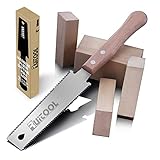
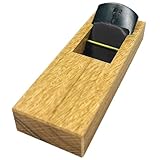

Quick comparison: what you gain and what you maintain
Dimensions and weights below are representative ranges, not specifications for every model. Check the maker’s current listing before buying; blade length, handle design, steel, and construction vary considerably.
| Tool | Typical size or weight | Cutting action and steel | Best realistic use | Main ownership cost |
|---|---|---|---|---|
| Replaceable-blade ryoba saw | Blade about 240–270 mm; roughly 200–350 g with handle | Pull cut; teeth on both edges, commonly for rip and crosscut | Hand-cut joinery, small stock, and general shop work | Replacement blades; avoid twisting the thin plate |
| Dozuki saw | Blade about 150–240 mm; roughly 150–300 g with handle | Pull cut; stiffening spine supports a thin blade | Shoulders and fine crosscuts where a clean kerf matters | Blade replacement or sharpening, depending on model |
| Japanese bench chisel | Common blade widths about 3–42 mm; roughly 100–300 g | Often laminated hard steel at the edge with softer backing | Paring, chopping, and fitting joinery after sharpening | Stone sharpening, occasional flattening, and careful edge handling |
| Kanna hand plane | Common body length about 200–270 mm; roughly 500–900 g | Pull stroke; iron bears against a wooden dai, often with a chipbreaker | Fine surface preparation and shaving removal on suitable stock | Setup, sole tuning, and sharpening are part of ownership |
| Marking knife and marking gauge | Knife blades often about 20–40 mm; gauge fences commonly about 50–100 mm wide | Score or scribe a physical line rather than relying only on pencil | Repeatable shoulders, baseline layout, and knife-wall cuts | Low wear; keep the knife sharp and the gauge fence square |
Pick by the work you actually do
For one versatile saw: start with a ryoba
A ryoba has rip teeth along one edge and crosscut teeth along the other. It is a practical first Japanese saw for a small shop making boxes, shelves, and straightforward furniture. The two tooth patterns save space and money, but switching edges does not make it a universal replacement for every Western backsaw or panel saw. A ryoba’s flexible plate can wander if forced sideways, and its lack of a stiffening spine makes a very straight cut depend on the user’s technique.
Choose a replaceable-blade model if you do not want to learn saw sharpening. Its teeth are usually impulse-hardened: they stay sharp well, but are generally not intended for conventional resharpening. A fixed-blade saw may suit a woodworker prepared to sharpen it, but confirm that the tooth geometry and steel are actually serviceable with your files.
For fine shoulders: choose a dozuki
A dozuki’s back stiffens its thin blade, helping it track through controlled crosscuts. It is especially useful for tenon shoulders, small dovetails, and trimming parts to a layout line. The spine limits cutting depth, so it is a poor choice for deep cuts or sawing stock thicker than the blade-and-spine geometry permits. For a general-purpose Western backsaw used on thicker work, the dozuki is a specialist addition, not an automatic upgrade.
For joinery fitting: buy a chisel for its steel and use
Many traditional Japanese chisels use laminated construction: a hard steel cutting layer is forge-welded to softer iron or steel. The hard layer can take and hold a keen edge, while the backing supports it. Other chisels use different constructions, so “Japanese steel” alone is not a useful buying specification. Ask what the cutting steel is, whether the maker specifies a hardness, and whether the tool is supplied ready to use or needs initial preparation.
High hardness is not free durability. A keen edge can chip if twisted in a mortise, struck against a hidden nail, or used as a pry bar. For a first chisel, a mid-range width around 12–18 mm is useful for many general tasks; add widths to suit actual joinery rather than buying a large set immediately. A Western bevel-edge chisel is often the better choice for rougher work, levering small waste, or shops that already use a compatible honing system.
For ultra-fine shavings: consider a kanna only if you will tune it
A kanna cuts on the pull stroke, and its wooden body and iron can produce exceptionally fine shavings when correctly fitted and sharpened. That is valuable for final surface work, thin stock, and tasks where a fine shaving is preferable to sanding. It does not arrive as a maintenance-free shortcut: the blade’s fit, chipbreaker contact, and sole need attention, and the body may need seasonal adjustment as wood moves.
If you want quick setup, predictable adjustment, and a plane ready to use out of the box, a well-made Western bench plane is likely the better purchase. Choose a kanna when its pull-cut action and shaving quality match your work—and when learning its setup is part of the appeal, not an unexpected chore.
For repeatable layout: buy the marking tool that fixes your error
A marking knife makes a fine line that can register a chisel or saw cut; a marking gauge carries a repeatable distance from an edge. These tools can improve accuracy even if the rest of your tool kit is Western. They do not replace careful measurement: a gauge with a loose fence, a skewed cutter, or debris under its face can repeat the same error across every part.
For occasional furniture work, a sharp knife and one adjustable gauge may be more useful than a collection of specialty marking tools. A pencil remains faster for rough cuts and hidden surfaces.
Decision matrix by budget, experience, and space
| Your situation | Best starting choice | Why | Wait on |
|---|---|---|---|
| Beginner, limited budget, occasional joinery | One replaceable-blade ryoba and a quality marking knife | Useful across many small cuts, with little sharpening investment | A kanna or a full chisel set |
| Intermediate, frequent dovetails or tenons | Dozuki plus a few chisel widths suited to the joints | More control at shoulders and fitting stages | Buying based on steel claims without checking sharpening needs |
| Small shop with little storage | Ryoba and a compact sharpening setup | One saw covers two common tooth patterns; maintenance kit stays modest | Multiple overlapping saws |
| Frequent hand-planing, comfortable with setup | Kanna, if fine shaving work justifies tuning time | Its distinctive advantage is fine pull-cut planing, not convenience | Expecting it to behave like a factory-adjusted Western plane |
Ownership realities that matter more than the label
- Saw blades: Thin plates can buckle from sideways pressure. Start the cut with light strokes, let the teeth establish a kerf, and replace a hardened blade when it becomes dull rather than trying to force it through stock.
- Chisel edges: Hard edges hold sharpness but can chip. Keep stones flat, remove the wire edge, and avoid twisting a chisel while it is buried in a cut. A chipped edge may require grinding back before honing.
- Kanna bodies: Keep the wooden dai dry and protect it from abrupt humidity changes. A plane that stops cutting may need its iron sharpened or its setup corrected—not more force.
- Marking tools: Check a gauge against a square and test the knife line on scrap. A clean reference line is useful only if the fence and cutter are aligned.
- Storage: Wipe exposed steel dry after use. In a damp shop, a light protective coating helps prevent rust; remove it before cutting where it could contaminate the work.
Bottom line
Buy Japanese woodworking tools where their particular strengths solve a real problem: a dozuki for fine, controlled crosscuts; a ryoba for compact rip-and-crosscut versatility; a laminated-steel chisel for keen joinery work; a kanna for fine planing when you accept the setup; and a marking knife or gauge for repeatable layout. If you are unsure, start with the tool that addresses your most frequent frustrating cut, then add the maintenance skills and complementary tools as the work demands.