What's inside
As an Amazon Associate I earn from qualifying purchases. This post may contain affiliate links at no extra cost to you.
The best work benches for shops combine a thick hardwood or steel-reinforced top, rated capacities above 500 lbs, and either dog-hole or T-track clamping systems — for most dedicated shop spaces, a stationary hardwood bench like the Sjöbergs Elite 2000 or a heavy-duty steel-frame bench in the 1,000–3,000 lb class covers 90% of serious builds.
As an Amazon Associate we earn from qualifying purchases at no extra cost to you.


Contents
What Separates a Shop-Grade Bench from a Garage Bench
Shop benches earn their keep on three numbers most listings bury: top thickness, static load rating, and the mass of the whole unit. A bench that weighs under 100 lbs will walk across the floor when you hand-plane or chisel mortises, no matter what the load rating says on paper.
- Top thickness: Look for 1.5″ minimum in laminated hardwood (beech and birch are standard), or 3/4″ MDF sacrificial layers over a plywood core for benchtop-style work surfaces.
- Load rating: 500 lbs is the floor for general joinery; 1,000+ lbs if you’re assembling cabinet carcasses, milling machinery, or parking a planer on top between passes.
- Dog holes: 3/4″ round holes on a 96mm or 3″ grid are the woodworking standard; 20mm holes are the Festool/MFT pattern and open up a large aftermarket of precision dogs and clamps.
- Workbench height: 33″–36″ suits power-tool work and assembly; hand-tool users often prefer 30″–32″ for planing leverage.
Stationary vs. Mobile: Which Base Fits Your Shop
This is the first real decision, and it depends on how many machines share your floor.
| Factor | Stationary Base | Mobile Base (Locking Casters) |
|---|---|---|
| Typical load rating | 1,000–4,000 lbs | 300–1,200 lbs |
| Bench weight (typical) | 150–400 lbs | 80–180 lbs |
| Best for | Hand planing, chopping mortises, carving, dedicated assembly spot | Multi-machine shops, small garages, benchtop-tool staging |
| Racking resistance | Excellent — mass plus aprons/stretchers | Good if caster locks actually engage both wheel and swivel |
| Storage options | Cabinet banks, drawers, tool well | Lower shelf; drawers rare due to weight |
| Price range (2026) | $400–$2,500+ | $150–$700 |
In a multi-machine shop — table saw, jointer, planer competing for space — a mobile bench on total-lock casters doubles as an outfeed table and can be parked against the wall. The trade-off is real: even good casters introduce a small amount of flex under lateral load, so hand-tool-heavy work suffers. Many serious shops end up with one of each.
Top Picks by Shop Situation
Best Traditional Stationary Bench: Sjöbergs Elite 2000
A European-style beech bench around 76″ long, roughly 180 lbs, with 3/4″ dog holes, twin vises (face and tail), and a rock-solid undercarriage. Load capacity is effectively limited by your floor rather than the bench. Expect the $1,800–$2,500 range. This is a lifetime purchase — tops can be flattened and refinished for decades.
Best Heavy-Duty Steel Workbench: Grizzly Industrial H8258 / Steel-frame bench class
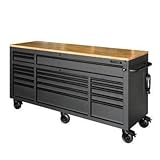
Steel-frame benches with butcher-block tops in the 60″–72″ range typically rate 1,500–3,000 lbs and cost $500–$900. They lack the vise hardware and dog-hole patterns of a joinery bench, but for a shop where the bench doubles as a machine stand and welding-adjacent surface, the rigidity-per-dollar is hard to beat.
Best Mobile Workbench: Kreg Mobile Project Center / Husky adjustable-height benches
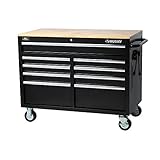
In the $150–$500 range, adjustable-height steel benches on locking casters (typically 30″–48″ heights, 500–1,200 lb ratings) serve multi-machine shops well. The Kreg-style folding project centers trade absolute rigidity for near-flat storage — useful in single-car garages where the bench must disappear.
Best Precision / MFT-Style Bench: Festool MFT/3 or 20mm dog-hole DIY tops
The MFT/3 is lighter (around 60 lbs) than a true shop bench but sets the standard for 20mm dog-hole layout, track-saw crosscutting, and clamping versatility. For a fixed station, building a 4’×8′ torsion-box top with a 20mm grid on a cabinet base gives MFT functionality with 1,000+ lb capacity for the cost of materials.
Decision Matrix: Match Your Situation to a Bench
| Your Situation | Recommended Type | Budget Tier |
|---|---|---|
| Garage shop, bench must move weekly | Mobile steel bench, total-lock casters | $200–$600 |
| Dedicated space, hand tools and joinery | Stationary hardwood bench with vises + dog holes | $800–$2,500 |
| Bench doubles as machine stand / heavy assembly | Steel-frame bench, 1,500+ lb rating | $500–$900 |
| Track saw + sheet goods focus | MFT-style top, 20mm dog grid | $300–$700 |
| Mixed shop, long-term | Stationary joinery bench + mobile outfeed bench | $1,200–$3,000 combined |
Ownership Realities Nobody Puts on the Listing
- What wears first: sacrificial top surfaces and dog-hole edges (dogs mushroom them over time — replaceable hardboard skins solve this), caster locks on mobile benches, and vise screw handles.
- Assembly truth: flat-pack hardwood benches ship as 100+ lbs of components and need careful squaring — a 1/16″ racked base telegraphs into the top.
- Height mistake: buying a 34″ bench for hand planing is the classic regret — measure your wrist height with arms at your sides and subtract 6″–8″ for planing work.
- Caster spec: polyurethane wheels outlast rubber on epoxy floors; verify casters lock both roll and swivel, or the bench will still pivot.
- Maintenance: hardwood tops want a coat of paste wax twice a year — it prevents glue from bonding to the surface and stops rust transfer from tools.
FAQ
Is a 500 lb capacity enough for a shop bench?
For assembly and layout, yes. The number matters less than bench weight — a 150 lb bench holds a 500 lb load fine, but it still slides during planing. Prioritize mass and racking resistance.
3/4″ or 20mm dog holes?
3/4″ is the traditional woodworking standard with cheaper accessories; 20mm suits track-saw and precision-fixture workflows. Converting later means drilling a new grid, so choose by your dominant tool system.
Can one bench serve as both outfeed and assembly surface?
Yes — set the bench height 1/8″–1/4″ below your table saw deck and keep the top smooth (no tail vise proud of the surface). A mobile bench makes this arrangement practical in tight shops.