What's inside
As an Amazon Associate I earn from qualifying purchases. This post may contain affiliate links at no extra cost to you.
Contents
The Short Answer
For most workshops, the best sawhorse is a pair of adjustable-height metal sawhorses rated at 1,000+ lb per pair — they fold flat, set your work at the right height for both cutting and assembly, and last for decades. Choose wood if you want sacrificial tops you can cut into without guilt, plastic if portability and weather resistance matter more than rigidity, and build your own from 2x4s if budget is the deciding factor.
Wood vs. Metal vs. Plastic: The Real Trade-Offs
Material isn’t just about strength — it changes how you work.
As an Amazon Associate we earn from qualifying purchases at no extra cost to you.

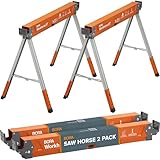

| Factor | Wood (DIY or premade) | Metal (steel/aluminum) | Plastic/composite |
|---|---|---|---|
| Typical capacity (per pair) | 500–2,000 lb (depends on build) | 1,000–2,500 lb | 500–1,300 lb |
| Weight (each) | 8–15 lb | 8–14 lb | 4–9 lb |
| Price range (per pair) | $15–40 in materials | $60–150 | $40–100 |
| Cut-through forgiving? | Yes — tops are sacrificial | No — blade damage risk | Partial — tops nick but survive |
| Height adjustable? | No (fixed at build) | Often yes (telescoping legs) | Rarely |
| Folding/storage | Poor unless knock-down design | Excellent | Excellent |
| Weather resistance | Poor unless sealed | Good (watch for rust) | Best |
The key insight: wood is the only material where accidentally cutting through the top is a non-event. If you regularly break down sheet goods with a circular saw, sacrificial 2×4 tops on a wood or hybrid frame save your blade and your nerves. Metal horses demand a sacrificial board on top anyway for that work.
Getting the Height Right: Cutting vs. Assembly
Most fixed sawhorses sit at 28–32 inches, which is a compromise that serves nobody perfectly.
- Cutting sheet goods and rough lumber (24–26 in): Lower is better. You want to kneel one knee on the sheet for stability and let the saw’s weight do the work. A 30-inch horse forces an awkward reach and unstable workpiece.
- Assembly, sanding, and glue-ups (34–36 in): Standard bench height. Work at elbow level so you’re not hunched over for an hour.
- Detail work and finishing (36–40 in): Higher still for close-up tasks.
A quick sizing check: stand next to the sawhorse and let your arm hang. For assembly work, the top should sit roughly at your wrist crease — the same rule used for workbench height. For cutting, aim for mid-thigh to hip level.
This is why telescoping-leg metal horses earn their price: models like the Bora Portamate Speedhorse or the DeWalt adjustable sawhorse span roughly 24–36 inches, covering both jobs with one pair. Fixed-height alternatives require two pairs at different heights to match that flexibility.
Pairing Sawhorses with a Door-Top Workbench
An old solid-core door on sawhorses is a classic instant workbench — a typical door is 30–36 inches wide and 80 inches long, giving you more surface than most commercial benches.
- Height math: a solid-core door adds about 1¾ inches. A 30-inch sawhorse plus door lands at ~32 inches — good for general work, low for tall users. If you’re over about 5’10”, choose adjustable horses set to 33–34 inches so the door top finishes near 35 inches.
- Use three horses for full-length doors. Two horses under an 80-inch door leave a floppy 30+ inch overhang in the middle; a third horse in the center prevents sag during sanding or planing. Alternatively, use two horses with a pair of 2x4s screwed across them as runners, and lay the door on those.
- Non-slip matters: look for horses with rubberized or textured top rails (most metal folding models have them). On smooth wood tops, a strip of drawer liner keeps the door from skating sideways.
- Clamping: open top-rail designs let you run bar clamps through the door’s rail area or clamp the door directly to the horse. Metal horses with a V-groove or clamp channel in the top rail are ideal here.
Decision Matrix: Which Sawhorse Fits Your Situation
| Your situation | Best choice | Why |
|---|---|---|
| Tight budget, garage-based | DIY 2×4 horses | ~$15–20/pair in lumber; make them any height; stackable designs store flat-ish |
| Limited storage, mixed tasks | Folding adjustable metal pair | One pair covers 24–36 in heights; folds to ~4 in thick |
| Frequent circular-saw sheet breakdown | Wood horses or metal frame + sacrificial 2×4 top | Cut into the top without blade damage |
| Jobsite use, in and out of truck | Heavy-duty metal (e.g., Bora Speedhorse, DeWalt, ToughBuilt C700) | Fast deploy/lever-fold legs; 1,300–2,500 lb pair ratings |
| Occasional DIY, outdoor projects | Composite/plastic folding pair | Light, rust-proof, cheap; accepts 2×4 tops via built-in slots |
| Door-top workbench for tall user | Adjustable metal set to 33–34 in | Door adds ~1¾ in to reach proper bench height |
Top Picks by Category (2026)
Best overall / jobsite: Bora Portamate Speedhorse
Lever-release legs deploy in seconds, height adjusts roughly 30–36 inches, and each horse is rated around 1,500 lb. Heavier than plastic (~15 lb each) but built for daily abuse.
Best budget buy: DIY 2×4 sawhorses
About six 8-foot 2x4s and a box of 3-inch screws makes a sturdy pair in an afternoon at a fixed height of your choosing. Search for “stackable sawhorse plans” — the I-beam style designs are strongest and nest for storage.
Best value metal: DeWalt DWST11031 or ToughBuilt C700
Both are folding metal horses with ~1,300 lb per-pair ratings, non-marring top rails, and mid-$50–80-per-pair pricing. ToughBuilt adds material support pegs that double as lumber stops.
Best lightweight/plastic: Keter folding work horses or similar composite pairs
Under 10 lb each, fold nearly flat, weatherproof, and many accept clamp-on 2×4 tops. Capacity is lower (~700–1,000 lb per pair) — fine for DIY, not for stacking oak timbers.
Ownership Realities
- What wears first: on folding metal horses, the leg-lock latches and pivot pins loosen or wear — keep them clean and check bolts seasonally. On plastic horses, UV exposure makes the polymer brittle; store indoors.
- Common mistake: trusting the “per pair” capacity rating while loading a single point. Ratings assume distributed load; an engine block or vise mounted to one horse concentrates force and can exceed the real-world limit.
- Rust prevention: wipe down steel horses after outdoor use and hit pivot points with dry lube — wet lube collects sawdust and gums up the folding mechanism.
- Safety habit: when cutting on horses, keep both horses’ feet fully splayed and check they’re on level ground; a rocking horse mid-cut is how blades bind and kick.
FAQ
How many sawhorses do I need?
Two minimum for a work surface, three for supporting a full 8-foot door or sheet goods without mid-span sag.
Can I leave sawhorses outside?
Composite horses tolerate it; wood will warp and rot within a season or two, and steel will rust at joints. Bring them in if you can.
Are cheap plastic sawhorses safe for table saw outfeed?
They’re workable but flex under load and are easily knocked over. For outfeed duty, a stable 30-inch wood or metal horse — or better, a dedicated roller stand — is the safer call.