What's inside
As an Amazon Associate I earn from qualifying purchases. This post may contain affiliate links at no extra cost to you.
Contents
Best Folding Sawhorses for Woodworking: Compare Capacity, Height, and Storage
For most woodworking shops, a pair of sturdy folding sawhorses with a working height near 29 inches and a clearly stated capacity of at least 1,000 pounds per pair is the most versatile starting point; choose lighter, narrower models for frequent transport, or adjustable-height horses when your projects call for different work surfaces.
The right choice depends on more than the largest load figure on the label. Working height affects comfort and control, feet and top width affect stability, and folded dimensions determine whether the pair fits behind a shop door or in a vehicle. The comparison below focuses on those practical differences.
As an Amazon Associate we earn from qualifying purchases at no extra cost to you.

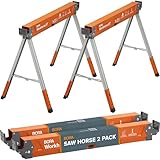


Folding sawhorses compared
These examples use manufacturer-published specifications for recognizable models. Capacities are not always measured or stated the same way: some are per horse and others per pair. Check the current product label and manual before loading a horse, and do not treat a pair’s rating as a safe rating for a single horse.
| Model | Working height | Published capacity | Material and notable features | Storage and best fit |
|---|---|---|---|---|
| STANLEY FatMax Folding Sawhorse (FMST1-75763) | About 31 inches | 1,000 lb per pair | Plastic body, folding legs, carry handle, and integrated material supports | Folds for transport; a practical general-purpose option for a home shop or jobsite |
| Worx Pegasus WX051 | About 32 inches as a sawhorse | 1,000 lb as a worktable; up to 300 lb as a sawhorse | Folding plastic work surface, clamps, and linked units | Folds relatively flat; suits buyers who want a convertible bench as well as a horse |
| DeWalt DWX725 Heavy-Duty Work Stand | About 32 inches | 1,000 lb per stand | Aluminum stand with folding legs and a compact profile | Designed for portable support and compatible tool mounting; check top width and accessory needs |
| Metal folding sawhorse, adjustable-height type | Commonly about 25–36 inches, depending on model | Varies; compare the rating per horse and per pair | Steel or aluminum frame, often with telescoping legs and non-slip feet | Useful when one fixed height will not suit assembly, cutting, and uneven floors; folded bulk varies |
Dimensions and specifications can vary by model version and market. Verify the exact SKU’s manual, particularly when comparing capacity: the Pegasus, for example, has different published limits in worktable and sawhorse configurations.
Choose by the work you do
- For a small shop with limited storage: Prioritize a narrow folded profile, a carry handle, and legs that latch securely. Measure the actual storage gap first; a folded depth that is only a little too large can make a compact-looking pair inconvenient to put away.
- For sheet goods and long boards: Look for a broad, non-slip top and stable feet. Two horses support the ends of a panel, but a third support or sacrificial cutting surface may be needed to prevent sagging or to keep a cut piece from tipping.
- For a multipurpose work surface: A convertible worktable such as the Worx Pegasus can be useful for layout and assembly. Read the separate ratings for table and sawhorse modes; the higher worktable number does not apply to every setup.
- For frequent transport: Favor a manageable weight, a positive leg lock, and a comfortable grip. Aluminum stands can reduce carrying weight, while molded plastic horses may provide a wider top or integrated features. Compare the complete folded package, not material alone.
- For changing tasks or uneven floors: Adjustable legs can help level the work surface, but extra joints and locks require inspection. Use only the adjustment range and locking method specified by the manufacturer.
How to compare the specifications that matter
Working height
Measure from the floor to the top of the horse, then account for anything placed on it. A thick sacrificial board raises a workpiece, and a panel supported on edge can bring the working surface much higher than expected. For a fixed-height pair, mock up the height with stacked boards before buying: stand in your usual working posture and check that the task does not force a prolonged reach or stoop.
Two horses do not automatically make a safe bench. If you add a plywood top, confirm that it cannot slide and that the combined setup is intended for the load. A smooth board resting on narrow plastic rails can shift even when the horse itself is rated for a heavy load.
Capacity and load distribution
Find out whether the rating applies to one horse, a pair, a worktable configuration, or a particular tool stand. Also check whether the load must be evenly distributed. A heavy object concentrated near one end or outside the feet can create a tipping force well below the printed weight limit. The capacity rating is not permission to overload or to stand on the horse.
For a pair, estimate the load each support will carry rather than dividing the project’s weight blindly. Uneven floors, an overhanging workpiece, and force from sawing can put much more load on one horse. Keep feet fully planted and the workpiece centered whenever possible.
Footprint, setup, and folded dimensions
Open footprint matters as much as folded size. A wide stance generally helps resist tipping, but it takes up more aisle space. Check the leg spread and the length of the top against the workpieces you commonly support. For setup, look for legs that open fully and lock without having to hold the frame in an awkward position. Keep fingers clear of hinges and pinch points.
A quick fit check before you buy
- Measure the storage spot. Record the maximum folded height, width, and depth available, including room to pull the horses out.
- Measure a typical workpiece. Note its length and weight, plus where you need clear access for clamps or a saw.
- Set a target working height. Include the thickness of any top or sacrificial material you expect to use.
- Compare capacity on the same basis. Separate per-horse, per-pair, and alternate-configuration ratings before comparing numbers.
- Check stability details. Look for non-slip feet, a secure open-position lock, and a top that supports the work without a narrow contact point.
For example, if a storage nook is 4 inches deep, a horse that folds to 5 inches will not fit just because its legs collapse. And if a planned worktop adds ¾ inch to a 32-inch stand, the surface will sit roughly 32¾ inches high. Those small measurements can settle the choice before a capacity comparison does.
Ownership: what wears and what to check
Folding joints, leg locks, feet, and top surfaces see the most routine wear. Sawdust can collect around hinges and latches, while grit on a foot can reduce its grip or scratch a finished floor. Brush off debris, wipe the contact surfaces, and check that every leg lock engages before use. Replace damaged feet or hardware only with compatible parts where available; do not improvise a repair that changes how the legs lock.
A common mistake is using folding horses as a permanent, unattended storage rack. Long-term loads, uneven weight, and bumps can loosen or shift a setup that was stable during a short task. Store the pair folded and unloaded, and keep them dry if the frame or hardware is susceptible to corrosion. Avoid using a horse with a cracked body, bent leg, loose hinge, or lock that will not hold.
Bottom line
For everyday woodworking, start with a pair near 29–32 inches high, a stable stance, and a capacity rating stated clearly for the configuration you intend to use. Choose a convertible model when its worktable function will see regular use, an adjustable model when variable height solves a real problem, and a compact portable pair when storage or carrying is the main constraint. The best saw horses folding for your shop are the ones that fit your workpieces and storage space without relying on the headline load number alone.