What's inside
- Best portable workbenches for beginners at a glance
- Our picks by situation
- 1. Worx Pegasus WX051: best overall for beginners
- 2. Keter Folding Work Table: best for heavy loads
- 3. BLACK+DECKER Workmate WM225: best compact vise-style bench
- 4. Folding sawhorse-and-top systems: best for large material
- What beginners should look for
- A practical setup procedure
- Ownership realities and common mistakes
- Final verdict
- Best portable workbenches for beginners at a glance
- Our picks by situation
- 1. Worx Pegasus WX051: best overall for beginners
- 2. Keter Folding Work Table: best for heavy loads
- 3. BLACK+DECKER Workmate WM225: best compact vise-style bench
- 4. Folding sawhorse-and-top systems: best for large material
- What beginners should look for
- A practical setup procedure
- Ownership realities and common mistakes
- Final verdict
As an Amazon Associate I earn from qualifying purchases. This post may contain affiliate links at no extra cost to you.
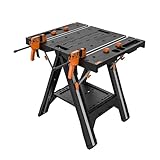
The best portable workbench for beginners is the Worx Pegasus WX051 for most people because it combines simple folding setup, a stable 31 × 25-inch surface, integrated clamping, useful storage, and a manageable weight of about 30 pounds.
That is not the right choice for everyone, though. A Keter Folding Work Table is better when maximum load capacity matters, a BLACK+DECKER Workmate WM225 suits small spaces and light projects, and a folding sawhorse-and-top system is the most flexible option for large sheets of plywood.
As an Amazon Associate we earn from qualifying purchases at no extra cost to you.


Contents
- Best portable workbenches for beginners at a glance
- Our picks by situation
- 1. Worx Pegasus WX051: best overall for beginners
- 2. Keter Folding Work Table: best for heavy loads
- 3. BLACK+DECKER Workmate WM225: best compact vise-style bench
- 4. Folding sawhorse-and-top systems: best for large material
- What beginners should look for
- A practical setup procedure
- Ownership realities and common mistakes
- Final verdict
Best portable workbenches for beginners at a glance
| Workbench | Approx. size | Weight | Rated capacity | Best for |
|---|---|---|---|---|
| Worx Pegasus WX051 | 31 × 25 × 32 inches | About 30 lb | 725 lb as a workbench; 1,000 lb as a sawhorse | Best all-around beginner choice |
| Keter Folding Work Table | About 33.5 × 21.7 × 29.7 inches | About 27.5 lb | Up to 1,000 lb | Heavy-duty projects on a budget |
| BLACK+DECKER Workmate WM225 | About 29 × 8.9 × 29 inches when folded | About 28 lb | Up to 450 lb | Small workshops and basic clamping |
| Folding sawhorse-and-top system | Typically 48–96 inches wide with two supports | About 25–45 lb, depending on model | Usually 600–1,500 lb per pair | Plywood, doors, and long boards |
Dimensions, capacities, and weights can vary slightly by revision and included accessories, so check the current manufacturer specification before buying. Capacity ratings also assume the load is centered, evenly supported, and used on a level surface.
Our picks by situation
| Your situation | Best fit | Why |
|---|---|---|
| First workbench for general DIY | Worx Pegasus | Integrated clamps, built-in shelf, comfortable height, and quick setup |
| Frequent heavy cutting or repair work | Keter Folding Work Table | High stated capacity and a broad plastic work surface |
| Very limited storage space | BLACK+DECKER Workmate WM225 | Folds compactly and functions as both a vise and small bench |
| Occasional large-sheet projects | Folding sawhorse-and-top system | Supports long material better than a compact tabletop bench |
| Uneven garage floor or mixed-height users | Workbench with adjustable legs | Leg adjustment reduces rocking and improves working posture |
1. Worx Pegasus WX051: best overall for beginners
The Pegasus is the easiest recommendation when one portable bench must handle sanding, drilling, assembly, and occasional cutting. Its folding legs open without a complex assembly process, while the integrated clamps hold boards without requiring a separate vise. The included clamping dogs can also be repositioned for different board widths.
The 31 × 25-inch surface is large enough for a cabinet door, small tabletop, or typical repair job without becoming difficult to store. A lower shelf provides a place for a drill, screws, or safety glasses. At roughly 30 pounds, it is portable enough for one person, although carrying it upstairs may be inconvenient.
The main limitation is height. At approximately 32 inches, it is suitable for many seated or general-purpose tasks, but taller users may prefer a taller adjustable bench for long periods of hand-planing. The plastic-and-metal construction is practical rather than furniture-like, and the surface can be marked by aggressive cutting.
2. Keter Folding Work Table: best for heavy loads
The Keter Folding Work Table is a strong choice for beginners who expect to work with heavier assemblies, power tools, or bulky materials. Its manufacturer-listed capacity can reach 1,000 pounds, substantially more than many compact folding benches. The broad molded surface is easy to wipe clean and resists occasional moisture better than an unfinished wood top.
It also folds into a relatively compact case and weighs about 27.5 pounds. That makes it easier to carry than its high capacity might suggest. The removable center divider and clamping accessories are useful for holding work, although the clamping arrangement is less intuitive than a conventional woodworking vise.
Choose it when load capacity matters more than fine woodworking precision. Plastic surfaces can flex slightly under localized pressure, and the relatively low height may not suit every user. Use a sacrificial board when drilling through material so the tabletop is not damaged.
3. BLACK+DECKER Workmate WM225: best compact vise-style bench
The Workmate WM225 is the most useful option when storage space is the deciding factor. Its folding design and split work surface let the two halves move to grip irregular objects, narrow boards, or small assemblies. It behaves more like a portable vise than a large open worktable.
Its stated capacity is up to 450 pounds, which is adequate for many hand-tool and DIY tasks but lower than the heavy-duty alternatives. The smaller surface also means that a large cabinet panel or long board will need additional support.
For beginners, the advantage is control: clamping a board securely before sawing is often more important than having a large tabletop. The disadvantage is that the hand-operated clamping system takes more adjustment, and the work height is not ideal for every task. It is a good second bench for a small apartment, utility room, or workshop where a full-size surface cannot remain set up.
4. Folding sawhorse-and-top systems: best for large material
A pair of folding sawhorses with a plywood or manufactured worktop is the better solution for doors, long boards, trim, and full sheets. The supports fold for storage, while the top can be replaced when it becomes damaged. Some systems include integrated clamps or slots; others rely on separate clamps and a removable top.
This design is less convenient for small parts because it has no built-in vise and may require more setup. It is also easier to make unstable if the top is too narrow, the legs are not fully open, or the supports are placed too close together.
For a beginner, use two supports on a level floor and allow the top to overhang each end by no more than about 12 inches unless the material is also supported elsewhere. A 4 × 8-foot sheet of plywood weighs roughly 50–70 pounds depending on thickness, so plan the lifting and support arrangement before cutting.
What beginners should look for
Simple assembly and setup
A portable bench should unfold quickly and lock positively. Avoid a model that requires rebuilding the frame whenever it is moved. Check that hinges do not bind and that the legs have a clear locking mechanism. A bench that takes five minutes to set up is more likely to be used than one that requires tools and loose hardware every time.
Stable working surface
Look for wide feet, cross-bracing, and a top that does not twist when you apply side pressure. A high load rating does not automatically mean good stability: a bench can support a heavy static object yet wobble when you saw. Push diagonally against the top after setup. Movement usually indicates an unlocked leg, an uneven floor, or insufficient bracing.
Beginner-friendly clamping
Integrated clamps or movable dogs are valuable because they leave both hands available for the tool. Check the maximum clamping width, the number of included clamps, and whether replacement clamps are available. Narrow clamp slots can limit you more than the headline weight capacity.
Manageable weight
For one-person carrying, about 25–35 pounds is a practical range. Heavier benches may feel steadier but become inconvenient to move. If the bench will stay in a garage, favor stability. If it must be carried from a closet to a balcony or driveway, favor a lighter design.
Height and adjustability
Many folding benches are approximately 29–32 inches high. That works for general assembly, but standing users may prefer a surface closer to 34–36 inches. Adjustable legs help on uneven floors and let different users work more comfortably. If the bench is not adjustable, add a stable platform under the feet rather than placing loose blocks beneath the top.
Storage and replacement parts
A shelf, tool tray, or built-in organizer prevents small hardware from ending up on the floor. Also check whether the manufacturer sells replacement clamps, dogs, feet, and work-surface inserts. These inexpensive parts often determine whether a portable bench remains useful after years of use.
A practical setup procedure
- Place the bench on the flattest available area and fully open every leg.
- Engage all locks, then push diagonally on the top to check for rocking.
- Position the work so its center of gravity stays between the legs.
- Clamp the material close to the cutting or drilling point, not only at one distant end.
- Use a sacrificial board beneath material whenever a drill bit or saw may pass through it.
- After the job, brush away chips, wipe off moisture, and fold the bench only when clamps and loose accessories have been removed.
Clamping close to the tool matters because it reduces vibration. For example, if a board is held only at one end, a handsaw can make the unsupported section bounce. A second clamp or support near the cut usually improves accuracy more than buying a bench with a higher load rating.
Ownership realities and common mistakes
The parts most likely to wear first are clamp threads, rubber feet, hinge hardware, and sacrificial work-surface inserts. Keep clamp threads free of sawdust and apply only the lubricant recommended by the manufacturer. Do not overtighten plastic clamps; firm pressure is usually enough to prevent movement.
Never exceed the stated capacity with a concentrated load such as a car jack, an anvil, or a heavy vise bolted to one small area. Do not stand on a folding bench unless it is specifically rated for that purpose. Finally, do not assume a workbench replaces a proper sawhorse: long material needs support beyond the tabletop to prevent tipping and pinching the blade.
Final verdict
Choose the Worx Pegasus WX051 as the best portable workbench for beginners who want one versatile, easy-to-use station. Pick the Keter Folding Work Table for higher loads, the BLACK+DECKER Workmate WM225 for compact vise-style clamping, and a folding sawhorse system when your projects involve plywood, doors, or long boards. The right choice is the one whose size, height, clamps, and weight match how you will actually move and use it.