What's inside
- Quick comparison of portable workbenches under $300
- Best overall: Kreg Mobile Project Center KWS1000
- Best lightweight option: Worx Pegasus WX051
- Best for heavy loads: ToughBuilt C700
- Best low-cost choice: a folding bench with an integrated vise
- Decision matrix: which bench fits your situation?
- Folded size matters more than advertised portability
- Setup and stability: the details that affect real use
- Durability and ownership costs
- Final recommendation
- Quick comparison of portable workbenches under $300
- Best overall: Kreg Mobile Project Center KWS1000
- Best lightweight option: Worx Pegasus WX051
- Best for heavy loads: ToughBuilt C700
- Best low-cost choice: a folding bench with an integrated vise
- Decision matrix: which bench fits your situation?
- Folded size matters more than advertised portability
- Setup and stability: the details that affect real use
- Durability and ownership costs
- Final recommendation
As an Amazon Associate I earn from qualifying purchases. This post may contain affiliate links at no extra cost to you.
The best portable workbench under 300 for most home woodworkers is the Kreg Mobile Project Center KWS1000, while the Worx Pegasus WX051 is the better lightweight choice and the ToughBuilt C700 is the stronger option for heavier, rougher work.
Under-$300 benches differ less in tabletop size than in how they handle real work: whether the folded package fits your vehicle, whether the height suits planing and assembly, how securely the clamps hold irregular stock, and how much setup is required each time. The comparison below focuses on those ownership decisions rather than catalog features alone.
As an Amazon Associate we earn from qualifying purchases at no extra cost to you.


Contents
- Quick comparison of portable workbenches under $300
- Best overall: Kreg Mobile Project Center KWS1000
- Best lightweight option: Worx Pegasus WX051
- Best for heavy loads: ToughBuilt C700
- Best low-cost choice: a folding bench with an integrated vise
- Decision matrix: which bench fits your situation?
- Folded size matters more than advertised portability
- Setup and stability: the details that affect real use
- Durability and ownership costs
- Final recommendation
Quick comparison of portable workbenches under $300
| Model or type | Typical market range | Working height | Weight capacity | Approx. weight | Folded or stored size | Setup time |
|---|---|---|---|---|---|---|
| Kreg Mobile Project Center KWS1000 | $200–$280 | 31 inches | 725 lb | ≈40 lb | About 35 × 23 × 11 inches | About 1–2 minutes |
| Worx Pegasus WX051 | $130–$180 | 32 inches | 300 lb as a worktable; 1,000 lb as a sawhorse | ≈30 lb | About 35 × 25 × 5 inches | Under 1 minute |
| ToughBuilt C700 Sawhorse and Jobsite Table | $150–$250 | About 32 inches | 1,300 lb per pair of sawhorses | ≈25–30 lb per pair | About 40 × 6 × 10 inches per sawhorse | About 1–2 minutes |
| Folding worktable with integrated vise | $70–$150 | 28–32 inches | 200–500 lb | 15–30 lb | Typically 30–36 × 5–10 × 25–35 inches | Under 1 minute |
Dimensions and capacities can vary by revision, accessory package, and seller, so confirm the current specification sheet before buying. A stated sawhorse capacity also does not mean the same bench is suitable for concentrated loads, aggressive hand-planing, or unsupported sheet goods.
Best overall: Kreg Mobile Project Center KWS1000
The Kreg KWS1000 is the most versatile choice when one bench must handle assembly, clamping, light routing, sanding, and occasional outdoor work. Its two-part work surface can be configured as a flat table or separated to hold work between opposing sections. Kreg’s integrated clamping system accepts the included bench dogs and clamp components, while the perforated surface provides more positioning options than a plain folding tabletop.
Its main advantage is not the headline weight capacity; it is the combination of a useful 31-inch height, a substantial work surface, and built-in ways to restrain a board without immediately reaching for a separate vise. At roughly 40 pounds, it is portable but not something most people will casually carry long distances.
Choose it if you frequently switch between projects and want one self-contained station. Avoid it if storage space is extremely limited or if every pound matters when loading a car.
Best lightweight option: Worx Pegasus WX051
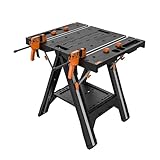
The Worx Pegasus WX051 is a better match for apartment workshops, occasional DIY, and users who carry a bench from a garage to a driveway or jobsite. It folds quickly, weighs around 30 pounds, and includes clamping dogs and integrated clamps. The 32-inch height is comfortable for many assembly and power-tool tasks, though tall users may prefer a taller stand for prolonged hand-planing.
The worktable capacity is commonly specified at 300 pounds, which is ample for cabinetry parts, trim, and most portable-tool setups. Its separate sawhorse rating is much higher, but that rating should not be interpreted as permission to place a concentrated 1,000-pound load on the tabletop. The plastic-and-metal construction keeps weight down, but it is more likely than a heavy steel bench to shift if you push hard laterally without securing its feet.
Choose the Pegasus when fast deployment and easy transport are more important than maximum rigidity.
Best for heavy loads: ToughBuilt C700
The ToughBuilt C700 is fundamentally a pair of folding sawhorses that can also support a temporary work surface. That makes it especially useful for cutting sheet goods, supporting long boards, and creating a large assembly platform from two sawhorses and a sacrificial plywood top.
Its quoted 1,300-pound capacity per pair is impressive, but the practical result depends on the top you add, the spacing between the supports, and how evenly the load is distributed. Unlike a dedicated clamping bench, the C700 does not provide a full integrated grid of dog holes or a built-in vise. You will usually add clamps, a plywood top, or portable hold-down hardware.
For remodelers and woodworkers who often work with long stock, that modularity is an advantage. For small-part joinery, it is less convenient than the Kreg or Worx designs.
Best low-cost choice: a folding bench with an integrated vise
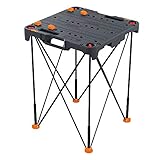
Generic folding benches with a split top and hand-tightened vise are usually the least expensive route. They commonly weigh 15 to 30 pounds, fold nearly flat, and include several bench dogs. Their two-piece top can grip narrow boards and small assemblies better than a plain tabletop.
They are useful for drilling, sanding, carving, and light assembly, but published capacity figures are often less consistent than those of established brands. Flex in the legs and tabletop becomes noticeable during hand-planing or when tightening clamps aggressively. Inspect the hinge locks, leg braces, and dog-hole fit before relying on one for heavy work.
Decision matrix: which bench fits your situation?
| Your situation | Best fit | Why | Compromise |
|---|---|---|---|
| Small home or apartment workshop | Worx Pegasus WX051 | Compact fold, modest weight, quick setup | Less rigid than a heavy fixed bench |
| Frequent mixed woodworking projects | Kreg KWS1000 | Better integrated clamping and versatile surface | Heavier and usually closer to the budget limit |
| Long boards, doors, or sheet goods | ToughBuilt C700 | Two supports create a wide, adaptable platform | Requires a separate top or clamping system |
| Occasional repairs on the lowest budget | Folding bench with vise | Low purchase price and small storage footprint | More movement and lower long-term refinement |
| Hand-planing or chopping joinery | Kreg KWS1000, with added anchoring | Heavier frame and more useful workholding | No portable bench fully replaces a heavy fixed bench |
Folded size matters more than advertised portability
Measure three spaces before ordering: the storage location, the vehicle opening, and the route from storage to the work area. A bench that is 35 inches long but 40 pounds may fit in a closet yet be awkward to carry down stairs. A 30-pound bench with a thin folded profile may be easier to transport, even if its footprint is only slightly smaller.
For car transport, also check whether the folded legs protrude beyond the tabletop. Projecting brackets can catch on other tools and make stacking difficult. If the bench will be carried often, a built-in handle and a balanced center of gravity are worth more than a small difference in folded dimensions.
Setup and stability: the details that affect real use
-
Open every leg completely and confirm that the locking mechanism has engaged. Do not assume a partially opened leg is secure because the bench appears level.
-
Place the feet on a clean, reasonably flat surface. Sawdust under one foot can create rocking, while a sloped driveway can make long stock slide during cutting.
-
Install the workholding hardware before placing the project on the bench. This prevents you from lifting or twisting a partially assembled piece to reach a clamp.
-
For sheet goods or long boards, support the center span or use two sawhorses. A high capacity rating does not prevent a plywood top from bowing between supports.
-
When using a circular saw or router, clamp the work and keep the blade or bit path clear of the bench. Marking a sacrificial top is preferable to cutting into the primary surface.
Durability and ownership costs
On portable benches, the parts most likely to wear first are leg locks, hinge rivets, clamp threads, rubber feet, and plastic bench dogs. Keep folding joints free of packed sawdust and wipe metal hardware dry after outdoor use. Avoid spraying oily lubricant onto surfaces that must grip; a dry lubricant or a small amount applied only to the pivot is usually less messy.
Plan on replacing or supplementing consumables rather than treating the bench as maintenance-free. Extra dogs, replacement clamps, rubber feet, and a sacrificial plywood top can add $20–$60 over the ownership period. A plywood top also spreads loads and protects the factory surface from saw cuts.
One useful cost calculation: if a $160 bench lasts five years and is used twice per month, it costs about $1.33 per use before accessories. A $260 bench used four times per month over the same period costs about $1.08 per use. The more expensive bench can therefore be the better value when its clamping system makes it likely that you will actually set it up instead of working on the floor.
Final recommendation
Buy the Kreg KWS1000 if you want the strongest all-round combination of clamping, versatility, and work height under $300. Pick the Worx Pegasus WX051 when carrying weight and fast storage are your priorities. Choose the ToughBuilt C700 for long or heavy work where a modular pair of supports is more useful than an integrated tabletop. A folding bench with a vise remains sensible for light, infrequent tasks, provided you accept more flex and inspect its locks carefully.