What's inside
As an Amazon Associate I earn from qualifying purchases. This post may contain affiliate links at no extra cost to you.
Contents
Best Herman Miller Chairs for Work and Home
The best Herman Miller chair for most people is the Aeron if its mesh fit suits your body and you want a highly adjustable chair for long workdays; choose the Embody for a more cushioned, flexible-feeling seat, the Sayl for a smaller footprint and lower-cost entry, or the Cosm when you want simple, automatic recline rather than lots of controls.
The right choice depends less on which chair has the most features and more on whether its dimensions match you, how much adjustment you want, and whether the chair must serve a dedicated office or a shared room. The comparison below focuses on those trade-offs. Dimensions are approximate and can vary slightly by configuration; check the current specification for the exact model before ordering.
As an Amazon Associate we earn from qualifying purchases at no extra cost to you.



Quick comparison
| Chair | Approx. dimensions (W × D × H) | Seat height range | Main materials and feel | Best fit and use |
|---|---|---|---|---|
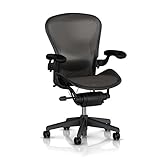
| Aeron | 27 × 27 × 38.5–43 in (size B; varies by size and options) | About 16–20.5 in | Pellicle suspension mesh; firm, ventilated support | Dedicated desk, frequent use, shoppers who want a size-specific fit |
| Embody | 29.5 × 29 × 42–45 in | About 16–20.5 in | Fabric seat over a flexible support structure; padded but responsive | Long desk sessions, varied sitting positions, users who prefer a fabric seat |
| Sayl | 27 × 24.5 × 34.5–38.5 in | About 15.5–20 in | Flexible elastomer back with an upholstered seat | Compact home offices, smaller desks, buyers seeking a simpler entry point |
| Cosm | About 28.5 × 28.5 × 36.5–41 in (mid-back version) | Varies by height option; roughly 16–20 in for mid-height | Suspension mesh; light, continuous feel | Shared work areas or people who want minimal manual adjustment |
These figures are useful for comparing scale, but they are not a substitute for measuring your room or checking a chair’s exact configuration. Arm style, base, back height and size can change the overall dimensions.
Choose by your workspace and sitting habits
- You work at a desk most weekdays and want a structured fit: Start with the Aeron. Its three sizes are a meaningful advantage, but the chair’s fixed frame and firm mesh make it less forgiving if you like to tuck a leg under you or sit cross-legged.
- You move around in your chair or dislike a taut mesh seat: Compare the Embody. Its seat and back are designed to respond as you shift, and the fabric surface feels different from the Aeron’s suspension. It takes more floor space and typically costs more than the simpler options.
- Your office is a bedroom corner or a compact shared room: The Sayl is the most space-conscious pick here. Its back is visually open, and its overall footprint is comparatively small. Confirm that its seat depth and back height feel adequate for your body before choosing it for full-time work.
- Several people use the same chair, or you want fewer controls: Consider the Cosm. Its automatic tilt responds to the sitter rather than relying on a conventional collection of manual tension and recline adjustments. That convenience can be a drawback if you want to fine-tune the feel precisely.
- You need a chair for occasional, shorter sessions: A Sayl or a less fully configured version of a chair may be a more sensible use of budget than paying extra for adjustments you will rarely use. Still, prioritize correct seat height and desk fit.
What the adjustment differences mean in practice
Aeron: choose the right size before the options
The Aeron’s A, B and C sizes are intended to accommodate different body proportions, not simply to represent small, medium and large clothing sizes. Herman Miller’s sizing guidance should be treated as a starting point: height and weight alone do not capture thigh length, hip width or preferred seat depth. A chair that is too large can leave you without good back contact; one that is too small can feel restrictive. If possible, sit in the exact size and arm configuration you plan to buy.
Depending on configuration, Aeron adjustments can include seat height, tilt tension, tilt limiter, arm height and position, and lumbar support options. More controls are useful only when they let you establish a comfortable working position. Start with seat height and arm placement, then tune recline; avoid buying an upgrade simply because it appears more adjustable.
Embody: a larger, more flexible-feeling alternative
Embody is a strong comparison when the Aeron’s mesh seat feels too firm or its frame limits your preferred posture. It offers seat-depth adjustment, back-fit adjustment, tilt controls and adjustable arms, depending on configuration. Its wider overall dimensions can make it a poor match for a cramped desk nook, so measure the chair’s reclined footprint as well as its static width.
Sayl and Cosm: simpler trade-offs
Sayl offers practical adjustments such as seat height and recline control, with additional features depending on the selected version. It does not provide the same sizing range as Aeron, so check seat depth, arm spacing and the height of the back rather than assuming its compact size will suit everyone.
Cosm is the outlier: its main appeal is a responsive recline that reduces the need to adjust tension manually. Different back heights and arm options affect fit and cost. It is convenient in a hot-desk setting, but less compelling if you want precise control over every part of your sitting position.
Measure first: a quick fit check
- Measure your desk height and underside clearance. Make sure the seat can rise high enough for your forearms to reach the work surface without lifting your shoulders, while your feet remain supported. If the desk is unusually high, a footrest may be needed.
- Check seat depth against your legs. When seated with your back against the backrest, look for a small gap between the seat edge and the back of your knees. A seat that presses into the legs or leaves you sliding forward is a poor fit.
- Measure the room around the chair. Allow room to roll back, recline and reach drawers. For a small office, compare the chair’s full width—including arms—with the available opening, not just the seat width.
- Set armrests to your desk. Arms should support relaxed shoulders and should not force you to sit too far away from the desk. If fixed or bulky arms prevent the chair from fitting under your desk, consider another arm configuration or model.
Budget, materials and ownership
Herman Miller chairs are premium-priced. As a broad market guide, new models often fall in the high-hundreds to well over $1,500, with configuration, upholstery, retailer and promotions affecting the final price. Aeron and Embody commonly sit toward the higher end; Sayl is generally the more accessible option. Used prices vary widely with condition, age and warranty status, so compare the savings against the risk of worn parts.
Mesh and suspension surfaces avoid the feel of a thick upholstered cushion, but they are not maintenance-free. Keep them clear of sharp objects, vacuum dust from crevices, and follow the maker’s cleaning instructions rather than using harsh solvents. On upholstered seats, inspect seams and fabric for wear. With any chair, arm pads, casters and adjustment mechanisms are parts worth checking on a used purchase; confirm that the chair holds its height and reclines smoothly, and ask for its age and service history.
Before buying refurbished or second-hand, verify that the chair is authentic, that all adjustments work, and whether any remaining warranty transfers. A low price is less attractive if the chair needs replacement parts or does not fit. For new purchases, compare the warranty terms and return policy for the exact seller and configuration.
Bottom line
Choose Aeron when its size-specific, breathable mesh fit and broad adjustment options match your body and work routine. Choose Embody when you want a fabric seat and a more flexible feel and have room for its larger frame. Choose Sayl for a compact workspace and a lower-cost route into the range. Choose Cosm when easy, shared use matters more than manual fine-tuning. The best Herman Miller chair is the one that fits your body, desk and habits—not necessarily the one with the longest feature list.