What's inside
As an Amazon Associate I earn from qualifying purchases. This post may contain affiliate links at no extra cost to you.
Contents
Best Motorcycle Lifts: Choose by Bike, Workspace, and Service Needs
The best motorcycle lift for most home mechanics is a stable, wide-platform hydraulic lift rated comfortably above the bike’s weight; choose a table lift for full-wheel access and a compact scissor lift for occasional jobs or tight storage. Before buying, check the lift’s usable platform dimensions, lowest and highest positions, wheel restraint, and how you will secure the motorcycle once it is raised.
Quick comparison: common lift types
Specifications vary by model, so treat these figures as representative ranges to compare against the manufacturer’s current manual. Capacity is the lift’s rated load, not a substitute for checking where the load can safely sit on the platform.
As an Amazon Associate we earn from qualifying purchases at no extra cost to you.


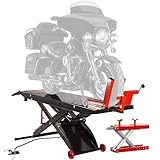

| Lift type | Typical rated capacity | Typical platform size | Typical lift height | Storage footprint | Best suited to |
|---|---|---|---|---|---|
| Hydraulic table lift | 1,000–1,500 lb | About 24–30 in wide × 80–90 in long | About 7–8 in minimum; 30–33 in maximum | Large; often roughly 30 × 90 in before allowance for a ramp | Regular maintenance, cruisers, touring bikes, and access to both wheels |
| Compact scissor lift | 1,000–1,500 lb | About 14–18 in wide × 14–20 in long | About 3–5 in minimum; 14–17 in maximum | Small; many fit under a bench or on a shelf | Sport bikes, dirt bikes, and occasional wheel or under-bike work |
| Air-over-hydraulic table lift | About 1,000–1,500 lb | About 24–30 in wide × 80–90 in long | About 7–8 in minimum; 30–33 in maximum | Large; also requires a suitable air supply | Frequent lifting where compressed air is already available |
| Center-stand or frame lift | Often 500–1,000 lb | Compact contact pads rather than a full deck | Varies; commonly raises one end or the frame by several inches | Small | Targeted wheel, chain, or suspension work on compatible bikes |
Choose the lift that fits your work
For a heavy cruiser or frequent maintenance: a full table lift
A table gives the broadest support and makes it easier to position a wheel chock and tie-downs. It is the practical choice for oil service, brake work, detailing, and jobs that need the motorcycle held at working height. A 1,000-pound rating may be enough for many motorcycles, but leave a sensible margin over the bike’s ready-to-ride weight and account for accessories or cargo. If the bike approaches the rating, select a higher-capacity model rather than relying on the limit.
Platform length matters as much as capacity. Measure the motorcycle from tire contact point to tire contact point, then check the lift’s usable deck—not just its overall length. A long touring bike may fit on a standard table but leave little room for a ramp, chock, or secure tie-down angles. Width also affects how confidently you can roll the bike onto the deck.
For limited garage space or occasional jobs: a scissor lift
A compact scissor lift stores easily and costs less than many full tables. It can raise a compatible motorcycle for tire, chain, and underbody work, but it supports the bike at a small area rather than along a deck. Confirm the frame or lifting points on your motorcycle are suitable, and use the manufacturer’s specified adapters. A scissor lift is not automatically appropriate for every frame or exhaust layout.
Check minimum height before buying. A lift that starts too high may not fit beneath a low sport bike or a motorcycle with little ground clearance. Check maximum height against the job: extra height is useful only if the lift stays stable and the motorcycle can be restrained safely at that position.
For a wheel-specific task: a compatible center or frame lift
These lifts take little space and can be convenient for chain lubrication or raising one end. Compatibility is the deciding factor: frame geometry, exhaust routing, and weight distribution differ between motorcycles. Read the fitment guidance and do not assume a generic lift will contact a safe, level point.
What to check before you buy
- Capacity and load position: Compare the rating with the motorcycle’s weight and follow the manual’s instructions for centering it. Capacity alone does not guarantee stability if the load is off-center.
- Deck dimensions: Measure the bike and the available garage floor. Leave room to approach the lift, operate the pump, attach straps, and lower the ramp.
- Height range: The minimum must clear the bike’s ground clearance; the maximum should suit your working posture without tempting you to work beyond the lift’s safe range.
- Wheel locking: A front wheel chock helps keep the motorcycle upright while it is rolled onto a table. Look for a clamp that accommodates your tire width and can be adjusted or removed for wheel access.
- Positive restraint: A chock is not a substitute for tie-downs. Use rated straps at suitable points, and keep the motorcycle secured before lifting or working on it.
- Stability and locks: Prefer a rigid frame, a broad base, and a mechanical safety lock or bar that supports the platform at height. Hydraulic pressure alone should not be the only thing holding a raised load.
- Storage and mobility: Check folded height, stored dimensions, and whether casters are intended only for moving an unloaded lift. A table can occupy nearly a full motorcycle-length of floor space.
A practical fit-and-capacity check
Suppose a motorcycle weighs 720 lb and you are considering a 1,000-lb table. The nominal capacity margin is 280 lb, or about 39% of the bike’s weight. That is a useful screening check, not permission to exceed the manufacturer’s limits or place the load unevenly. Next, compare the bike’s tire-to-tire span with the usable deck length. If the lift is 84 inches long and the measured span is 74 inches, the remaining 10 inches must accommodate positioning—not necessarily a full-size ramp or extra clearance at both ends.
Finally, check the floor and access route. The lift, motorcycle, and mechanic create a substantial concentrated load; use a sound, level surface and follow the lift maker’s floor requirements. If the motorcycle cannot be rolled onto the deck under control, get help rather than trying to balance it while managing a narrow ramp.
Ownership: the parts and habits that matter
On hydraulic models, seals, hoses, release valves, and pump components are the parts to monitor for leaks, slow descent, or inconsistent lifting. Keep the mechanism clean, use only the fluid specified by the manufacturer, and inspect for damage before each use. On all lift types, check welds, pivots, fasteners, lock engagement, and wheel-chock hardware. Replace worn straps rather than trusting frayed webbing.
Common avoidable problems include lifting with the bike off-center, raising it before the chock is secured, using a table on an uneven surface, and relying on hydraulic pressure without engaging the mechanical safety lock. Lower the platform fully before moving or storing it unless the manual specifically permits another procedure. Keep the lift dry and protect exposed metal from corrosion; dirt and grit around moving joints accelerate wear.
Best choice by situation
| Your situation | Best fit | Why |
|---|---|---|
| Weekly servicing and a dedicated garage bay | Hydraulic table lift with chock and mechanical lock | Broad support, useful working height, and easier access for varied jobs |
| One lightweight bike and very little storage space | Compact scissor lift matched to the bike’s lifting points | Small footprint and lower cost, with less convenience for rolling the bike on |
| Heavy touring motorcycle | Higher-capacity table lift with a long, wide usable deck | More room for the bike and restraint; verify the rating and dimensions carefully |
| Occasional chain or wheel work | Compatible center or frame lift | Compact and task-focused, provided the motorcycle is designed for its contact points |
Bottom line
For a home shop with room and regular maintenance needs, a stable hydraulic table lift with a suitable wheel chock, tie-down points, and mechanical safety lock is the most versatile choice. Choose a compact scissor lift when storage is the priority, and a center lift only when its contact points suit your motorcycle. In every case, verify the actual dimensions and operating instructions for the specific model before buying.