What's inside
As an Amazon Associate I earn from qualifying purchases. This post may contain affiliate links at no extra cost to you.
The best reflow ovens for most hobbyists are a profile-controlled convection oven with at least 200 × 200 mm of usable tray space, while small-batch producers should step up to a larger, multi-zone machine with a documented temperature curve and better uniformity.
As an Amazon Associate we earn from qualifying purchases at no extra cost to you.


Contents
Quick picks by situation
| Situation | Best fit | Why | Typical market range |
|---|---|---|---|
| Occasional hobby assembly | Modified convection toaster oven with controller | Low cost, adequate for small boards, easy to repair | $150–$400 |
| Regular prototyping | Puhui T-962 or similar programmable desktop oven | Compact chamber and built-in profiles | $300–$600 |
| Larger hobby boards or several boards per run | Puhui T-962A or similar larger chamber oven | More tray area without industrial pricing | $500–$900 |
| Small-batch production | NeoDen IN6 or comparable six-zone convection oven | Better thermal control, throughput, and repeatability | $2,000–$4,000 |
What matters more than the maximum temperature
Nearly every modern reflow oven reaches temperatures suitable for lead-free solder. The harder problem is following the complete profile: controlled preheat, a gradual soak, time above liquidus, and a reasonably quick but controlled cool-down.
Look for these specifications rather than focusing only on a headline temperature:
- Usable chamber area: Measure the tray or rack, not the outside dimensions. Allow clearance around the board so hot air can circulate.
- Profile control: A programmable oven should let you set multiple temperature stages and dwell times. Preset profiles are useful, but adjustable profiles are essential when changing solder paste or board thickness.
- Temperature measurement: A thermocouple attached to the board is more useful than relying on the oven’s air-temperature display.
- Heating method: Convection generally gives more even heating than exposed radiant elements, particularly for boards with large ground planes or mixed component sizes.
- Cooling: A fan-assisted cool-down reduces the time the assembly remains hot and helps make repeated cycles more consistent.
- Ventilation: Solder flux fumes should be exhausted or filtered. An oven used for soldering should not also be used for food.
Head-to-head: the main oven types
Modified convection toaster ovens
A converted toaster oven can be the best value for low-volume assembly. A temperature controller, solid-state relay, thermocouple, and suitable wiring can transform a basic oven into a useful reflow tool. Many makers use open-source controllers or dedicated kits, but the quality of the conversion depends heavily on wiring, insulation, sensor placement, and electrical safety.
The main limitation is uneven heating. Small ovens often have hot spots near the elements, while inexpensive thermostats may overshoot substantially. Expect a practical board area around 150 × 200 mm unless the oven has a larger interior.
Choose this route if you enjoy building and calibrating equipment, use the oven only a few times per month, and want the lowest ownership cost. Do not choose it if you need predictable production output immediately.
Puhui T-962
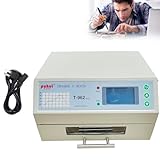
The Puhui T-962 is a compact, commonly encountered desktop reflow oven aimed at hobby and prototype work. Its usable area is approximately 180 × 235 mm, with a power rating commonly listed around 800 W. It uses infrared heating with forced-air circulation and stores programmable temperature profiles.
Its compact footprint makes it suitable for a small workshop, but the limited tray area can be restrictive. A typical two-layer prototype board may fit comfortably; a large development board, panelized design, or several boards at once may not. Temperature uniformity can also vary across the chamber, so profiling the actual board is important.
It is a sensible choice when space and budget matter more than throughput. Inspect the electrical safety and temperature-control implementation of the particular unit before use, since versions and revisions can differ.
Puhui T-962A
The T-962A provides a larger working chamber than the smaller T-962, commonly listed at approximately 300 × 320 mm of usable area and around 1,500 W of heating power. That extra space is valuable for larger boards and small panels, but it does not automatically guarantee uniform temperature across the whole tray.
This model suits a serious hobbyist or design office that runs several prototype cycles each month. Buy it when your boards no longer fit comfortably in a compact oven, but you do not need the workflow, conveyor equipment, or capital cost of a production machine.
NeoDen IN6
The NeoDen IN6 is a larger convection-style desktop reflow oven designed for more repeatable small-batch assembly. Published specifications commonly give a working area of about 395 × 245 mm, six heating zones, and roughly 3,000 W of power. Its larger chamber and multi-zone control make it better suited to panelized boards and regular daily use than compact hobby ovens.
The trade-offs are size, weight, electrical demand, and price. A machine in this class may weigh around 50 kg, so it needs a stable bench and a suitable circuit. It is usually excessive for a few boards per month, but the extra control can pay off when failed assemblies and operator time become more expensive than the oven.
Decision matrix: match the oven to your workflow
| Use pattern | Minimum useful chamber | Recommended control | Practical choice |
|---|---|---|---|
| 1–5 small boards monthly | 150 × 200 mm | Basic programmable profile plus thermocouple | Converted oven or compact desktop oven |
| Several prototype runs monthly | 200 × 250 mm | At least four profile stages and recorded temperatures | Puhui T-962 or larger equivalent |
| Large boards or small panels | 300 × 300 mm | Convection, adjustable zones, fan cooling | Puhui T-962A class |
| Daily or weekly small-batch production | 395 × 245 mm or more | Six-zone control and repeatable recipes | NeoDen IN6 class |
Worked sizing example
Suppose your PCB measures 160 × 100 mm and you want to reflow four boards at once. With a 10 mm air gap between boards and around 20 mm clearance at the tray edges, the required tray width is approximately:
2 × 160 mm + 10 mm = 330 mm
The required tray depth is:
2 × 100 mm + 10 mm = 210 mm
In practice, allow additional edge clearance and room for a thermocouple lead. A nominal 330 × 210 mm minimum is therefore marginal; a tray around 350 × 250 mm is a more comfortable target. This is why a compact 180 × 235 mm oven may be adequate for one board but unsuitable for a four-board batch.
How to set up and verify a reflow profile
- Start with the solder-paste manufacturer’s profile. Note the recommended ramp rate, soak range, peak temperature, and time above liquidus.
- Attach a thermocouple to the board. Use high-temperature tape or solder so the sensor tip contacts the board near a large thermal mass, such as a ground plane or connector pad.
- Run an empty or sacrificial cycle. Confirm that the oven heats, cools, and vents correctly before risking a populated board.
- Record the board temperature. Compare the measured curve with the paste specification. The display temperature alone can be substantially different from the PCB temperature.
- Adjust one variable at a time. If the ramp is too steep, reduce the setpoint or heating rate. If the peak is too low, increase the peak stage gradually rather than dramatically raising every stage.
- Inspect the result. Look for incomplete wetting, tombstoning, solder balls, bridges, and overheated plastic parts. Re-profile after changing board size, paste, or loading pattern.
Ownership realities and common mistakes
The first parts to wear are usually door seals, cooling fans, thermocouples, relays, and heating elements. Flux residue accumulates on chamber surfaces and can produce more smoke over time. Clean cooled surfaces with an appropriate non-abrasive method, and avoid contaminating the chamber with food, grease, or ordinary household cleaners.
- Do not overload the tray; crowded boards block airflow and create cold spots.
- Do not place boards directly against heating elements.
- Do not assume a factory preset matches every lead-free paste.
- Do not open the door repeatedly during peak reflow, since the temperature can collapse unevenly.
- Do not operate a converted oven without inspecting grounding, insulation, strain relief, and enclosure protection.
- Keep solder paste refrigerated according to its data sheet, then allow it to reach room temperature before printing.
Bottom line
For occasional, low-cost prototyping, a properly converted convection oven or compact Puhui T-962-class machine is usually enough. The Puhui T-962A is a better middle ground when board size and batch quantity are growing. For frequent assembly, larger panels, and repeatable small-batch work, the NeoDen IN6 class is the stronger choice because its chamber size and multi-zone convection reduce thermal compromises. Whatever you buy, verify the temperature at the PCB—not just on the front-panel display—and size the chamber for your largest realistic batch rather than your smallest board.