What's inside
- Quick picks by room and use
- What to decide before comparing cabinets
- Best display cabinet designs for different rooms
- Noise, glass, and energy use are room-selection issues
- Decision matrix: match the cabinet to your priorities
- Fit the cabinet safely before ordering
- Ownership realities: what wears first
- Bottom line
As an Amazon Associate I earn from qualifying purchases. This post may contain affiliate links at no extra cost to you.
The best wine display cabinets are the ones that fit your room first, then match your bottle count, serving habits, temperature requirements, noise tolerance, and need for glass protection.
Contents
- Quick picks by room and use
- What to decide before comparing cabinets
- Best display cabinet designs for different rooms
- Noise, glass, and energy use are room-selection issues
- Decision matrix: match the cabinet to your priorities
- Fit the cabinet safely before ordering
- Ownership realities: what wears first
- Bottom line
Our Top Picks
 Loomie Wine Bar Cabinet with LED Lighted Liquor47.24" W x 15.7" D x 42.2" H15.7 x 47.24 x 42.2 Inches100 PoundsCheck on Amazon
 Loomie 70" Corner Bar Cabinet with LED Lights18.9"D x 26.8"W x 69.6"H18.9 x 26.8 x 69.6 inches74.34 PoundsCheck on Amazon
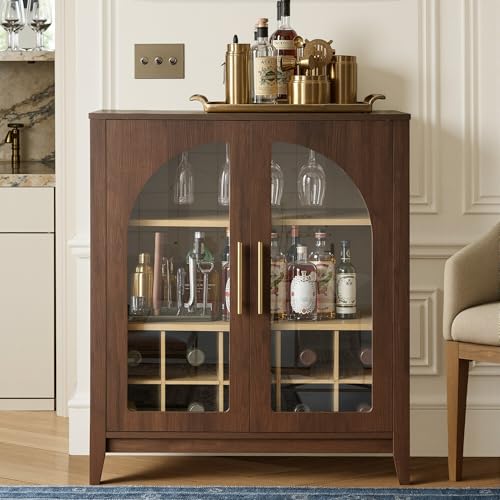 FORTUNETEC 31.5" Coffee Bar Cabinet Arched Glass Doors15.7 x 31.5 x 37.4 inches97.12 poundsCheck on Amazon
 PAOFIN 75" H Locking Display Cabinet with Glass75"15.7 x 31.5 x 74.8 Inches101 PoundsCheck on Amazon
Quick picks by room and use
| Situation | Best cabinet type | Useful target specification | Why it fits |
|---|---|---|---|
| Small kitchen, apartment, or office | Freestanding compact cabinet | 12–24 bottles; 45–55 cm wide; under 42 dB | Uses little floor space and can sit under a counter or against a wall |
| Dining room display | Glass-door furniture-style cabinet | 30–50 bottles; 60–75 cm wide; UV-resistant glass | Shows labels clearly while providing more visual presence |
| Mixed red and white collection | Dual-zone cabinet | 30–50 bottles; zones adjustable to about 7–18°C | Allows whites to be served cooler than reds |
| Large collection or entertaining | Full-height cabinet or wine cooler | 80–180 bottles; 60–70 cm wide; front ventilation | Provides capacity without scattering bottles around the house |
| Long-term storage | Cellar-style, single-temperature cabinet | 40–200 bottles; stable 10–14°C; humidity-conscious design | Fewer temperature transitions and usually better storage efficiency |
What to decide before comparing cabinets
Capacity: count usable spaces, not the headline number
Manufacturers commonly calculate capacity using standard Bordeaux bottles arranged tightly on fixed shelves. Burgundy bottles, sparkling bottles, magnums, and unusually tall bottles occupy more room. A cabinet advertised for 50 bottles may hold closer to 35–42 mixed bottles once shelves are spaced for real-world use.
As an Amazon Associate we earn from qualifying purchases at no extra cost to you.


A practical allowance is 20% spare capacity. If you currently own 32 bottles and expect to buy a few each month, a nominal 40-bottle cabinet is a safer starting point than a 32-bottle model. Use this calculation:
Required advertised capacity = current bottles × 1.2 + expected additions before your next upgrade.
For example, 32 bottles plus 10 bottles expected over the next year gives 32 × 1.2 + 10 = 48.4, so look at cabinets rated for approximately 50–60 bottles.
Bottle orientation: display versus storage
Horizontal shelves make labels easy to see and keep traditional cork closures from drying during longer storage. They also waste less vertical space when bottles are uniform. Angled presentation shelves create a more attractive display, but they reduce capacity and can make heavier bottles slide forward.
Standing bottles are convenient for short-term serving storage, particularly for screw-capped wine, but they are not the most space-efficient arrangement. A cabinet with removable shelves is more flexible than one with permanently fixed ledges. Check the shelf depth as well as the count: a narrow shelf may not safely support broad sparkling-wine bottles.
Single zone or dual zone?
A single-zone cabinet is usually the better choice for a collection stored at one consistent temperature. It is simpler, often quieter, and gives more usable space. A cellar-style setting around 10–14°C suits general wine storage, while serving temperatures can be adjusted temporarily with an ice bucket or refrigerator.
Choose dual-zone when you regularly keep both reds and whites ready to serve. Typical usable ranges are approximately 7–12°C in the cooler section and 12–18°C in the warmer section, though the exact range depends on the cabinet and room temperature. Dual-zone models often sacrifice capacity because each compartment needs its own airflow path and controls.
Do not assume two temperature displays mean two equally capable zones. Look for the minimum and maximum temperature of each zone, the minimum number of bottles per compartment, and whether both zones remain stable when the room is warm.
Best display cabinet designs for different rooms
Kitchen or compact apartment
A 12–24-bottle freestanding unit is usually the least disruptive option. Measure the available width, depth, and height, then reserve ventilation space specified by the manufacturer. A cabinet that is 45 cm wide may need several additional centimetres at the sides or rear, depending on its cooling system.
For a kitchen, front-venting models are easier to integrate beneath counters, but they still need a level floor and unobstructed grille. Avoid placing a wine cabinet directly beside a cooker, radiator, dishwasher exhaust, or sunny window; heat makes the compressor run longer and increases noise.
Dining room or living room
Choose a furniture-style cabinet with a framed door, adjustable shelves, and lighting that can be switched off. A black, stainless-steel, or wood-trimmed exterior can look intentional rather than appliance-like. Glass protection matters more here because the cabinet will receive daylight and room lighting.
Look for double- or triple-layer glass, a UV-resistant coating, and a door seal that closes evenly. Tinted glass reduces light exposure, but it does not make a cabinet suitable for direct sun. Leave a little visual clearance around the unit; an oversized cabinet squeezed between furniture can make door access and cleaning awkward.
Home bar, cellar, or entertaining area
A full-height cabinet is efficient when you have a dedicated wall. Models holding 80–180 bottles commonly approach the width of a narrow refrigerator and may weigh 50–100 kg when empty, so confirm that the floor can support the loaded unit and that it can pass through doorways and around stair corners.
For frequent entertaining, prioritize pull-out shelves, bright but switchable interior lighting, and a clear front display row. If the cabinet will be built into cabinetry, use a model specifically designed for built-in installation. A freestanding unit placed inside a tight alcove can overheat if its exhaust cannot escape.
Noise, glass, and energy use are room-selection issues
Noise is easy to overlook in a showroom. A rating around 36–40 dB is generally more suitable for a bedroom, study, or open-plan living space than a unit rated around 44–48 dB. Compressor cabinets cycle on and off, so a quiet average rating does not eliminate every startup sound. Thermoelectric cabinets can be quiet and compact, but their cooling performance is more dependent on room temperature and they are usually better for smaller capacities.
Glass doors protect against dust and make labels visible, but they can reduce insulation compared with solid doors. Double glazing is a useful minimum for a display cabinet; low-emissivity or UV-resistant glass is preferable where daylight is unavoidable. Keep the interior light off when the cabinet is not being shown.
Energy use varies substantially by size, insulation, ambient temperature, and door opening frequency. Compare the annual energy figure on the product label rather than assuming a smaller cabinet always costs less. A dual-zone cabinet may use more electricity than a larger single-zone model because it has additional controls and cooling demands.
Decision matrix: match the cabinet to your priorities
| Your priority | Recommended choice | Trade-off to accept |
|---|---|---|
| Lowest purchase cost | Compact single-zone thermoelectric or basic compressor cabinet | Less capacity, weaker performance in warm rooms, or fewer shelf adjustments |
| Quiet operation near seating | Cabinet rated at 40 dB or below, with vibration-isolated compressor mounting | Usually a higher price and slower recovery after frequent door opening |
| Best label visibility | Front-facing shelves, interior lighting, and clear double-glazed door | Less dense storage than bottle-neck or stacked arrangements |
| Mixed wine ready to serve | Dual-zone compressor cabinet | Reduced usable capacity and potentially higher noise |
| Long-term collection storage | Stable single-zone cellar cabinet with solid insulation and alarm functions | Less dramatic display and possibly a larger footprint |
| Frequent entertaining | Pull-out shelves, wide temperature controls, and at least 20% spare capacity | Greater depth and a higher loaded weight |
Fit the cabinet safely before ordering
Measure the complete route, not just the final location. Record doorway width, stair turns, lift dimensions, and the height needed to tilt the cabinet if it must be moved upright. At the destination, measure width, depth, ceiling clearance, and the distance needed to open the door at least 90 degrees.
For a built-in location, also measure the ventilation path. Front-venting is essential unless the manufacturer explicitly permits rear or side clearance inside cabinetry. A cabinet that fits the opening but cannot release heat will run continuously, consume more electricity, and may fail prematurely.
Place the cabinet on a hard, level surface. Adjust the feet so the door seals evenly and bottles cannot roll toward the front. After installation, let a compressor cabinet stand upright for the period specified in its manual before switching it on, particularly if it was transported at an angle.
Ownership realities: what wears first
- Door seals: Dust and spills can prevent a tight seal. Wipe the gasket with mild soapy water and check that it springs back without gaps.
- Shelves and runners: Overloading pull-out shelves bends runners and makes bottles difficult to retrieve. Observe the shelf weight limit, especially with full sparkling bottles.
- Filters and ventilation grilles: Dust restricts airflow. Vacuum external grilles several times a year, more often in kitchens or homes with pets.
- Interior surfaces: Clean spills promptly with a lightly damp cloth. Avoid abrasive cleaners and excessive water around controls and fans.
- Temperature sensors: Do not block them with bottles. A tightly packed cabinet can display an apparently correct reading while parts of the compartment cool unevenly.
- Vibration: Keep the unit stable and do not place objects on top that rattle when the compressor starts.
Common mistakes include filling the cabinet immediately with warm bottles, setting the temperature far below the recommended range, blocking the exhaust, and opening the door repeatedly while the unit is recovering. Allow several hours for the internal temperature to settle before judging performance.
Bottom line
For most homes, the best wine display cabinets are adjustable-shelf compressor models with double-glazed UV-resistant doors, a noise rating near 40 dB or below, and at least 20% more nominal capacity than your present collection requires. Pick single-zone for stable storage and simplicity; choose dual-zone only when serving two temperature groups at the same time matters. The right cabinet is not the one with the largest bottle count—it is the one that leaves adequate ventilation, opens comfortably, protects the wine from light and vibration, and fits the way your room is actually used.