Our Top Picks
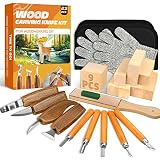
 Wood Carving Kit Whittling Kit: Wood Carving KnifeWiddle Kit6 x 4 x 8 inches2.3 PoundsCheck on Amazon


What's inside
As an Amazon Associate I earn from qualifying purchases. This post may contain affiliate links at no extra cost to you.
For a beginner who wants to try more than one style of carving, the SakerNeo 25-piece kit is the broadest pick because its listing includes gouges and chisels as well as knives, all in a leather storage bag. If you would rather start with knives only, the 32-piece and 23-piece kits supply a large knife selection, and the 24-piece kit adds templates and basswood blocks. A wood carving tool set bundles the edge tools, a storage case and usually some practice wood so a newcomer can shape, hollow and detail a piece without buying each tool separately.
Contents
Quick List
- 23-Piece Kit with 4 Carving and 5 Detail Knives – best for lots of knife variety plus nine practice blocks
- 24-Piece Kit with Templates and Blocks – best for following patterns on included basswood
- Leather-Case Deluxe Carving Kit – best for a neat, giftable set that stores in one case
- 32-Piece Kit with 11 Carving Knives – best for the biggest knife selection and templates
- Kids’ Round-Tip Whittling Kit – best for supervised young beginners (a runner-up for adults)
- SakerNeo 25-Piece Carving Kit – best for mixing gouges, chisels and knives
Which One Is Right for You?
| If you… | Choose |
|---|---|
| want to try knives, gouges and chisels in one go | SakerNeo 25-piece kit |
| want many blades and plenty of practice wood | 23-piece kit with 9 blocks |
| learn best by following a pattern | 24-piece kit with templates |
| want one big knife collection and templates in a bag | 32-piece kit with 11 knives |
| need a presentable gift in a case | Leather-case deluxe kit |
| are buying for a child under adult supervision | Kids’ round-tip kit |
The common mistake with beginner sets is chasing the piece count. A bigger number often includes blocks, templates and accessories, so look at the count of actual cutting tools, and check which of them match the projects you plan to make.
All 6 Picks in Detail
1. 23-Piece Kit with Four Carving Knives, Five Detail Knives and Nine Blocks – Best for Knife Variety
As an Amazon Associate we earn from qualifying purchases at no extra cost to you.

This listing puts the emphasis on knives and practice material. It names four wood carving knives, five detail knives and nine blocks, which together make up most of the 23 pieces. That is a useful ratio for a beginner who wants to learn how different blade shapes feel without consuming good lumber. The kit is marketed as a whittling kit for adult hobbyists.
- 23 pieces, per the listing name
- Four carving knives and five detail knives
- Nine blocks for practice
- Whittling kit for adults, per the listing
- Steel type, handles and remaining pieces: confirm on listing
Pros
- Nine blocks give you plenty of material to practice on
- Several knife shapes help you learn which cuts you prefer
- Focused on knives, so less to manage than a mixed tool kit
Cons
- No gouges or chisels are named, so deep hollows are limited
- Storage and sharpening supplies are not stated in the listing name
Against the 32-piece kit, it has fewer knives but gives you more blocks to practice on.
A good way to use a knife-heavy kit is to dedicate one block to each knife. Make a few cuts with every blade, label the block with the knife and notice how the shape changes the stroke. After nine blocks, you will know which knives you reach for and which are redundant.
Before you commit, check how the blocks are sized. Small blocks are ideal for tiny figures but frustrating if you want to carve something hand-sized, so measure the dimensions against the projects you imagine. If the listing is silent, plan on buying a few extra basswood blanks in a size you prefer. Also keep the packaging notes about what is a knife and what is an accessory, so you know what to maintain.
2. 24-Piece Kit with Templates and Basswood Blocks – Best for Pattern-Led Learning

This kit supplies a storage bag, four templates and six basswood blocks alongside the carving tools. The templates matter more than they seem: they give a beginner a shape to aim for, which removes the blank-block problem and shows how much wood to remove at each stage. The listing describes it as a whittling and carving kit for DIY beginners.
- 24 pieces, per the listing name
- Storage bag
- Four templates
- Six basswood blocks
- Knife and tool breakdown: confirm on listing
Pros
- Templates give clear first projects
- Basswood suits learning
- Bag stores the tools together
Cons
- Number of true cutting tools is not stated in the listing name
- Six blocks run out fast if you practice often
It is the pattern-first alternative to the 23-piece kit, which hands you more blocks and no stated templates.
Trace a template onto a block with pencil, then cut away the waste in stages: rough out the outline first, then round the edges, then add detail. Stop frequently to look at the piece from all sides. The templates are most helpful on the first two or three blocks; after that, try drawing your own simple outlines.
The templates in a kit like this are best treated as training wheels. Use them for the first handful of pieces, then try modifying one: make the beak longer, the ears smaller, the base wider. Altering a known shape builds design confidence without the risk of an entirely open-ended project, and you will quickly develop an eye for proportion that the printed outlines cannot teach.
3. Leather-Case Deluxe Carving Kit – Best for a Giftable Set

This listing presents a deluxe woodworking hobby kit with a leather case for beginners, adults and kids. It is the presentation pick: a single case, a set of knives and tools, and wording aimed at relaxation and hobby use. It suits someone who wants a neat package to give or to keep on a shelf.
- Leather case
- Whittling kit with carving knife tools
- Marketed to beginners, adults and kids
- Deluxe hobby kit positioning
- Tool count and steel type: confirm on listing
Pros
- Case keeps tools protected and organized
- Broad appeal as a gift
- Compact enough for travel
Cons
- The exact tools are not clear from the listing name
- May not include practice wood
Compared with the 24-piece kit, it spends its effort on presentation rather than included wood and templates.
Because it is marketed to all ages, use it as you would any real edge tool: sit at a table, wear a cut-resistant glove on the holding hand and keep onlookers clear. If you are gifting it, add a pack of basswood and a glove so the recipient can start right away.
When choosing between deluxe-looking kits, pay attention to how the case closes and whether tools are held in separate slots. Tools that rattle against each other lose their edges, so a case with individual loops or sleeves is worth more than a decorative finish. If your kit lacks a strop, add one at the start, since it is the most useful accessory in a beginner carving routine.
4. 32-Piece Kit with Eleven Carving Knives – Best for the Largest Knife Selection

With eleven carving knives and four templates inside a storage bag, this is the largest knife collection in the group. It suits a hobbyist who wants to experiment widely and does not mind sorting through a lot of blades. The 32-piece count includes accessories, so treat it as a knife-heavy bundle rather than 32 cutting tools.
- 32 pieces, per the listing name
- Eleven wood carving knives
- Four templates
- Storage bag
- Steel, handle and blade details: confirm on listing
Pros
- Large selection of blade shapes
- Templates help with first projects
- Single bag for storage
Cons
- Many knives may be redundant for a beginner
- More tools to keep sharp
Choose it over the 23-piece kit if you want a wider blade range and templates; choose the 23-piece if you prefer more practice blocks.
The easiest way to manage an eleven-knife set is to pick three to start: a larger knife for roughing, a mid-size for shaping and a small one for details. Leave the others in the bag until you have a project that calls for them. This keeps sharpening manageable and avoids the confusion of too many choices.
Large kits make sense when you are not sure which style you will like, but resist the urge to use every knife in the first week. Sort them by blade length, keep the smallest for detail work and put away any that feel awkward in your hand. If you discover that you always reach for the same two knives, that tells you what to buy in a higher-quality version later.
5. Kids’ Round-Tip Whittling Kit – Best for Supervised Young Beginners (Runner-Up)

This kit is built for children, not for adult beginners, and it should be treated as a runner-up for this guide. The listing describes a round-tip knife set with a storage bag, supervised starter projects, cut-resistant gloves and tape. Round tips reduce the chance of puncture, and the included gloves reflect that the kit is designed to be used with an adult nearby.
- Round-tip knife set
- Storage bag
- Cut-resistant gloves and tape, per the listing
- Supervised starter projects
- Number of knives and blade material: confirm on listing
Pros
- Designed with child safety in mind
- Gloves are included
- Starter projects give kids direction
Cons
- Not intended as a serious tool set for adults
- Always requires adult supervision
It is the only kit here aimed at children, so compare it only against other kids’ options, not against the adult kits.
Even with round tips and gloves, a knife is a real tool. Set ground rules before the first cut, sit at a table, carve away from the body and stop immediately if the child is tired or distracted.
Good first projects for a young carver are simple ones: a wooden wand, a plant marker or a small boat shape. Keep sessions short, let the child decide when to stop and have an adult check the blades for dullness or damage before every session. When the child outgrows the kit, an adult-sized starter set is the natural next step, and the skills carry over directly.
6. SakerNeo 25-Piece Carving Kit – Best for Mixing Gouges, Chisels and Knives
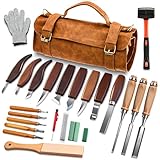
SakerNeo’s kit is the broadest in tool type. Its listing names gouges, chisels and knives, along with a leather storage bag. That combination suits a beginner who is curious about relief carving, spoon carving or simple sculpture and wants to learn which tools they enjoy using. It is also the only kit in this list that clearly includes tools you strike with a mallet or push with the palm.
- 25 pieces, per the listing name
- Gouges, chisels and knives
- Leather storage bag
- Marketed as a whittling and carving kit
- Steel, handle and exact tool counts: confirm on listing
Pros
- Wide range of tool types
- Good for exploring different carving styles
- Bag keeps everything together
Cons
- More skill needed to sharpen gouges and chisels
- Some pieces may see little use
Compared with the knife-only kits, it covers more types of work but gives fewer instructions by name.
Gouges remove wood in curved scoops, chisels make flat cuts and V-tools incise lines. Clamp your work, keep both hands behind the cutting edge and use light mallet taps rather than hard blows. Begin with soft wood so the tools cut easily, and sharpen before you start.
A last practical thought on this kit: with gouges and chisels, the sharpening workload is higher than with knives alone. Set aside time for a few slip stones or a sharpening guide, and learn to hone the inside curve of a gouge with a shaped stone or a leather-wrapped dowel. Many beginners get the most out of such a kit by practicing sharpening on the least-used tools first.
Specs Compared
| Kit | Piece count | Cutting tools named | Practice wood and templates | Storage |
|---|---|---|---|---|
| 23-Piece (4 + 5 knives) | 23 | 4 carving knives, 5 detail knives | 9 blocks | Confirm on listing |
| 24-Piece with Templates | 24 | Confirm on listing | 4 templates, 6 basswood blocks | Storage bag |
| Leather-Case Deluxe | Confirm on listing | Knife tools; count: confirm on listing | Confirm on listing | Leather case |
| 32-Piece (11 knives) | 32 | 11 carving knives | 4 templates | Storage bag |
| Kids’ Round-Tip Kit | Confirm on listing | Round-tip knives | Starter projects; gloves and tape | Storage bag |
| SakerNeo 25-Piece | 25 | Gouges, chisels, knives | Confirm on listing | Leather storage bag |
How We Chose These
We built this guide from research on current catalog listings rather than direct use. For each kit we looked at which cutting tools are named, whether practice wood or templates are included, how the tools are stored and who the manufacturer says the kit is for. We prioritized sets that describe their contents clearly and separated knife-only kits from mixed-tool kits. Where a listing name is cut off, we say so and recommend confirming steel type, handle material and exact piece counts on the product page before you buy.
What to Look For
Real Tool Count Versus Piece Count
A kit labelled 32 pieces might contain eleven knives, four templates, a bag, gloves and assorted accessories. Count only the tools that cut. For a beginner, three to six well-chosen tools are enough, and the rest are extras. Read the description for a list of contents and look at the photos. If a kit lists only a number, treat that number with caution.
Tool Types and Their Jobs
Knives shape and detail wood with push and pull cuts. Gouges have curved cutting edges and remove material in scoops, which is how you hollow bowls and spoons. Chisels have flat edges and make straight cuts, and V-tools cut grooves and lines. Knives work well alone for small figures, but relief carving and spoon work need gouges. If you want to learn a style, pick a kit that includes its main tool. Otherwise start with knives and add specialist tools later.
Steel, Handles and Sharpness
Most beginner kits use carbon or stainless steel. Carbon takes a sharper edge but needs oiling; stainless resists rust but can be harder to sharpen. Handles should be smooth and comfortably sized. Do not assume a new tool is sharp enough: strop it on leather with polishing compound before you start, and again regularly. A sharp tool needs less force and gives better control, which is both safer and more fun. A common bevel angle for carving knives is roughly 15 to 20 degrees, with gouges and chisels often a little steeper.
Safety Gear
Cut-resistant gloves on the holding hand are the single best investment for a beginner. A thumb guard helps with push cuts. Work seated at a stable table, secure the wood in a clamp or against a bench hook for chisel work, and always cut away from your body. Keep your off hand behind the blade. Store tools covered, and never leave them within reach of children. If you are using a mallet, wear eye protection in case chips fly.
Setting Up a Comfortable Carving Space
Good light and a stable seat do more for your results than any single tool. Place a lamp to one side so shadows fall across the cuts and show you the surface. Sit with your elbows supported on your knees or the table so your cutting hand moves with control rather than force. Lay a towel or a mat in your lap to catch chips, and keep a small brush nearby. Take a break every half hour to stretch the hand and wrist; carving tires the grip muscles more than most beginners expect. A bench hook or a carving vise holds the work firmly for chisel and gouge cuts, and it keeps your other hand out of the line of fire.
Common Beginner Mistakes
The most frequent error is cutting toward the hand that holds the wood, which is how most carving injuries happen. Close behind are using a dull blade that needs force, trying to remove too much wood in one cut and carving against the grain so the wood splits ahead of the edge. Learn to read the grain: if the surface tears or the cut feels crunchy, rotate the piece and cut the other way. Take thin slices rather than deep ones, and finish a section before moving on. If a tool feels hard to control, stop, sharpen it and try again.
Choosing Wood and Planning the First Month
Basswood is the standard choice for learning, with butternut and soft pine as alternatives. Avoid hardwoods like oak at first. As a worked example, plan four sessions: in week one carve a simple geometric shape with stop cuts to learn control; in week two round a small figure; in week three add details with a knife; in week four try a shallow relief or a spoon blank if your kit includes the right tool. Keep each session short, because tired hands make mistakes.
Questions
What is the best first tool for wood carving?
A medium-size carving knife with a pointed tip covers most beginner tasks, from roughing to detail. Add a detail knife and a strop as your second purchase. Gouges are best added when you start spoons or relief carving.
Do I need a mallet?
Not for knife work. A mallet is useful with chisels and some gouges, where you drive the tool with light taps. Many beginner kits do not include one.
How many tools should a beginner kit have?
Three to six cutting tools are plenty. Larger kits give you variety, but you will probably use only a few regularly. Judge a kit by the quality and type of its cutting tools rather than the piece count.
Can adults use kits marketed for kids?
You can, but the tools are designed for safety rather than performance, with round tips and limited cutting ability. Adults will usually be happier with a standard kit. Kids’ sets are best used with an adult nearby.
How do I keep my carving tools sharp?
Strop frequently on leather with polishing compound, and only go to a stone when stropping no longer restores the edge. Wipe the blades dry and apply a light oil film before storage. Keep tools in a roll, bag or case so edges do not touch each other.
Is basswood really the best wood to practice on?
For most beginners, yes. It is soft, even and forgiving, and it holds detail. It is also widely available as blocks and blanks. Move to harder woods only after your knife control improves.
Update History
- October 20, 2026 – Initial publication; product set drawn from current catalog listings.
- Check the product page for current specifications and availability before buying.
Sources
- Retailer listing titles and specification fields for each carving kit in this guide
- Manufacturer information on knife, gouge and chisel types from carving tool makers
- General hand-tool safety and sharpening guidance from woodcarving suppliers