Our Top Picks
 Pony Jorgensen 27091 Medium Duty Woodworker's VisePack 116.25 x 8.25 x 6 inches11.8 poundsCheck on Amazon
What's inside
As an Amazon Associate I earn from qualifying purchases. This post may contain affiliate links at no extra cost to you.
- Top Pick: Yost M7WW Rapid Action Woodworking Vise
- Runner-up: Eclipse EWWQR7-NA Quick Release Woodworking Vise
- Also consider: Pony Jorgensen 27091 Medium Duty Woodworker's Vise
The best bench vise for a woodworking bench is a quick-release front vise with a 7-inch jaw, an opening of at least 8 inches, and cast-iron construction, because that combination covers most boards, panels, and furniture parts a home shop handles. The Yost M7WW is the strongest all-around pick on those numbers, the Eclipse EWWQR7-NA is the classic English-pattern alternative, and the Pony Jorgensen 27091 keeps the same format at a lighter weight. Woodworkers who clamp tapered parts should look at the Wilton 78A and its pivoting front jaw, while a first bench on a budget can start with the compact Irwin 226361. As an Amazon Associate, we earn from qualifying purchases.
Contents
Quick Picks
- Best overall: Yost M7WW Rapid Action Woodworking Vise — 7-inch jaw, 8-inch opening, rapid-action lever, and a movable bench dog.
- Best classic quick-release: Eclipse EWWQR7-NA — the traditional English-pattern vise with a quick-release trigger and adjustable front stop.
- Best for irregular parts: Wilton 78A Rapid-Action Woodworking Vise — a front jaw that pivots 10 degrees and a 10-inch maximum opening.
- Best mid-range value: Pony Jorgensen 27091 — 7-inch jaw width and a 9-inch opening in a lighter grey-iron body.
- Best budget starter: Irwin 226361 Woodworker’s Vise — a compact 6-1/2-inch light-duty vise with toe-in jaws.
Table of Contents
- Quick Picks
- Yost M7WW Rapid Action Woodworking Vise
- Eclipse EWWQR7-NA Quick Release Woodworking Vise
- Wilton 78A Rapid-Action Woodworking Vise
- Pony Jorgensen 27091 Medium Duty Woodworker’s Vise
- Irwin 226361 Woodworker’s Vise
- How to Choose a Bench Vise for Woodworking
- FAQ
- Conclusion
- Product and ASIN Reference
Yost M7WW Rapid Action Woodworking Vise

The Yost M7WW is the vise to beat for a general-purpose woodworking bench. Its 7-inch jaw width and 8-inch jaw opening handle the stock sizes that show up in furniture work, from table legs to cabinet door frames, and the 3-inch throat depth keeps the screw and guide rails clear of most board edges. The body is cast from 30,000 PSI cast iron with chrome-plated steel moving parts.
The defining feature is the rapid-action lever. Pulling the lever toward the handle disengages the half nut, which lets the front jaw slide freely to the approximate position; releasing the lever re-engages the buttress-threaded main screw for final tightening. Buttress threads take clamping load on the strong face of the thread, suiting the one-directional pressure a vise screw produces. A movable bench dog in the front jaw, adjusted with a finger bolt, works with dog holes in the benchtop so long boards can be clamped flat across the bench surface.
Mounting is through pre-drilled holes in the vise body, and the jaw faces are pre-drilled for wooden facings. At 21 pounds, the M7WW stays planted under planing and sawing forces, yet remains manageable during installation. It sits in the mid-range tier and carries a 1-year limited warranty.
Specs
- Jaw width: 7 inches
- Jaw opening: 8 inches
- Throat depth: 3 inches
- Body material: 30,000 PSI cast iron with chrome-plated steel handle and guide rails
- Screw type: buttress-threaded main screw with rapid-action quick-release lever
- Bench dog: movable front dog with finger bolt
- Weight: 21 pounds
- Finish: blue
- Warranty: 1-year limited
Eclipse EWWQR7-NA Quick Release Woodworking Vise
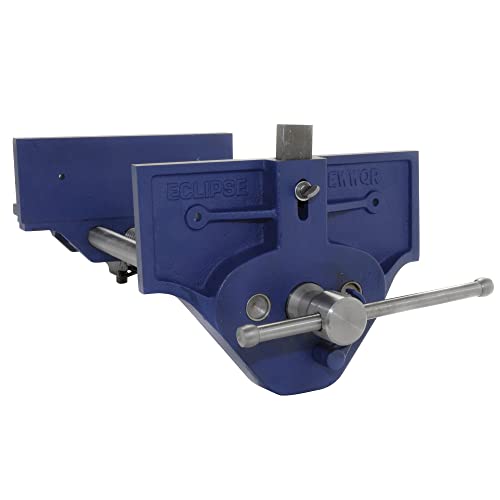
The Eclipse EWWQR7-NA follows the English-pattern design generations of bench woodworkers have used: a heavy grey cast-iron front vise with a quick-release trigger, twin steel guide rods, and jaws that toe in slightly at the top so clamping pressure stays even across the full depth of a board. The manufacturer lists a 178 mm jaw width (7 inches), a 202 mm jaw opening of about 8 inches, and a maximum clamping force of 1,900 kilograms-force.
The quick-release trigger trips the split nut so the front jaw slides without winding the handle through the full travel, then the screw takes over for the final squeeze. An adjustable front stop rises from the front jaw and works as a bench dog, so the same vise serves as a face vise for edge work and as an end vise for long stock. The front jaw is pre-drilled for wooden jaw liners.
One published safety detail sets the Eclipse apart: the tommy bar is a fused design made to bend before the castings reach the force at which they could fracture, so over-tightening damages a replaceable bar rather than the vise body. At 9.4 kilograms, roughly 21 pounds, it has the mass a primary bench vise needs, and it sits in the premium tier.
Specs
- Jaw width: 7 inches (178 mm)
- Jaw opening: about 8 inches (202 mm)
- Throat depth: about 3.5 inches (90 mm)
- Maximum clamping force: 1,900 kilograms-force (manufacturer specification)
- Body material: grey cast iron with steel guide rods and screw
- Release type: quick-release trigger with split nut
- Bench dog: adjustable front stop
- Safety feature: fused tommy bar designed to bend before the castings overload
- Weight: 9.4 kilograms (about 21 pounds)
Wilton 78A Rapid-Action Woodworking Vise
The Wilton 78A, sold under stock number 63144, solves a problem the other vises here cannot: clamping parts that are not parallel. Its front jaw pivots 10 degrees, so tapered legs and irregular stock can be gripped without shimming, and the pivot jaw can be removed entirely when maximum capacity matters more. The jaw measures 4 inches wide by 7 inches deep, and the vise opens to a maximum of 10 inches, the largest opening in this group.
Wilton encloses the screw mechanism in a metal housing, a published design feature that keeps sawdust away from the rapid-action release and extends its working life. The front jaw also travels vertically up to 9/16 inch to act as a full-length bench dog, so the 78A can clamp wide panels flat against the benchtop the way a tail vise does.
The 78A is cast iron, weighs about 30 pounds, and is backed by Wilton’s lifetime warranty against manufacturing defects, the strongest warranty published for any vise here. Mounting instructions are included in the package. It is the premium pick for woodworkers who regularly clamp angled or odd-shaped work.
Specs
- Model: 78A (stock number 63144)
- Jaw dimensions: 4 inches wide by 7 inches deep
- Maximum jaw opening: 10 inches
- Front jaw pivot: 10 degrees, removable for wider clamping
- Bench dog travel: up to 9/16 inch vertical movement
- Screw housing: fully enclosed metal housing protects the mechanism from sawdust
- Body material: cast iron
- Weight: about 30 pounds
- Warranty: lifetime against manufacturing defects
Pony Jorgensen 27091 Medium Duty Woodworker’s Vise
The Pony Jorgensen 27091 keeps the classic face-vise layout but trims the weight, making it a practical match for smaller benches and lighter bench tops. The castings are grey iron with an orange baked enamel finish, the jaw width is 7 inches, and the maximum opening is 9 inches, exceeding several heavier vises here. The manufacturer rates it for medium-duty use.
A steel dog sits inside the front jaw and works with a bench stop so oversized work can be held flat on the benchtop. The main screw uses an Acme thread, and dual plated-steel guide bars keep the front jaw tracking straight. The jaws are drilled for timber facings, and the vise is designed so the jaw tops sit flush with the benchtop.
At 16.25 by 8.25 by 6 inches and 11.8 pounds, the 27091 is the easiest vise here to handle during mounting, and its dimensions suit benches that cannot take a 30-pound casting on the front apron. It sits in the mid-range tier and is a sensible step up from a clamp-on vise.
Specs
- Jaw width: 7 inches
- Maximum jaw opening: 9 inches
- Body material: grey iron castings with orange baked enamel finish
- Screw type: Acme-thread main screw with dual plated-steel guide bars
- Bench dog: steel dog in the front jaw
- Dimensions: 16.25 by 8.25 by 6 inches
- Weight: 11.8 pounds
- UPC: 044295270915
- Duty rating: medium duty
Irwin 226361 Woodworker’s Vise

The Irwin 226361 is the light-duty entry in this roundup, a compact under-bench vise for smaller stock and occasional bench work. Its jaw measures 6-1/2 inches and the published jaw capacity is 4-1/2 inches, so it is sized for trim, small boxes, and light assembly rather than full-size furniture parts. The square body seats beneath the bench, keeping mounting simple and the jaw tops flush with the work surface.
The jaws toe in toward the top, a design detail shared with far more expensive vises: as the screw tightens, the top of the jaw meets the work first, compensating for jaw flex and producing a firmer grip along the full face. The body has provision for wooden cheeks, so soft facings can protect finished surfaces. Construction is forged iron, and published dimensions are 7 by 3.8 by 8 inches, small enough for a portable bench or secondary workstation. It sits in the budget tier, and published comparison data lists a lifetime warranty for the model.
Specs
- Jaw width: 6-1/2 inches
- Jaw capacity: 4-1/2 inches
- Body material: forged iron
- Jaw design: toe-in toward the top jaws for a firmer grip
- Mounting: square body seats under the bench, jaws flush with the bench top
- Jaw facings: provision for wooden cheeks
- Dimensions: 7 by 3.8 by 8 inches
- Duty rating: light duty
- Warranty: lifetime (per published listing data)
How to Choose a Bench Vise for Woodworking
Start with jaw width and opening. Jaw width sets the largest board face the vise can support, and jaw opening sets the thickest assembly it can swallow. A 7-inch jaw with an 8- or 9-inch opening covers most furniture-scale work. Drop to a 6-1/2-inch vise only if the work is genuinely small, and step up to a 10-inch opening if thick glue-ups are routine.
Decide whether quick release matters. A quick-release mechanism disengages the nut so the jaw slides freely, then re-engages for final tightening. Where stock thickness changes constantly, that saves real time. Every vise in this roundup except the Irwin 226361 offers some form of rapid action.
Check the throat depth and the dog. Throat depth, the distance from the top of the jaw to the screw, determines how far a board can sit into the vise before the screw interferes; 3 inches is the common figure here. A built-in bench dog, found on the Yost, Eclipse, Wilton, and Pony models, lets the vise clamp long work flat against dog holes in the benchtop.
Match the vise to the bench. A heavy casting on a light bench can rack the structure. Benches with thin tops or light frames pair better with the 11.8-pound Pony than with a 30-pound Wilton. Confirm the jaw tops can sit flush with the benchtop and that there is room under the bench for the screw and guide rods.
Plan on wooden jaw facings. Iron jaws mark finished wood, so every serious setup adds hardwood facings. All five vises here have drilled jaws or provision for cheeks, making facings quick work.
Read the warranty as a specification. Warranty terms are published data, and they differ sharply in this group: lifetime coverage on the Wilton 78A and the Irwin 226361, a 1-year limited warranty on the Yost M7WW. For a tool expected to outlast its bench, that difference is worth weighing.
FAQ
What size bench vise is best for a woodworking bench?
A 7-inch jaw width with at least an 8-inch opening is the most versatile size, covering most furniture parts, door frames, and panels without overwhelming a standard bench. Smaller 6-1/2-inch vises suit light work; a 10-inch opening helps with thick glue-ups.
Is a quick-release vise worth it for woodworking?
For most bench work, yes. A quick-release mechanism lets the jaw slide freely to the approximate position before the screw engages, saving repeated handle winding when stock thickness changes often. Enclosed designs like the Wilton 78A protect the mechanism from sawdust.
Should a bench vise jaw sit flush with the benchtop?
Yes. Mounting the vise so the rear jaw top is flush with the benchtop lets long boards rest flat across the bench and the vise at the same time, and keeps the bench surface usable as a reference.
Do I need wooden facings on a woodworking vise?
Yes, in practice. Bare iron jaws dent and stain finished wood, while hardwood facings grip firmly, distribute pressure, and can be replaced when they wear. All five vises here accept facings or wooden cheeks.
Conclusion
For a single vise that handles nearly everything a woodworking bench sees, the Yost M7WW pairs a 7-inch jaw and 8-inch opening with a rapid-action lever and a bench dog in a mid-range package. The Eclipse EWWQR7-NA suits woodworkers who prefer the traditional English pattern, and the Wilton 78A earns its premium place with a pivoting jaw, a 10-inch opening, an enclosed screw, and a lifetime warranty. The Pony Jorgensen 27091 brings the same format down to a weight smaller benches can carry, and the Irwin 226361 covers light-duty work at the budget end. Match jaw size and opening to the work, and any of these five will hold stock securely for years.
Related guides
More from Amazon
Programs that pair well with the guide above. Offers and eligibility are set by Amazon and may change.
A free business account with business pricing and bulk-buying tools for work, shop or home office.
Create a business accountFree shipping on eligible items, Prime Video and more. Eligible new members can start with a free trial.
Start a Prime free trialAudiobooks and podcasts to listen to on the go. Eligible new members can start with a free trial.
Try Audible freeAd-free music streaming. Eligible new subscribers can start with a free trial.
Try Music Unlimited freeAs an Amazon Associate we earn from qualifying purchases.