Key takeaways
- Grit numbers, sheet and disc formats, and wet or dry use explained in plain terms, with five assortment packs compared by the grits each one covers.
What's inside
- Quick answer
- How to choose
- POWERTEC 71002 Cleaning Stick and 50-Pack 5 Inch Sanding Discs
- Serious Grit 3″ x 4″ Assorted Grit Sanding Sheets
- 3M Wetordry Sandpaper, 5 Sheets, Assorted Grits 220/320/400
- Dura-Gold Premium 50 Sheet Assorted Wet or Dry Sandpaper
- Hyietta Sand Paper Assortment, 52 Sheets
- Who should skip
- FAQ
- Final verdict
As an Amazon Associate I earn from qualifying purchases. This post may contain affiliate links at no extra cost to you.
Sanding is the stage that decides how a finish looks and feels, yet the paper itself often gets picked by habit. A board can come off the saw flat and square and still show swirl marks or dull patches under a coat of varnish, simply because the grit run skipped a stage or began too fine for the surface at hand.
This guide explains how grit numbers work, how sheet and disc formats differ, and when wet sanding belongs in the sequence. It then compares five assortment packs sold on Amazon: a coarse disc set for a random orbital sander, sheets for a small sheet sander, a fine hand pack for work between coats, and two wide-range wet and dry sheet packs.
As an Amazon Associate, we earn from qualifying purchases.
Contents
- Quick answer
- How to choose
- POWERTEC 71002 Cleaning Stick and 50-Pack 5 Inch Sanding Discs
- Serious Grit 3″ x 4″ Assorted Grit Sanding Sheets
- 3M Wetordry Sandpaper, 5 Sheets, Assorted Grits 220/320/400
- Dura-Gold Premium 50 Sheet Assorted Wet or Dry Sandpaper
- Hyietta Sand Paper Assortment, 52 Sheets
- Who should skip
- FAQ
- Final verdict
Quick answer
Grit numbers run from coarse to fine: a low number removes material fast and leaves deeper marks, and each higher number refines the marks left by the one before it. For most woodworking, move in stages, for example 80, then 120, then 180 or 220, and pick an assortment whose grit list covers every stage of your job.
How to choose
Grit numbers in plain terms. The grit number describes the size of the abrasive grains on the paper. A low number means large grains that cut fast and leave a rougher surface. A high number means small grains that cut slowly and leave a finer surface. In the ranges shops talk about most, coarse grits around 40 to 80 shape wood and strip old finish, medium grits around 100 to 150 level a surface and clear milling marks, fine grits around 180 to 220 prepare bare wood for a finish, and very fine grits from 320 upward scuff between coats and polish. A widely taught rule is to work through the grits in order and skip no more than one grit in a run, since each stage must erase the scratches of the stage before it.
Sheet or disc. Full sheets, most often 9 by 11 inches, fold around a sanding block or cut down to fit a tool. Third-size sheets, around 3-2/3 by 9 inches, suit block work and many small sanders. Discs in the 5 inch size with hook and loop backing fit random orbital sanders, and the hole pattern has to match the pad so dust can clear. Small 3 by 4 inch sheets fit the compact sheet sanders named on their listings. Match the format to the tool you own before you look at the grit list.
Wet or dry use. Some packs are listed for dry use only, and others, often silicon carbide, are listed for wet or dry sanding. Wet sanding uses water to keep fine dust from loading the paper, and it belongs to the fine stages, such as sanding between coats of varnish, lacquer, or paint. Use a pack with water only when its listing states wet use.
Match the grit to the stage of the work. Rough lumber, glued panels, and old finish call for the coarse end. New furniture parts usually need a medium run, for example 120 then 150 then 180 or 220. Work between coats needs fine grits, and polishing needs the very fine end. Check that an assortment’s grit list covers every stage of your job, and note how many pieces of each grit it holds, because the middle grits run out first.
Dust, in general terms. Sanding makes fine dust, so follow the maker guidance for any dust mask you wear, and clear dust off the work between grits so you can see the surface. Treat a mask as one layer of care among several, not as a promise of protection on its own.
POWERTEC 71002 Cleaning Stick and 50-Pack 5 Inch Sanding Discs
This kit pairs a box of 50 assorted discs with an abrasive cleaning stick, and it covers the coarse half of a grit run. The discs come in 40, 60, 80, 120, and 220 grit, which spans shaping, leveling, and a first smoothing pass on bare wood. The cleaning stick is rubbed against a running abrasive to pull out loaded dust and residue, which stretches the useful life of each disc. For shops that sand mostly with a 5 inch random orbital sander, it is the rough-stock pick here.
Specs
- Format: 5 inch round discs, hook and loop backing
- Grits included: 40, 60, 80, 120, 220
- Count: 50 discs, plus one abrasive cleaning stick
- Abrasive: zirconia
- Hole pattern: universal multi-hole, listed to fit 5 and 8 hole random orbital sanders
- Backing: polyester film, per the maker copy on the listing
Serious Grit 3″ x 4″ Assorted Grit Sanding Sheets

Serious Grit builds this box for compact sheet sanders, with 50 sheets in a 3 by 4 inch size and a 6-hole pattern. The grit run is 80, 120, 150, 180, and 220, with ten sheets of each, a sensible spread for the middle stages of a project: flattening, smoothing, and preparing bare wood for finish. The even count per grit helps, because the 120 and 150 sheets that do most of the work are not gone while the ends sit untouched.
Specs
- Format: 3 in x 4 in sheets, 6-hole
- Grits included: 80, 120, 150, 180, 220, ten of each
- Count: 50 sheets
- Fit, as listed: Surfprep, Uneeda Ekasand, and Mirka DEOS 343 sheet sanders
- Compatible material, as listed: wood
3M Wetordry Sandpaper, 5 Sheets, Assorted Grits 220/320/400
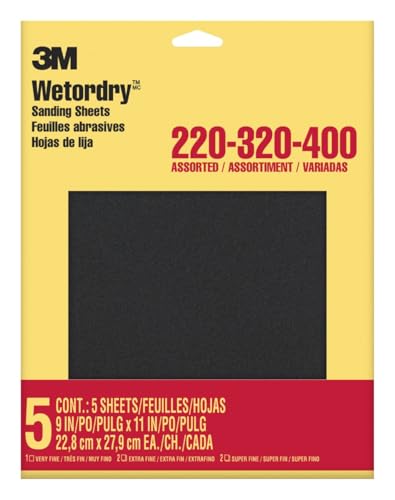
This small 3M pack sits at the fine end of the sequence. The five full-size sheets come in 220, 320, and 400 grit, and the listing describes them for wet and dry sanding, with sanding between coats of varnish, lacquer, paint, and other finishes as the named use. That makes it a finishing-stage tool rather than a general one: it will not level a rough board, but between coats a 320 or 400 sheet used wet knocks down nibs and dust specks while leaving a surface the next coat can grip.
Specs
- Format: full sheets, 9 in x 11 in
- Grits included: 220, 320, 400
- Count: 5 sheets
- Abrasive: silicon carbide
- Use, as listed: wet and dry sanding, for sanding between coats of varnish, lacquer, paint, and other finishes
- Model: 9088DC-NA
Dura-Gold Premium 50 Sheet Assorted Wet or Dry Sandpaper

Dura-Gold packs the widest grit ladder of the sheet sets here into one box: 50 sheets across ten grits, five of each, running from 150 up to 3000. The sheets measure 3-2/3 by 9 inches, a third-size format that suits block sanding and detail work. Because the run covers medium smoothing, finish prep, between-coat scuffing, and the polishing grits above 1000, one box can follow a small project from bare wood to a rubbed-out topcoat. The trade-off is depth: five sheets of a hard-working grit such as 320 go quickly, so treat the box as a sampler for choosing single-grit packs later.
Specs
- Format: sheets, 3-2/3 in x 9 in
- Grits included: 150, 220, 320, 400, 600, 800, 1000, 1500, 2000, 3000, five of each
- Count: 50 sheets
- Abrasive: silicon carbide
- Use, as listed: wet or dry sanding
- Model: DUR WD-VP3-50
Hyietta Sand Paper Assortment, 52 Sheets
The Hyietta assortment spreads 52 sheets across thirteen grits, four of each, from 120 through 3000. The sheets measure 9 by 3.6 inches and are listed for dry and wet sanding. With steps at 120, 150, 180, 240, and 320, the bare-wood part of the run is more gradual than most packs offer. Above 400 the ladder climbs through 600, 800, 1000, 1500, 2000, 2500, and 3000 for fine finishing and polishing. Four sheets per grit is a thin supply, so this pack fits smaller jobs and careful hand work better than a full furniture build.
Specs
- Format: sheets, 9 in x 3.6 in
- Grits included: 120, 150, 180, 240, 320, 400, 600, 800, 1000, 1500, 2000, 2500, 3000, four of each
- Count: 52 sheets
- Abrasive: silicon carbide
- Use, as listed: dry and wet sanding
- Model: HYT-SDP-001
Who should skip
Skip assortment packs if you already know the two or three grits your work uses and buy those in single-grit bulk boxes, since it gives you sheets at both ends you may never open. Skip the disc kit if you sand by hand or with a sheet sander, and skip the sheet packs if your only sander takes 5 inch discs. Skip the wide-range wet and dry packs if you never sand between coats or polish, because half of their ladder sits above 400. And skip the fine 3M pack as your only purchase if your projects begin with rough lumber, since nothing in it cuts below 220.
FAQ
What grit should I begin with on rough lumber?
Begin at the coarse end, around 60 or 80 grit, to level the surface and remove milling marks, then move up in stages through 120 and 150 to 180 or 220. Beginning too fine on rough stock takes far longer and leaves deep marks in place.
Can I skip a grit in the sequence?
The common shop rule is to skip no more than one grit in a run. Each stage has to erase the scratches left by the stage before it, and a big jump leaves coarse marks hiding under a surface that feels smooth until finish shows them.
When does wet sanding make sense?
Wet sanding makes sense at the fine stages, most often between coats of varnish, lacquer, or paint, and only with paper whose listing states wet use. Water keeps fine dust from loading the sheet and helps the abrasive cut evenly at grits such as 320 and 400.
How do I know when a sheet or disc is worn out?
A worn abrasive stops cutting and begins to slide, loads up with dust that will not clear, or leaves the surface no smoother after several passes. Swap in a fresh piece, and on discs a cleaning stick can pull out loaded residue and extend useful life.
Final verdict
Choosing sandpaper grits comes down to planning the whole run first: coarse grits to shape and level, medium to smooth, fine to prepare for finish, very fine between coats. The POWERTEC kit covers the coarse stages for orbital sander users, the Serious Grit box covers the middle stages for sheet sander users, and the 3M Wetordry pack handles the between-coat stage by hand. The Dura-Gold and Hyietta assortments each cover nearly the full ladder in one box, a good fit for smaller projects.

Related guides
More from Amazon
Programs that pair well with the guide above. Offers and eligibility are set by Amazon and may change.
A free business account with business pricing and bulk-buying tools for work, shop or home office.
Create a business accountFree shipping on eligible items, Prime Video and more. Eligible new members can start with a free trial.
Start a Prime free trialAudiobooks and podcasts to listen to on the go. Eligible new members can start with a free trial.
Try Audible freeAd-free music streaming. Eligible new subscribers can start with a free trial.
Try Music Unlimited freeAs an Amazon Associate we earn from qualifying purchases.