Key takeaways
- The best wooden outdoor vegetable planters compared: cedar raised beds and elevated planter boxes with legs, checked by wood type, depth and drainage.
What's inside
As an Amazon Associate I earn from qualifying purchases. This post may contain affiliate links at no extra cost to you.
Buying a wooden planter for vegetables is really a decision about time. Metal and plastic beds ask almost nothing of you, but wood is the material most gardeners still want next to food crops — and the wrong wood, or boards too thin for wet soil, turns a promising bed into a bowed, rotting frame within a few seasons. The real choice is which species, board thickness and form will still be holding soil square and level years from now.
This guide is for three kinds of growers: households with open ground who want a full-size bed for rows of vegetables, patio and balcony gardeners who need the soil lifted off the surface entirely, and anyone whose back rules out kneeling at ground level. Every pick below is a wooden outdoor planter or raised planter box sold for vegetable growing, chosen from the wood species, dimensions, board and capacity details stated on its Amazon product page.
Contents
Quick Picks
As an Amazon Associate we earn from qualifying purchases
| Product | Best for | Key spec from title |
|---|---|---|
| Greenes Fence Original Cedar Raised Garden Bed | Large ground-level vegetable plots | 4 x 8 ft untreated North American cedar |
| Yaheetech 8x2ft Wooden Horticulture Raised Garden Bed | Long narrow beds along a fence or wall | 95 x 25 x 11 in divisible fir bed |
| Maple99 Cedar Raised Garden Bed with Legs | Standing-height growing on a deck | 48 x 24 x 30 in cedar, 200 lb capacity |
| Best Choice Products 48x24x30in Raised Garden Bed | Patio growers who want a liner included | Chinese fir with bed liner, 5 cu ft |
| Yaheetech 48x24x30in Elevated Wooden Planter Box with Legs | Balconies where soil cannot touch the ground | 48 x 24 x 30 in elevated box on legs |
How to Choose
Wood species and treatment come first
Cedar is the benchmark for food beds because its natural oils resist rot and insects without chemical treatment, and the Greenes Fence bed below uses untreated North American cedar for exactly that reason. Fir is the other common choice: it is lighter and widely used in elevated boxes, but it softens sooner in constant soil contact, so fir planters reward a liner and good drainage. Whatever the species, check the listing for the words untreated or chemical-free if the wood will touch vegetable soil, and be wary of stained finishes whose composition the seller does not state.
Ground bed or elevated box
A ground-level raised bed sits directly on the soil, so roots can grow past the frame into the earth below and the box only has to hold its own walls together. It is the better form for long rows and deep-rooted crops, but it demands level, cleared ground. An elevated planter on legs lifts the whole soil mass off the surface, which suits decks, patios and balconies and brings the work to standing height. The trade is capacity: a legged box must carry every pound of wet soil on its frame, so check the stated weight limit before the dimensions.
Depth and soil volume for your crops
Match the soil depth to the shallowest crop you actually plan to grow. Leafy greens, herbs and radishes manage in the roughly seven to eleven inches that low ground beds and slim boxes provide. Peppers, bush beans and most flowers are happier with more, and tomatoes and carrots want the deepest root run you can give them — in an elevated box, remember that total height is not soil depth, because the legs make up much of the measurement. Volume matters too: a four-by-eight bed holds many times the mix of a two-foot box, and filling it is a real cost in bags and effort.
Boards, joinery, drainage and liners
Wet soil pushes outward constantly, so board thickness and corner construction decide whether a bed stays rectangular. The strongest kits pair boards around three-quarters of an inch thick with solid corner posts and interlocking or screwed joints; thin panels fastened with staples are where cheap beds fail first. Drainage is the other half of the structure. Ground beds shed water into the earth, but an elevated box needs holes or slatted gaps in its floor, and a breathable liner keeps soil from washing through them while slowing the wood’s contact with moisture. Feet or caps that lift the frame slightly also help the underside dry between waterings.
The 5 Best Options
Greenes Fence Original Cedar Raised Garden Bed

The Greenes Fence bed is the traditional choice for a serious vegetable plot: a full four-by-eight frame of untreated North American cedar that assembles without tools, the dovetail boards sliding into routed corner posts. At seven inches tall it suits greens, herbs, peppers and succession rows of beans, and because it sits open on the ground, roots are not limited to the frame’s depth. The boards are smooth and sanded rather than rough budget stock, and the untreated cedar can sit directly against vegetable soil without a barrier layer in between.
Specs
- Material: North American cedar, untreated and chemical-free
- Dimensions: 4 ft wide x 8 ft long x 7 in high
- Boards: 3/4-inch thick, smooth sanded
- Corner posts: 2.5-inch square
- Assembly: dovetail interlocking joints, no tools required
- Soil capacity: up to 18.7 cubic feet
- Model: RC48967
Best for: A full-size ground bed for rows of vegetables on open soil.
Watch out for: The 7-inch walls are shallow for long carrots and parsnips, and this listing family includes several footprints, so confirm the 4 x 8 size is the one selected.
ASIN: B00NP96Y4O
Yaheetech 8x2ft Wooden Horticulture Raised Garden Bed
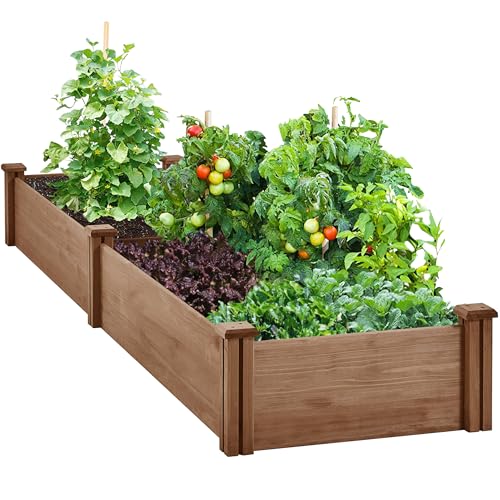
Most wooden beds are wide rectangles, and this Yaheetech is the exception worth knowing about: a 95-inch-long, 25-inch-wide fir bed that fits the strips of ground other planters waste, along fences, walls and side paths. A divider board splits the length into two planting sections, which makes it easy to keep a salad row separate from herbs or to rotate crops within one frame. At 11 inches deep it covers the root zone of most vegetables, and the dark brown finish suits gardens where a raw cedar frame would look unfinished.
Specs
- Dimensions: 95 x 25 x 11 in
- Material: fir wood
- Design: divisible bed with a divider for separating crops
- Color: Dark Brown
- Model: YT-00132774
Best for: A long, narrow vegetable bed along a fence, wall or side yard.
Watch out for: The divider fixes your planting sections at one split point, so check the listing photos for board thickness if you plan to fill it to the brim.
ASIN: B0CQTDCZQ2
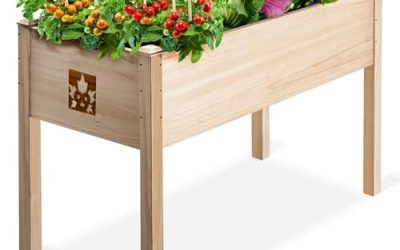
Maple99 Cedar Raised Garden Bed with Legs

The Maple99 brings cedar up to standing height. Its 48-by-24-inch box sits on 30-inch legs, so planting, weeding and harvesting happen without kneeling, and the listing rates the frame for 200 pounds of soil and plants. Cedar is the right species for a box that holds moisture this far off the ground, since the wood is in constant contact with damp mix on five sides. A bed liner and drainage hole are part of the design, and foot caps are included to keep the legs steady and protect deck boards underneath.
Specs
- Material: cedar wood
- Dimensions: 48 x 24 x 30 in
- Capacity: 200 pounds of soil and plants
- Included: bed liner and foot caps
- Drainage: drainage hole in the base
- Item weight: 33.3 pounds
Best for: Standing-height vegetable and herb growing on a deck or patio.
Watch out for: The listing’s dimension fields are inconsistent, showing 48 inches in the title and 26.5 inches in one spec field, so verify the exact footprint of the size option before ordering.
ASIN: B0C62D5QPX
Best Choice Products 48x24x30in Raised Garden Bed

This is the elevated box for gardeners who want the setup decisions already made. The Chinese fir frame holds about five cubic feet of mix, the stated capacity is 200 pounds, and a fabric bed liner comes in the box to separate soil from wood and slow the moisture damage that shortens fir’s life. Drainage holes in the base handle excess water, and the 30-inch height keeps the work at a comfortable level for tending greens, herbs and compact vegetables on a patio or balcony through the season.
Specs
- Material: Chinese fir wood
- Dimensions: 48 x 24 x 30 in
- Planting space: 5 cubic feet
- Capacity: 200 pounds
- Included: bed liner
- Drainage: drainage holes in the base
Best for: Patio growers who want an elevated fir box with the liner already included.
Watch out for: Confirm the liner appears in the box contents on the listing before ordering, and weigh wet mix against the 200-pound capacity rather than filling by eye.
ASIN: B01CQ7A0DQ
Yaheetech 48x24x30in Elevated Wooden Planter Box with Legs

Yaheetech’s elevated box is the straightforward option for hard surfaces: a 48-by-24-inch wooden planter carried on legs to a 30-inch working height, sized for a balcony, terrace or paved corner where a ground bed cannot go. The raised floor keeps soil contained and off the paving, which matters for renters and for anyone whose only sun falls on concrete. The dark brown finish matches the brand’s ground beds if you want both forms in one garden, and the footprint takes a useful row of greens, herbs or compact peppers without dominating a small space.
Specs
- Dimensions: 48 x 24 x 30 in
- Design: elevated planter box with legs
- Color: Dark Brown
- Model: YT-00132528VC
- Stated use: backyard, patio or balcony growing
Best for: Balcony and terrace gardeners who need a self-contained box off the ground.
Watch out for: A near-identical two-pack is sold under a separate listing, so make sure you are ordering the single 48x24x30in box.
ASIN: B0CQLSRYMZ
Which One Fits Your Situation
You have open ground and want a real harvest row
Choose the Greenes Fence cedar bed. Its four-by-eight footprint is the only one here sized for proper rows of vegetables, the open bottom lets roots run into your soil, and untreated cedar is the safest long-term material against food crops. Clear and level the ground first, because a frame this size will not hide an uneven site.
Your garden is a patio, deck or balcony
Choose the Maple99 cedar bed if the surface must stay clean and you want the longest-lasting wood, or the Best Choice Products fir box if you prefer the liner and drainage already sorted in one purchase. Both lift five cubic feet of growing space to standing height and keep every bit of soil contained above your boards or paving.
Bending and kneeling are off the table
Choose one of the three elevated boxes and tend everything at 30 inches. The Maple99 suits gardeners who want cedar’s rot resistance in a box that stays damp inside; the Yaheetech elevated box is the pick when the planter has to sit on paving and be moved or removed at the end of a tenancy.
You are starting small along a fence or side yard
Choose the Yaheetech 8x2ft bed. Its long, narrow shape turns a strip of ground beside a fence or path into a working vegetable bed, and the divider lets a first-time grower run greens on one side and herbs on the other without a second frame. It is also the easiest of these beds to empty and store if the experiment does not stick.
Common Mistakes
- Choosing by footprint alone and ignoring soil depth, then finding tomatoes and carrots cramped in a seven-inch frame.
- Filling an elevated box past its stated weight capacity, forgetting that soaked soil weighs far more than the dry mix that went in.
- Sealing the inside of a wooden planter with impermeable plastic, which traps water against the boards and speeds up the rot it was meant to prevent.
- Setting a ground bed over unweeded turf or unlevel soil, so the frame rocks, gaps open at the corners and mix washes out.
- Putting the planter where it fits instead of where the sun is, then blaming the bed for vegetables that needed six or more hours of light.
Frequently Asked Questions
Is untreated wood safe for growing vegetables?
Yes, and it is the option most food gardeners prefer. Untreated cedar and fir contain no preservative chemicals to migrate into the soil, which is why the Greenes Fence bed is sold chemical-free. If a planter has a stained or painted finish and the seller does not say what it is, line the inside so the finish never touches the mix.
How deep should a wooden planter be for tomatoes?
Aim for at least twelve inches of soil for full-size tomatoes where you can. A low ground bed gets help from the earth beneath it, since roots pass through the open bottom, but an elevated box is a closed system: its soil depth is the whole root zone. Compact and determinate varieties are the safer choice for the shallower boxes in this guide.
Should I line a wooden vegetable planter before filling it?
A breathable liner is worth it for elevated boxes, where it keeps mix from washing through drainage gaps and slows moisture contact with the wood. Use landscape fabric or the liner supplied with the planter, and keep the drainage holes uncovered. Ground beds usually need no liner at all, though fabric under the frame can suppress weeds while roots grow through.
How long will a wooden vegetable planter last outdoors?
Cedar generally outlasts fir in constant soil contact, and both last longer when the box drains freely, sits on feet or caps rather than in standing water, and is emptied or covered over harsh winters. Treat any wooden planter as a multi-season product rather than a permanent structure, and inspect corners and bottom boards each spring for soft spots.
Related guides
More from Amazon
Programs that pair well with the guide above. Offers and eligibility are set by Amazon and may change.
A free business account with business pricing and bulk-buying tools for work, shop or home office.
Create a business accountFree shipping on eligible items, Prime Video and more. Eligible new members can start with a free trial.
Start a Prime free trialAudiobooks and podcasts to listen to on the go. Eligible new members can start with a free trial.
Try Audible freeAd-free music streaming. Eligible new subscribers can start with a free trial.
Try Music Unlimited freeAs an Amazon Associate we earn from qualifying purchases.