What's inside
- Contents
- Pick by How You Camp
- Common Table Types
- What to Check Before You Buy
- Sizing for Your Group and Vehicle
- Top and Frame Materials Compared
- Using a Table Well: Cooking, Wind and Slopes
- Care, Cleaning and Storage
- A Note for Woodworkers
- Who Should Choose What
- Useful Gear to Browse
- Common Mistakes
- Checklist
- Frequently Asked Questions
- Conclusion
As an Amazon Associate I earn from qualifying purchases. This post may contain affiliate links at no extra cost to you.
Short answer: the best camping table is one that stays steady on uneven ground, fits in your vehicle or pack, and matches how you cook and eat. Fold-in-half tables are quick and roomy for car camping, roll-top tables pack long and slim, compact tabletop models suit solo trips, and camp kitchen stations organize serious cooking. Compare height, top material, stated load rating, weight and packed size before you buy, and open the table once at home before your first trip.
A camp table quietly decides how pleasant a trip feels. A good one gives you a clean place to cook, eat and organize gear. A bad one wobbles, sags under a cooler or will not fit in the car. This guide covers the main types, what to check, how to match a table to the way you camp, and how to keep it working for years.
Contents
- Contents
- Pick by How You Camp
- Common Table Types
- What to Check Before You Buy
- Sizing for Your Group and Vehicle
- Top and Frame Materials Compared
- Using a Table Well: Cooking, Wind and Slopes
- Care, Cleaning and Storage
- A Note for Woodworkers
- Who Should Choose What
- Useful Gear to Browse
- Common Mistakes
- Checklist
- Frequently Asked Questions
- Conclusion
Our Top Picks
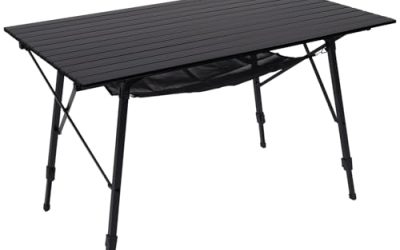
 Byliable Folding Camping Table36.8"L x 21.9"W x (21.7-29.5)"H36.8 x 21.91 x 29.5 inches9 poundsCheck on Amazon
 GCI OUTDOOR Master Cook Station56.3" X 21.7" X 32.3"22.2 x 70.1 x 68.3 Inches22.5 poundsCheck on Amazon
Contents
- Pick by how you camp
- Common table types
- What to check before you buy
- Sizing for your group and vehicle
- Top and frame materials compared
- Using a table well: cooking, wind, slopes
- Care, cleaning and storage
- A note for woodworkers
- Who should choose what
- Common mistakes
- Checklist
- FAQ
- Conclusion
Pick by How You Camp
Start with your use, not the product page. The same table can be perfect for one trip and wrong for another.
- Car camping with a family: You have trunk space, so choose a larger fold-in-half or multi-fold table with adjustable legs. It should hold meals, a stove and a few dishes without crowding.
- Backpacking, kayaking or bikepacking: Every ounce counts. A small roll-top or a miniature tabletop is the realistic range, and many people carry no table at all.
- Camp kitchen: If you cook real meals, a dedicated kitchen station with a prep surface, shelf space and side tables keeps everything within reach.
- Tailgating, beach days and picnics: A portable table that opens in seconds and carries by a handle saves effort.
- Van life and truck bed use: Look for compact tables that fold flat and fit in a narrow storage space, or tables that mount on a door or bumper.
- Group or event camping: A longer table or a pair of tables set side by side gives space for communal meals.
Common Table Types
| Type | Strengths | Trade-Offs | Best For |
|---|---|---|---|
| Fold-in-half | Quick setup, carry handle, generous top | Bulky when packed; may sag at the center fold | Family car camping |
| Roll-top | Packs into a long bag, often light | Slats can rattle; lower weight limit | Smaller groups, moderate loads |
| Four-fold or tri-fold | Compact, sturdy frame | More hinges to clean and check | Limited storage space |
| Tabletop mini | Very small; useful on a rock or log | Not a full table; needs a flat surface | Solo trips, hikers |
| Camp kitchen station | Organized cooking space with shelves | Heavier, bulkier, usually costs more | Frequent cooks, longer stays |
| Hybrid bench-table set | Seats and table in one package | Heavy; less flexible placement | Fixed basecamps |
The next table compares how these types behave in practice, which is often more useful than the spec sheet.
| Type | Setup Speed | Stability on Uneven Ground | Packed Shape | Cooking Suitability |
|---|---|---|---|---|
| Fold-in-half | Fast | Good with adjustable legs | Flat suitcase | Fair; keep stoves away from the fold |
| Roll-top | Moderate | Fair; depends on frame | Long tube or bag | Fair if the top is heat-tolerant |
| Four-fold | Moderate | Good | Compact block | Good |
| Tabletop mini | Very fast | Depends on the surface beneath | Tiny | Limited |
| Camp kitchen station | Slower | Good with leveling feet | Large | Excellent |
What to Check Before You Buy
Height
Standard dining tables sit around 28 to 30 inches high, but many camp tables are lower to suit folding chairs. If you cook or prep food, a taller setting saves your back. Adjustable legs let you use the same table at low height for relaxed meals and higher for cooking. Check that your camp chairs actually fit under the edge.
Top Material
Aluminum is light and resists rust. Plastic is inexpensive and wipes clean but can warp in heat. Wood or bamboo looks good and feels solid but is heavier and needs care. Composite and laminated tops vary, so look at what the maker says about heat and moisture.
Frame and Leg Design
Wide-set legs, cross braces and locking mechanisms add stability. Fold-out legs that lock with a clear click are better than loose friction joints. Adjustable legs with simple clamps or twist locks make slopes manageable.
Stability
If you can, press down on the corners and the middle in a shop and push sideways. If you are shopping online, read what owners say about wobble and sagging in the center. Stability matters most when you place hot cookware or heavy coolers on the table.
Load Rating
The stated weight limit tells you roughly what the table can support, but read the details. The number may assume the weight is spread across the surface, not concentrated at one spot or at the center of a folding top. Leave margin: a full cooler, a stove and a cast iron pan add up quickly.
Packed Size and Weight
Measure your trunk, roof box or storage bin, then compare with the packed dimensions. Consider how you will carry it from the car to the site. A table that is easy to move is one you will actually use.
Setup and Fasteners
Try opening and closing the table without instructions. Pinch points, stiff latches and fiddly pins make setup tedious in the dark or with cold hands. Simple locking mechanisms are a good sign.
Edges, Lips and Extras
A slightly raised lip keeps small items from rolling off, and cup holders or hooks can be convenient. Treat these as extras, not reasons to choose a weak table.
Sizing for Your Group and Vehicle
A small table is easier to pack but forces you to stack items. A large table is pleasant to use but can crowd a tent pad, block paths and take up valuable cargo space.
- Solo or couple: A table about the size of a small dining table is often plenty. A mini tabletop may do for stove and cup.
- Family of four: Look for a surface that allows plates, drinks and some shared dishes. A table that fits four chairs around it without crowding is a reasonable target.
- Larger groups: Two tables of moderate size are easier to carry and place than one very long table.
Leave walking space around the table, a few feet at least, and keep it away from the tent door and fire ring. Mark your cargo space with measurements before you buy: width, depth and height, plus whatever else needs to share that space.
Top and Frame Materials Compared
| Material | Weight | Cleaning | Heat Tolerance | Watch For |
|---|---|---|---|---|
| Aluminum top and frame | Light | Easy to wipe | Conducts heat; surface can get hot | Dents and scratches |
| Plastic top, steel frame | Moderate to heavy | Easy | Low; can melt or warp near a stove | Rust on the frame if the coating chips |
| Wood or bamboo slats | Moderate | Needs gentle care and drying | Moderate; may scorch | Moisture swelling and splinters |
| Fabric or mesh top | Very light | Washable but stains | Poor | Sagging under heavier loads |
| Composite or laminate | Moderate | Easy | Varies | Edge damage if water gets in |
Heat tolerance is the part people forget. Even a table sold for cooking may not tolerate a stove placed directly on the surface, so read the manufacturer’s guidance and use a heat-resistant pad or board under a hot burner. Never put a hot pan straight onto a plastic or laminate top.
Using a Table Well: Cooking, Wind and Slopes
Set Up on the Best Ground Available
Look for flat, firm ground away from low spots where water collects. On a slope, extend the downhill legs or place a flat stone or board under them. Check level with a quick glance at a water bottle placed on the surface.
Cooking Safely
Use a stove designed for outdoor use and place it on a stable, heat-tolerant surface at the center of the table, not near an edge. Keep fuel containers away from the burner and flames. Never use a camping stove inside a tent or enclosed space because of fire and carbon monoxide risks. Keep children and pets away from the cooking zone and let hot cookware cool before you move it.
Handle Wind
Light tables and lightweight gear can tip in a gust. Weigh the table down with a water jug or a heavy bag on the lower rail if the design has one, and stow loose items when you leave the site. Wind screens help stoves but should be used according to the stove’s instructions so that heat does not build up around a fuel canister.
Organize the Space
Group items by function: cooking at one end, food prep in the middle, and eating at the other end if space allows. A small folding side table or a hanging organizer saves clutter.
Food and Wildlife
Wipe the table after meals and put food away in sealed containers or approved storage, following the rules of your campground. Where bears or other wildlife are active, never leave food or scented items on the table overnight.
Care, Cleaning and Storage
- Wipe off dirt and food with a damp cloth and a mild soap, then rinse if needed.
- Let the table dry completely before folding it, because trapped moisture causes mildew, corrosion and odors.
- Shake out sand and grit from hinges and folds, and brush debris from slats and locking points.
- Check bolts, rivets, latches and feet for looseness, cracks or bent parts before each season.
- Store in a bag or case, in a dry spot, with nothing heavy stacked on top.
- If joints stiffen, a small amount of silicone-based lubricant may help, but check the maker’s guidance, and keep lubricant away from food surfaces.
A Note for Woodworkers
If you enjoy building, a simple camp table is a satisfying project. A common route is a folding slatted top on a cross-leg frame, or a small box-style table that doubles as a gear box. Keep these points in mind:
- Choose a light wood that holds up outdoors, and think about weight, since a wood table is heavier than aluminum.
- Use exterior-grade fasteners and hinges that will not rust.
- Round over edges and corners so hands do not catch on sharp points or splinters.
- Seal the wood with a finish suited to outdoor use, and keep the finish off the food-contact area unless it is labeled food-safe.
- Test the load with sandbags or gear at home before taking it out.
Who Should Choose What
- The weekend car camper: A fold-in-half or multi-fold table with adjustable legs. It balances speed and space.
- The serious camp cook: A kitchen station with leveling feet and room for a stove, prep zone and storage.
- The minimalist: A roll-top or tabletop mini that fits inside your existing kit.
- The van or truck traveler: A compact fold-flat table that stores in a narrow slot.
- The family with small children: A sturdy table with rounded corners and a low, stable profile, placed away from the stove and fire.
- The occasional tailgater: A simple, easy-carry table that opens quickly.
Useful Gear to Browse
If you want to compare options, these categories are a practical starting point:
Disclosure: As an Amazon Associate we may earn from qualifying purchases made through links on this page, at no extra cost to you.
Common Mistakes
- Choosing the biggest table and then finding it leaves no space for chairs, a tent or a walkway.
- Putting a hot stove or pan on a plastic or laminate top.
- Not testing setup at home. Open it once before the trip.
- Ignoring wind, so light tables tip over with gear on them.
- Ignoring the weight limit when stacking a cooler, stove and cookware together.
- Packing the table damp or sandy.
- Forgetting height, so chairs do not fit or cooking is uncomfortable.
- Buying a heavy table for backpacking, or a flimsy one for family cooking.
Checklist
- Decide who sits, who cooks and how many people share the table.
- Pick a type from the tables above.
- Measure your storage space and compare with packed dimensions.
- Check height, adjustable legs and compatibility with your chairs.
- Review the top material and its heat tolerance.
- Read the load rating with margin to spare.
- Open and fold it at home before the first trip.
- Bring a stove pad, a damp cloth and a way to weigh the table down.
Frequently Asked Questions
What is the best type of camping table for families?
A fold-in-half or multi-fold table with adjustable legs is a good all-round choice. It sets up quickly, offers generous space and handles uneven ground.
How tall should a camping table be?
Around standard dining height, 28 to 30 inches, works for chairs of normal height, though many camp tables are lower. Adjustable legs help you use the table for both eating and standing prep.
Are roll-top tables sturdy?
They can be sturdy enough for light to moderate use, but they usually have lower weight limits than rigid folding tables. Check the load rating and avoid placing heavy items at the center.
Can I put a camp stove on any camping table?
No. Check the manufacturer’s heat guidance, keep the stove away from edges, and use a heat-resistant pad. Do not place a hot burner on plastic or laminate surfaces.
What is the best camping table for backpacking?
For most backpackers, no table at all is the lightest option. If you want one, choose a small tabletop or roll-top model and accept its low weight limit.
How do I stop a camping table from wobbling?
Move it to firmer, flatter ground, adjust the legs, place flat stones or boards under short legs and check that all locks are fully engaged. A weighted bag on the lower rail adds stability.
How do I clean and store a camping table?
Wipe it with mild soap and water, dry it fully, remove sand from hinges, and store it in a dry bag or case. Inspect fasteners and locks before the next trip.
Is a camp kitchen table worth it?
If you cook often or camp for several days, an organized station can make cooking easier. For short trips with simple meals, a good folding table is usually enough.
Conclusion
The best camping tables are the ones that fit your habits: stable on rough ground, light enough to carry, and sized for the people and gear you bring. Decide how you camp first, choose a type from the comparison tables, check height, top material, load rating and packed size, and test the table at home. Look after it with simple cleaning and dry storage, and it will serve many trips. Cook safely, keep wildlife and weather in mind, and your table becomes the quiet center of a good campsite.
Related guides
More from Amazon
Programs that pair well with the guide above. Offers and eligibility are set by Amazon and may change.
A free business account with business pricing and bulk-buying tools for work, shop or home office.
Create a business accountFree shipping on eligible items, Prime Video and more. Eligible new members can start with a free trial.
Start a Prime free trialAudiobooks and podcasts to listen to on the go. Eligible new members can start with a free trial.
Try Audible freeAd-free music streaming. Eligible new subscribers can start with a free trial.
Try Music Unlimited freeAs an Amazon Associate we earn from qualifying purchases.