Key takeaways
- Compare five of the best dovetail saws for hand-cut joinery, with blade length, TPI, kerf and handle specs for Japanese dozuki pull saws explained.
What's inside
As an Amazon Associate I earn from qualifying purchases. This post may contain affiliate links at no extra cost to you.
- Top Pick: Gyokucho 372 Rip Dozuki
- Runner-up: SUIZAN Dozuki Dovetail Saw 9.5 Inch Crosscut (D-001)
- Also consider: Gyokucho Razorsaw Dozuki No. 370 (240 mm)
The best dovetail saw for most woodworkers is a fine-tooth Japanese dozuki pull saw with a replaceable blade: the thin plate, stiff spine and narrow kerf make it far easier to follow a marked line than with a general-purpose hand saw. If dovetails are the priority, the Gyokucho 372 Rip Dozuki is the standout pick because its teeth are ground for rip cuts along the grain, which is exactly the cut that forms tails and pins. For a lower-cost starting point, the SUIZAN Dozuki 9.5-inch Crosscut covers dovetails, tenon shoulders and small box joinery in one tool. This guide compares five dovetail saws by blade length, tooth count, kerf and handle design so you can match the saw to the stock you cut most often.
As an Amazon Associate, we earn from qualifying purchases.
Contents
Table of Contents
- What Makes a Saw a Dovetail Saw
- Best Dovetail Saws Compared
- Gyokucho 372 Rip Dozuki
- SUIZAN Dozuki Dovetail Saw 9.5 Inch Crosscut (D-001)
- Gyokucho Razorsaw Dozuki No. 370 (240 mm)
- SUIZAN Dozuki Dovetail Saw 8 Inch (D-002)
- Gyokucho 770-3500 Razor Dozuki Saw (No. 290)
- Dovetail Saw Buying Guide
- Frequently Asked Questions
- Conclusion
- Product and ASIN Reference
What Makes a Saw a Dovetail Saw
A dovetail saw is a small backsaw built for short, accurate cuts in thin stock. Two features define the type. First, a rigid spine runs along the back of the blade, holding a very thin plate straight so it tracks a knife line instead of wandering. Second, the teeth are fine, usually between 14 and 30 teeth per inch, so the saw removes little wood and leaves a narrow kerf that needs minimal cleanup before the joint is fitted.
Western dovetail saws cut on the push stroke and carry brass or steel backs, with pistol-grip or closed handles. Japanese dozuki saws cut on the pull stroke. Because the blade is in tension while cutting, a dozuki plate can be ground much thinner, commonly around 0.3 mm, which produces a kerf of roughly 0.5 mm. The trade-off is depth: the spine limits how deep a dozuki can cut, typically to about 2 inches, which is still more than enough for drawer sides, box parts and most casework dovetails.
One detail matters more than any other. Cutting dovetails is a rip cut, following the grain down the end of the board. A saw filed or ground for rip cutting will start easier and track straighter on tail and pin cuts than one filed for crosscutting, although crosscut-pattern dozuki saws are widely used for shoulder lines and general joinery.
Best Dovetail Saws Compared
Gyokucho 372 Rip Dozuki

Tier: Mid-range
The Gyokucho 372 is the rare dozuki ground specifically for rip cutting, which makes it the most purpose-built dovetail saw in this group. Its vertical-grind tooth pattern is designed to sever fibers along the grain, so tail cuts in hardwood start cleanly and stay on the line. The blade tapers in depth from heel to toe, giving extra clearance at the toe for angled dovetail cuts, and the traditional rattan-wrapped wooden handle keeps the saw light and balanced through a long stroke.
Because the teeth are impulse hardened, the blade holds its edge for a long working life, and when it eventually dulls the blade unclips and a replacement slots in. For woodworkers who cut dovetails regularly in maple, walnut or oak, this is the saw that most closely matches the job description.
Specs:
- Blade length: 9-7/16 inches (240 mm)
- Tooth pattern: 19 TPI, rip grind
- Kerf: 0.018 inch
- Blade material: High-speed steel with impulse-hardened teeth
- Handle: Wood with rattan cane wrap
- Overall length: 23-7/8 inches
- Weight: 8-1/4 ounces
- Blade: Replaceable
- Model: 372
SUIZAN Dozuki Dovetail Saw 9.5 Inch Crosscut (D-001)
Tier: Budget
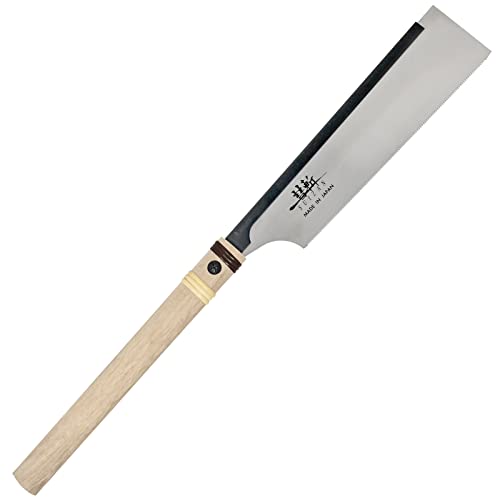
The SUIZAN D-001 is a full-size 240 mm dozuki made in Sanjo, Japan, a city with a long metalworking tradition. Its 25 TPI crosscut teeth and 0.3 mm plate produce a kerf of about 0.5 mm, fine enough for crisp dovetail baselines and clean tenon shoulders. The carbon steel spine keeps the thin blade rigid, and the wingnut-wood handle wrapped in rattan gives a secure, comfortable grip.
This is the most versatile budget pick here: the blade length handles wider casework boards, the tooth count suits both softwood and hardwood joinery, and replacement blades are readily available when the original dulls. Woodworkers building a first hand-tool kit for dovetails, boxes and small tenons get a lot of capability from this one saw.
Specs:
- Blade length: 9.5 inches (240 mm)
- Tooth pattern: 25 TPI, crosscut
- Blade thickness: 0.012 inch (0.3 mm)
- Kerf: 0.02 inch (0.5 mm)
- Blade material: Japanese steel
- Spine: Carbon steel
- Handle: Japanese wingnut wood with rattan wrap
- Overall length: 21.57 inches
- Weight: 6.7 ounces
- Blade: Replaceable
- Model: D-001
Gyokucho Razorsaw Dozuki No. 370 (240 mm)

Tier: Mid-range
The Gyokucho No. 370 is the fine-finish member of the Razorsaw dozuki family. With 25 TPI on a 240 mm blade that is only 0.3 mm thick, it is tuned for smooth, precise cuts in joinery where the sawn surface is close to the final surface. The cutting depth of 51 mm covers drawer boxes, frame parts and most furniture dovetails without the spine fouling the work.
Like other Razorsaw models, the 370 uses impulse-hardened teeth that cannot be resharpened with a file, balanced by a replaceable blade system: a worn blade is swapped for a fresh one rather than sharpened. It suits woodworkers who want the cleanest possible cut straight off the saw and are happy to treat blades as consumables.
Specs:
- Blade length: 240 mm (9.5 inches)
- Tooth pattern: 25 TPI
- Blade thickness: 0.3 mm
- Depth of cut: 51 mm (2 inches)
- Blade material: High-speed steel, impulse-hardened teeth
- Blade: Replaceable
- Model: 370
SUIZAN Dozuki Dovetail Saw 8 Inch (D-002)

Tier: Premium
The SUIZAN D-002 is a specialist for the finest work in this roundup. Its blade is ground to just 0.008 inch thick, which the maker describes as an exceptionally thin plate, and it carries 30 TPI for an ultra-fine cut. That combination leaves a hairline kerf and a very smooth wall, which helps when fitting small drawers, instrument work, kumiko-style lattice and other delicate joinery where every fraction of a millimeter shows.
The shorter 210 mm blade gives up some stroke length compared with the 240 mm saws, so it is slower across wide boards, but for detail work the control is the point. The wooden handle keeps the traditional dozuki feel, and the whole saw weighs only 6 ounces.
Specs:
- Blade length: 8 inches (210 mm)
- Tooth pattern: 30 TPI, crosscut
- Blade thickness: 0.008 inch (0.2 mm)
- Blade material: Japanese steel
- Handle material: Wood
- Overall length: 20.28 inches
- Weight: 6 ounces
- Model: D-002
Gyokucho 770-3500 Razor Dozuki Saw (No. 290)

Tier: Budget
The Gyokucho 770-3500, also known as the No. 290, is the compact entry in the Razorsaw line. Its 180 mm blade and 17 TPI make it a handy size for small boxes, model-scale joinery and dovetails in thin drawer stock, where a full-size 240 mm saw can feel oversized. The high-speed steel blade uses the same replaceable-blade system as the larger Razorsaw models, so a dull blade is a quick swap rather than a sharpening job.
The molded plastic handle is plain compared with the rattan-wrapped handles elsewhere in this guide, but it keeps the saw light and inexpensive. As a first dozuki for learning to cut dovetails by hand, or as a small second saw alongside a larger one, it covers the essentials at the lowest tier here.
Specs:
- Blade length: 180 mm (7.09 inches)
- Tooth pattern: 17 TPI
- Blade material: High-speed steel
- Handle material: Plastic
- Blade: Replaceable
- Model: 770-3500 (No. 290)
- Distributor: Robert Larson Co
Dovetail Saw Buying Guide
Rip versus crosscut teeth
Dovetail tails and pins are rip cuts, so a rip-ground tooth pattern tracks best on the cuts that define the joint. Crosscut-pattern dozuki saws still cut dovetails, and their finer teeth often leave a smoother shoulder line, but they can feel slower and fuzzier along the grain. If you cut dovetails more than anything else, favor a rip pattern like the Gyokucho 372. If the saw will also handle tenon shoulders and general small joinery, a crosscut pattern is a reasonable compromise.
Tooth count and stock thickness
Fine teeth suit thin stock. A useful rule is to keep at least three teeth in contact with the wood: for drawer sides around 3/8 to 1/2 inch thick, a 25 to 30 TPI saw stays smooth and controllable, while 17 to 20 TPI clears waste faster in 3/4 inch casework stock. Very fine teeth in thick hardwood cut slowly, and coarse teeth in thin stock can feel grabby and tear the fibers.
Kerf and plate thickness
A thinner plate leaves a narrower kerf, which means less material removed, less paring to fit the joint and less effort per stroke. Japanese dozuki plates around 0.3 mm leave kerfs near 0.5 mm, and the SUIZAN D-002 goes thinner still. The compromise is fragility: thin plates kink if they are forced or twisted, so technique matters more as the plate gets thinner.
Blade length and depth of cut
Blade length sets stroke length. A 240 mm blade covers most furniture work comfortably, while 180 to 210 mm blades trade speed for control in small parts. Depth of cut is limited by the spine on any backsaw or dozuki, typically around 2 inches, which is ample for dovetails but rules these saws out for deep tenons or resawing.
Replaceable blades versus resharpening
Impulse-hardened Japanese teeth are too hard to file, so dozuki blades are replaced when dull. Western dovetail saws and a few traditional models use softer steel that can be resharpened many times. Neither approach is wrong: replaceable blades give a factory-fresh edge in seconds, while resharpenable saws reward the skill of maintaining your own teeth and avoid ongoing blade purchases.
Handle style
Rattan-wrapped wooden handles, traditional on Japanese saws, offer grip without bulk and keep weight low. Molded plastic handles cost less and shrug off workshop knocks. On Western saws, a closed pistol-grip handle gives the most control for push cutting. Handle comfort is personal, but weight is not: every saw in this guide is under 9 ounces, so fatigue rarely decides the choice.
Frequently Asked Questions
Should a dovetail saw be rip or crosscut?
Rip is the better match for dovetails, because tail and pin cuts run along the grain and rip teeth are shaped to slice fibers in that direction. A crosscut-pattern saw will still complete the joint and is often finer toothed, but it usually cuts more slowly along the grain and can leave a rougher kerf wall that needs more cleanup.
What TPI is best for a dovetail saw?
For most furniture dovetails in stock between 1/2 and 3/4 inch thick, 17 to 25 TPI is the practical range. Choose the finer end, 25 to 30 TPI, for thin drawer sides and delicate work, and the coarser end for thicker casework stock where waste removal speed matters more than surface finish.
Can a Japanese dozuki replace a Western dovetail saw?
For dovetails and small joinery, yes. A dozuki does the same work with a thinner kerf and a pull stroke that many woodworkers find easier to control. The differences are habit and maintenance: the pull stroke takes a short adjustment period, the spine limits depth to about 2 inches, and hardened blades are replaced rather than sharpened.
Are replaceable saw blades a drawback?
Not for most users. A replacement blade restores a factory-ground edge in under a minute, with no files, saw sets or sharpening skill required. The ongoing cost is a new blade when the old one dulls. Woodworkers who enjoy sharpening, or who cut daily, may prefer a resharpenable Western saw, but for occasional joinery the replaceable system is the simpler path.
Conclusion
For hand-cut dovetails, the Gyokucho 372 Rip Dozuki is the most focused tool here, with rip-ground teeth and a thin, replaceable blade built for the exact cuts a dovetail joint needs. The SUIZAN D-001 is the value pick for a first dozuki, the Gyokucho No. 370 favors the finest finish, the SUIZAN D-002 serves delicate detail work, and the Gyokucho 770-3500 covers small-scale joinery at the lowest tier. Match tooth pattern to grain direction first, then tooth count to your stock thickness, and any of these five saws will cut clean, accurate dovetails.
Related guides
More from Amazon
Programs that pair well with the guide above. Offers and eligibility are set by Amazon and may change.
A free business account with business pricing and bulk-buying tools for work, shop or home office.
Create a business accountFree shipping on eligible items, Prime Video and more. Eligible new members can start with a free trial.
Start a Prime free trialAudiobooks and podcasts to listen to on the go. Eligible new members can start with a free trial.
Try Audible freeAd-free music streaming. Eligible new subscribers can start with a free trial.
Try Music Unlimited freeAs an Amazon Associate we earn from qualifying purchases.