What's inside
- Forehead vs. Ear: How They Work and Who Each Suits Best
- What to Compare Before You Choose
- Spec Comparison: Common Forehead and Ear Models in 2026
- Best Picks by Family Situation
- Decision Matrix: Match Your Household to the Right Type
- Ownership Realities: What Wears First and How to Keep Readings Consistent
- Frequently Asked Questions
- Forehead vs. Ear: How They Work and Who Each Suits Best
- What to Compare Before You Choose
- Spec Comparison: Common Forehead and Ear Models in 2026
- Best Picks by Family Situation
- Decision Matrix: Match Your Household to the Right Type
- Ownership Realities: What Wears First and How to Keep Readings Consistent
- Frequently Asked Questions
As an Amazon Associate I earn from qualifying purchases. This post may contain affiliate links at no extra cost to you.
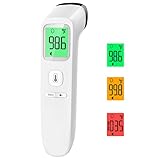
The best infrared thermometers for adults and kids are non-contact forehead models for newborns and toddlers who won’t stay still, and ear models like the Braun ThermoScan series for older children and adults who need slightly tighter accuracy when technique is correct — most families do best with a forehead thermometer as the primary device and add an ear thermometer only if you want a second check for school-age kids and adults.
As an Amazon Associate we earn from qualifying purchases at no extra cost to you.


Contents
- Forehead vs. Ear: How They Work and Who Each Suits Best
- What to Compare Before You Choose
- Spec Comparison: Common Forehead and Ear Models in 2026
- Best Picks by Family Situation
- Decision Matrix: Match Your Household to the Right Type
- Ownership Realities: What Wears First and How to Keep Readings Consistent
- Frequently Asked Questions
Forehead vs. Ear: How They Work and Who Each Suits Best
Both types are infrared thermometers, but they measure different sites. Forehead (temporal) models read infrared heat from the temporal artery on the forehead, either with no contact or a light sweep. Ear (tympanic) models read infrared heat from inside the ear canal, close to the eardrum.
That difference drives age suitability:
- Forehead / non-contact: Works at a distance of 1-3 cm, so you can measure a sleeping baby without waking them. No ear canal positioning required, which is why pediatricians often suggest this type for infants under 6 months. Accuracy depends heavily on sweat, hair, ambient temperature, and distance.
- Ear: Requires a proper seal in the ear canal and a gentle pull on the outer ear to straighten the canal. Easier to get a consistent reading once children are 6 months to 1 year and older and can sit still for 2-3 seconds. Poor fit in small or waxy canals is the most common source of low or error readings.
- Dual-mode forehead + ear: Models like some iHealth and Withings designs offer both. Versatile, but you trade simplicity for more parts to clean.
For mixed-age households, silent mode, reading speed, and hygiene often matter more than a 0.2-degree spec difference. If you will take temperatures at night, prioritize a backlit display with mute and a non-contact design.
What to Compare Before You Choose
Use these five criteria to narrow your shortlist:
1. Reading Speed and Technique Sensitivity
Most modern infrared thermometers report in 1 to 3 seconds. Forehead models are faster to position but sensitive to distance and sweat — wipe the forehead dry and hold steady at the distance stated in the manual. Ear models take slightly longer to position but are less affected by room temperature once sealed correctly.
2. Accuracy Features
Look for features that improve real-world consistency rather than lab accuracy claims alone:
- Age-adjustable fever thresholds (e.g., Braun Age Precision) that shift the fever guidance by age group
- ExacTemp or positioning sensors that confirm stable placement before measuring
- Multiple-reading memory with timestamps so you can track trends for a sick child or share with a clinician
- Calibration and ambient temperature compensation — general-purpose forehead thermometers may drift if stored in a cold bathroom or car
For general information only, no home thermometer replaces professional evaluation if you have concerns about fever, especially in newborns. Talk to your pediatrician or primary care provider about what reading should prompt a call.
3. Silent and Night Modes
If you measure sleeping children, check for a true mute function, not just low volume. Best implementations offer a silent button, a dimmable or color-coded backlight (green/yellow/red fever guidance), and vibration-free operation. Ear thermometers naturally make less light disturbance than aiming a forehead beam.
4. Hygiene for Family Use
Non-contact forehead thermometers are the most hygienic for shared use because nothing touches skin. Ear thermometers require disposable probe covers for each family member to avoid cross-contamination and earwax buildup on the sensor. Factor cover cost and availability into ownership.
5. Display, Memory, and Power
Large LED or LCD with fever color alerts helps tired parents read quickly. 20-50 reading memory is enough for a family cold cycle. Most models use 2x AAA batteries, a small number use CR2032 or rechargeable cells via USB-C — AAA models are easier to replace quickly at night.
Spec Comparison: Common Forehead and Ear Models in 2026
The market changes frequently, but these established types illustrate typical trade-offs. Specifications are representative of current-generation retail versions and may vary slightly by sub-model.
| Model Type | Measurement Site | Reading Time | Weight (with batteries) | Memory | Battery & Life | Hygiene Needs |
|---|---|---|---|---|---|---|
| Braun ThermoScan 7 (IRT6520) – Ear | Ear (tympanic) | 2-3 seconds | ~95g, 128mm x 45mm x 32mm | 9 readings | 2x AA, ~500-800 readings | Disposable probe cover required (Hygiene caps) |
| Exergen TemporalScanner TAT-5000 – Forehead contact | Forehead (temporal artery, light contact sweep) | 2-3 seconds | ~120g, 152mm x 45mm x 30mm | 0 (instant read) on base model | 9V battery, ~1,000 readings | Wipe sensor with alcohol swab, no covers |
| Withings Thermo – Forehead non-contact | Forehead non-contact (temporal) | ~2 seconds, plus sync time | ~75g, 120mm x 35mm x 25mm | Unlimited via app, 8 on device | 2x AAA, ~18 months typical use | Non-contact, wipe clean; app tracks family profiles |
| iHealth No-Touch PT3 – Forehead non-contact | Forehead non-contact | 1 second | ~90g, 150mm x 42mm x 38mm | 99 readings | 2x AAA, ~600 readings | Non-contact, no covers; vibration + mute option |
| Kinsa QuickScan – Forehead non-contact | Forehead non-contact | 1 second | ~70g, 118mm x 38mm x 22mm | App-based history | 2x AAA, ~800 readings | Non-contact, wipe clean; pairs with phone for guidance |
General price ranges in 2026: basic non-contact forehead thermometers typically run $20 to $45, app-connected forehead models $55 to $95, and ear thermometers with probe cover systems $35 to $70 before consumables.
Best Picks by Family Situation
Best for Newborns and Toddlers: Non-Contact Forehead Thermometer
Choose a non-contact forehead model with mute, fever color light, and 1-second reading. You can measure without touching or repositioning the child. The iHealth PT3 and Kinsa QuickScan types excel here because they are lightweight, silent, and forgiving of movement. Keep the room at a stable temperature and hold the distance exactly as instructed.
Best for Accuracy-Focused Parents of Older Kids and Adults: Ear Thermometer
If your household is mostly adults and children over 12 months who can cooperate, an ear model like the Braun ThermoScan 7 offers very consistent repeat readings when you use a fresh probe cover and correct ear-tug technique. Age Precision and ExacTemp guidance reduce user error, which is the main failure point for ear readings.
Best for Night Checks and Shared Family Use: Forehead with Silent Mode
The Withings Thermo or similar backlit non-contact forehead thermometer with true mute and multi-user app profiles is ideal. You can take a reading in a dark room, see green/yellow/red at a glance, and log each family member separately without waking anyone.
Best Budget Simple Choice: Basic Non-Contact Forehead
A basic 1-second forehead thermometer with 30+ reading memory, mute, and AAA batteries covers most families without app fees or cover costs. You give up advanced fever guidance and app tracking, but gain simplicity and lower running costs.
Decision Matrix: Match Your Household to the Right Type
| Your Situation | Recommended Type | Why |
|---|---|---|
| Infant under 6 months in the house | Non-contact forehead | No ear canal insertion, can measure while sleeping, easier hygiene |
| Frequent night checks for 2+ kids | Non-contact forehead with mute + backlight | Silent operation and color fever alert prevent waking the household |
| Adults + school-age kids, want repeatable spot checks | Ear with probe covers | Less affected by sweat/ambient temp once sealed correctly |
| Want phone log to share with clinician | App-connected forehead (Withings/Kinsa type) | Automatic history, family profiles, trend charts |
| Minimize ongoing costs | Non-contact forehead (no covers) | No consumables; see calculation below |
Ownership Realities: What Wears First and How to Keep Readings Consistent
Worked Calculation: Cost Per Use With vs. Without Probe Covers
Ear thermometers need a new probe cover for each reading. Forehead non-contact models do not.
Example for a family of four during a 5-day illness: 3 readings per day per sick person x 2 sick people x 5 days = 30 readings. If probe covers cost $0.12 to $0.18 each in bulk packs of 40-60, that episode costs $3.60 to $5.40 in covers. Over a year with 4-6 illness episodes (120-180 readings), annual cover cost is roughly $14 to $32. A basic forehead thermometer avoids that entirely, while a rechargeable or AAA-powered forehead model costs only battery replacement — about $4 to $8 per year for AAA alkalines at typical use.
Cleaning and Durability
- Sensor lens: The infrared sensor is the first part to degrade accuracy. Never touch it with fingers. Clean with a cotton swab lightly dampened with 70% isopropyl alcohol, then air dry. Ear models get wax buildup fastest — inspect the tip before each use.
- Probe cover system: On ear models, the eject mechanism and cover detector wear with drops. Store in the included case, not loose in a drawer.
- Batteries: Remove batteries if storing for more than a month to prevent corrosion. Low battery often causes “Lo” or inconsistent readings before the indicator appears — replace early during fever episodes.
- Common mistakes that cause errors: Measuring forehead with sweat, hat, or after coming indoors from cold; measuring ear with incorrect angle or flat ear tug; measuring immediately after a bath or hot drink; storing the thermometer in a bathroom where humidity and temperature swing wide. Let the device and the person acclimate to room temperature for 15-20 minutes for most consistent results.
Setup and Care Steps
When you bring a new thermometer home: 1) Install batteries and set units to Fahrenheit or Celsius, set date/time if it has memory. 2) Enable silent mode and test the backlight in a dark room. 3) Run 2-3 practice readings on healthy family members to learn correct distance or ear positioning. 4) Store at 16-30 C, not in a cabinet above a heater or in a cold garage. 5) Wipe after each use and keep probe covers sealed until use.
Frequently Asked Questions
Can I use the same thermometer for adults and kids?
Yes, most infrared thermometers are rated for all ages, but technique matters. Use forehead mode for infants and sleeping children, ear mode only when the child can sit still and you can get a good seal. Some ear models have smaller probe tips that fit children better — check the manual for age guidance.
Why do I get different readings on forehead and ear?
Different sites measure slightly different tissue temperatures, and infrared readings shift with technique, sweat, and room temperature. A difference of 0.3 to 0.6 degrees between sites or successive readings is common. Track trends with the same device and site, at the same distance or ear, rather than comparing across sites.
Do I need Wi-Fi or an app?
No. Apps help log family history and remind you when to recheck, but a basic model with on-device memory and a fever color light is sufficient for most households. Choose app models only if you want to export or share logs.
General information only — not medical advice. If you are concerned about a fever, especially in an infant under 3 months, or if fever is high, prolonged, or accompanied by other symptoms, contact your healthcare provider promptly.