What's inside
As an Amazon Associate I earn from qualifying purchases. This post may contain affiliate links at no extra cost to you.
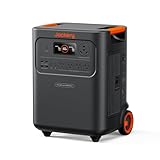
The best Jackery power station depends on the job: choose the Explorer 300 Plus for lightweight camping, the Explorer 1000 v2 for most weekend and emergency needs, and the Explorer 2000 v2 or 2000 Plus when you need to run workshop tools with high starting loads.
As an Amazon Associate we earn from qualifying purchases at no extra cost to you.


Contents
Best Jackery power stations at a glance
| Model | Capacity | AC output | Approx. weight | Solar input | Best suited to |
|---|---|---|---|---|---|
| Explorer 300 Plus | 288Wh | 300W continuous | 3.75kg | Up to 100W | Light camping, phones, cameras, small electronics |
| Explorer 500 | 518Wh | 500W continuous | 6.4kg | Up to 200W | Budget camping and short emergency use |
| Explorer 1000 v2 | 1,070Wh | 1,500W continuous | 10.8kg | Up to 400W | Best all-rounder for home backup and camping |
| Explorer 1000 Plus | 1,264Wh | 2,000W continuous | About 14.5kg | Up to 400W | Longer backup and expandable capacity |
| Explorer 2000 v2 | 2,042Wh | 2,200W continuous | About 17.5kg | Up to 400W | Power-hungry appliances and serious backup |
| Explorer 2000 Plus | 2,042Wh | 3,000W continuous | About 27.9kg | Up to 1,400W with suitable input setup | Workshop tools and expandable home backup |
Weights, outlet arrangements, charging limits, and included accessories can differ by country. Check the regional specification sheet before buying, particularly if you need a specific socket type or a high solar-input limit.
Which Jackery is best for camping?
Best lightweight choice: Explorer 300 Plus
The Explorer 300 Plus is the easiest model to carry to a campsite, especially where the power requirement is mostly phones, lights, a camera battery charger, a small fan, or a laptop. Its 288Wh battery is modest, but the unit is small enough to pack without turning power into a major part of your camping load.
It has USB-C and USB-A charging alongside AC power, so many camping devices can be connected without wasting energy through an AC adapter. A practical load might be a 60W laptop, two phones, and LED lighting. It is not a sensible choice for a kettle, heater, microwave, induction hob, or power tool.
Best for a family campsite: Explorer 500
The Explorer 500 provides a useful step up in capacity without becoming difficult to move. Its 518Wh battery can cover several days of light electronic use, or a shorter period with a portable fridge or other continuous load. It remains limited for heating appliances: a 1,000W kettle would exceed its inverter rating even though the battery has enough watt-hours to run it briefly.
Best Jackery for emergency backup
Best overall: Explorer 1000 v2
For most households, the Explorer 1000 v2 is the best balance of capacity, output, portability, and recharge speed. Its 1,070Wh battery and 1,500W inverter can support a refrigerator, modem, lights, chargers, and selected kitchen appliances, provided their combined running and starting demands stay within the output limits.
Its lithium iron phosphate battery chemistry is a significant ownership advantage over older lithium-ion designs. LiFePO4 cells generally tolerate more charge cycles and are less prone to rapid capacity loss when used regularly. The trade-off is that the unit is heavier than a similarly sized compact power station.
For an outage, connect essential loads rather than the whole house. A refrigerator, router, a few LED lamps, and phone chargers are realistic. Electric heaters, immersion heaters, and hot plates consume the battery quickly and are usually poor matches for portable battery backup.
When the Explorer 1000 Plus makes more sense
Choose the Explorer 1000 Plus if you want more usable capacity or expect to expand later. Its 1,264Wh battery and 2,000W inverter give more headroom for appliances with demanding startup currents. Compatible expansion batteries can increase total storage, but that adds cost, weight, and charging complexity. Expansion is worthwhile for frequent outages; it is unnecessary if the station will only be used for occasional phone charging.
Best Jackery for a woodworking workshop
For light-duty tools: Explorer 1000 Plus
The Explorer 1000 Plus can suit a small workshop when the tools are intermittent and relatively efficient. Battery chargers, LED work lights, a compact soldering station, a small trim router, or a low-power jigsaw are more realistic than a table saw or dust extractor.
Check the tool nameplate and startup behavior. A motor marked at 900W may draw substantially more for a fraction of a second when starting. The power station’s continuous output is only part of the decision; surge capability and the tool’s starting current matter just as much.
For demanding tools: Explorer 2000 Plus
The Explorer 2000 Plus is the stronger workshop option because its 3,000W inverter provides considerably more headroom for motor startup. It is still not a universal substitute for a mains circuit. A large table saw, shop vacuum, compressor, or dust collector may have a startup surge that defeats even a high-rated portable inverter.
Use it for short cuts and intermittent jobs rather than expecting a full day of production. A power station converts stored energy into AC power with losses, and a motor tool can empty a large battery surprisingly quickly. Keep the unit on a stable, dry surface and allow ventilation around its cooling openings.
Runtime calculation: how much battery do you need?
Power-station capacity is measured in watt-hours, but the full printed capacity is not delivered to AC equipment. Inverter losses, battery-management limits, and temperature reduce practical output. A useful planning estimate is:
Usable AC watt-hours = rated capacity × 0.85
Suppose you want to run a 60W laptop, a 10W router, and two 5W LED lights for six hours. The calculation is:
- Combined load: 60W + 10W + 5W + 5W = 80W
- Required energy: 80W × 6 hours = 480Wh
- Approximate battery needed: 480Wh ÷ 0.85 = 565Wh
That makes the Explorer 500 marginal for this example, while the Explorer 1000 v2 leaves useful reserve for phone charging, cold weather, or additional runtime. For motor tools, calculate from the tool’s measured running draw where possible, then allow extra capacity for startup and short-term overloads.
Solar input and recharge time
Solar charging is useful, but the panel’s advertised wattage is a maximum under favorable conditions. Angle, clouds, shade, heat, and cable losses all reduce actual input. A 400W solar array might average 200–300W during a good part of the day rather than delivering 400W continuously.
As an example, replenishing roughly 850Wh after losses through a 400W solar input would require at least 2.1 hours at a perfect 400W. In real outdoor conditions, plan on approximately three to five hours of strong sunlight, and longer in winter or partial shade. Smaller stations with 100W input can be convenient for camping but may take most of a day to refill a heavily depleted battery.
Fast AC charging is usually the practical choice before leaving home. Solar is best treated as a way to extend an outing or recover energy during a prolonged outage, not as a guaranteed replacement for mains charging.
Decision matrix for choosing a Jackery
| Your situation | Recommended model | Why | Main limitation |
|---|---|---|---|
| Lowest weight and occasional use | Explorer 300 Plus | Easy to carry and efficient for USB devices | Cannot run high-wattage appliances |
| Budget camping with more reserve | Explorer 500 | 518Wh capacity without a large footprint | Limited inverter output |
| One station for camping and outages | Explorer 1000 v2 | Good capacity-to-weight ratio and 1,500W output | Not suitable for every heating or workshop load |
| Frequent outages or future expansion | Explorer 1000 Plus | Higher output and expandable storage | Heavier and more expensive |
| Large appliances and workshop tools | Explorer 2000 v2 or 2000 Plus | Large battery and stronger inverter options | Heavy; motor startup must still be checked |
Ownership realities and maintenance
The battery is not usually the first thing to wear out through normal use; connectors, fans, cables, and the inverter’s cooling system are more likely to cause practical problems. Keep dust away from vents, especially in a woodworking shop. Sawdust can restrict airflow and accumulate around fans, so inspect the housing regularly and clean it with a soft brush or low-pressure air while following the manufacturer’s safety guidance.
- Do not store the station fully empty. Recharge it periodically if it will sit unused.
- Keep it dry and out of direct heat. A vehicle interior in strong sun can become too hot for safe storage.
- Do not exceed the AC, USB, or solar-input ratings.
- Use undamaged cables and stop using a cable that becomes hot, frayed, or loose.
- For workshop use, place the unit away from fine dust, rain, solvents, and moving machinery.
- Before an outage, test the actual devices you intend to power rather than relying only on their label ratings.
For most buyers, the Explorer 1000 v2 is the best Jackery power station to start with. Pick the Explorer 300 Plus when portability matters most, the Explorer 500 for economical camping, the 1000 Plus for expandable backup, and the 2000 Plus when high inverter output is more important than carrying weight.