What's inside
As an Amazon Associate I earn from qualifying purchases. This post may contain affiliate links at no extra cost to you.
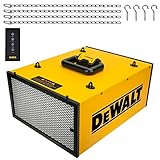
The best air filtration system under $400 for woodworking is the JET AFS-1000B for balanced airflow, filtration, timer control, and build quality; choose the WEN 3410 for the lowest-cost small-shop option, or the Shop Fox W1666 when maximum circulation matters more than compact size.
These machines are ceiling- or wall-mounted ambient-air cleaners. They are not substitutes for dust collection at a table saw, router, planer, or sander, and they do not capture every hazardous particle before it reaches your breathing zone. Their job is to recirculate the shop air through filters after the source dust has been collected.
As an Amazon Associate we earn from qualifying purchases at no extra cost to you.

Contents
Best air filtration systems under $400: quick comparison
| System | Typical market range | Published airflow | Filtration arrangement | Timer | Recommended room size | Best for |
|---|---|---|---|---|---|---|
| JET AFS-1000B | $300–$400 | 550 / 702 / 1,044 CFM | Outer filter about 5 microns; inner filter about 1 micron | Yes, up to 9 hours | Up to about 800 sq. ft. with suitable air mixing | Best overall balance |
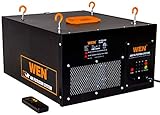
| WEN 3410 | $120–$200 | 556 / 702 / 1,044 CFM | Outer filter about 5 microns; inner filter about 1 micron | Yes, 1, 2, or 4 hours | About 400–500 sq. ft. | Budget shops and garages |
| Shop Fox W1666 | $250–$350 | Up to about 1,100 CFM | Two-stage filter system, commonly specified around 5 and 1 micron | Yes, remote-controlled timer | About 600–800 sq. ft. | High-airflow circulation |
| Grizzly G0738 | $250–$350 | Up to about 1,300 CFM | Outer filter about 5 microns; inner filter about 1 micron | Yes, remote-controlled timer | About 600–800 sq. ft. | Larger hobby shops |
Airflow figures are manufacturer-rated maximums, not guaranteed airflow through a loaded filter. Room-size estimates assume a reasonably enclosed room, a clear return path, and enough circulation to prevent stagnant corners. Check the current manual before buying because filter specifications and control details can vary by production run.
Head-to-head: which system is strongest for your situation?
Best overall: JET AFS-1000B
The JET AFS-1000B is the safest recommendation when you want a well-rounded machine rather than the lowest price or the largest headline CFM number. Its three speed settings let you trade airflow for noise, and its two-stage filter arrangement is appropriate for the fine airborne residue left after normal shop cleanup. The long timer range is useful when you want the unit to continue running after leaving the shop.
Its main limitation is value. At the upper end of the under-$400 category, it can cost roughly twice as much as a budget unit with similar published airflow. The premium makes more sense for a frequently used shop, a ceiling-mounted installation that you do not want to replace soon, or a user who values accessible replacement filters and a more established woodworking-tool ecosystem.
Best budget choice: WEN 3410
The WEN 3410 gives a small woodworking shop the core features that matter: three speeds, remote control, a timer, and approximately 1,044 CFM at the highest setting. Its 1-micron inner filter is a useful specification, but it should not be interpreted as proof that all particles leaving the machine are exactly 1 micron or larger. Real-world performance depends on filter sealing, filter condition, fan speed, and leakage around the housing.
This is the best air filtration system under 400 when your shop is modest in size and your budget is better spent on source capture, ducting, or a quality respirator. The shorter timer choices—1, 2, and 4 hours—are sufficient for most small shops, although they offer less flexibility than the JET or some Shop Fox and Grizzly models.
Best for airflow: Grizzly G0738
The Grizzly G0738 is attractive for a larger hobby shop because its maximum published airflow is around 1,300 CFM. That extra circulation can shorten the time required to process the room’s air after sanding or sawing. It is also a sensible choice when the machine will run at medium speed most of the time and needs reserve capacity for particularly dusty sessions.
Do not choose it solely by dividing 1,300 by room size. A high-CFM unit can still perform poorly if mounted in a corner, blocked by lumber, or operated with a clogged filter. It may also be louder at full speed than a lower-output machine running at medium speed.
Best alternative for a value-conscious larger shop: Shop Fox W1666
The Shop Fox W1666 sits between budget and premium choices. It offers roughly 1,100 CFM, a two-stage filter design, multiple speeds, and remote timer control. It is a good fit when you want more substantial shop equipment than a basic garage unit but cannot justify the top end of the price range.
Its value depends on local replacement-filter pricing. Before ordering, price both the outer and inner filters. A low purchase price can lose its advantage if replacement media is difficult to find or costs nearly as much as the original unit.
How to size an air filtration unit
Use air changes per hour rather than the manufacturer’s room-size label alone. The basic calculation is:
Air changes per hour = CFM × 60 ÷ room volume in cubic feet.
For example, a 20-by-20-foot shop with an 8-foot ceiling contains 3,200 cubic feet. A 1,044-CFM unit theoretically provides:
1,044 × 60 ÷ 3,200 = about 19.6 air changes per hour.
That is a strong theoretical result, but actual circulation will be lower because published CFM is normally a maximum rating, filters add resistance, and room geometry creates dead zones. Mounting the unit near the ceiling with several feet of clearance and aiming the discharge across the room improves mixing. A portable fan can also move air through a corner the filter cannot reach directly.
- Up to 400 square feet: the WEN 3410 is usually adequate if source dust collection is good.
- 400–700 square feet: consider the JET AFS-1000B or Shop Fox W1666.
- 700–800 square feet: the Grizzly G0738 offers useful airflow headroom, but verify ceiling height and actual room volume.
- Open-plan or very tall spaces: use the room’s full cubic-foot volume, not floor area; one under-$400 unit may not be enough.
Noise, controls, and everyday usability
Manufacturers do not consistently publish comparable decibel measurements, so published CFM is easier to compare than noise. In practice, the lowest speed is the most comfortable for conversation and finishing work, while medium speed is often the best compromise between noise and cleaning. High speed is useful immediately after heavy sanding but may be unnecessarily loud for continuous operation.
Remote controls are more useful than they appear. A ceiling-mounted unit can be switched between speeds without climbing a ladder, and a timer prevents the common mistake of shutting the machine off as soon as the tool stops. Letting filtration continue after dusty work gives suspended particles more time to pass through the filters, although it does not make an unsafe dust cloud safe to breathe while it is present.
Maintenance and ownership costs
The outer filter loads first because it catches the larger material. Inspect it every few weeks in regular use and sooner after sanding MDF, drywall compound, or finishes that produce fine residue. Replace filters when they are visibly damaged, remain dirty after approved cleaning, or cause a noticeable drop in airflow. Do not wash a filter unless the manual specifically permits it; moisture can damage the media and encourage mold.
- Turn off and unplug the unit before opening the filter access panel.
- Support the filter while removing it so accumulated dust does not spill into the shop.
- Vacuum the housing and sealing surfaces rather than blasting dust deeper into the motor.
- Check the filter gasket for gaps, compression, and tears.
- Keep replacement filters sealed until needed.
The fan motor and filter seals generally outlast the filters. The parts most likely to affect performance are loaded filter media, compressed gaskets, a stretched drive or mounting component where fitted, and dust buildup on the fan. A filter that looks only moderately dirty can still create substantial airflow resistance, so a decline in circulation is a reason to inspect it rather than simply selecting a higher fan speed.
Decision matrix
| Your priority | Recommended choice | Why |
|---|---|---|
| Lowest purchase cost | WEN 3410 | Provides three speeds, timer control, and roughly 1,044 CFM at a relatively low market price. |
| Frequent woodworking and balanced ownership | JET AFS-1000B | Strong airflow, useful timer range, and a robust feature set without exceeding the stated budget range. |
| Larger room or high sanding frequency | Grizzly G0738 | Its higher published maximum airflow provides more circulation capacity. |
| Medium-size shop with emphasis on value | Shop Fox W1666 | Offers approximately 1,100 CFM and two-stage filtration in the middle of the price range. |
| Quiet continuous operation | Any three-speed model, operated on low or medium | Speed control matters more than maximum CFM; check filter loading to preserve airflow at the quieter setting. |
Final recommendation
Choose the JET AFS-1000B if you want the strongest all-around answer to the best air filtration system under 400. Choose the WEN 3410 for a compact, inexpensive shop, the Shop Fox W1666 for a middle-ground value purchase, and the Grizzly G0738 when airflow capacity is your first priority. Whichever model you buy, connect it with effective tool-level dust collection, seal obvious air leaks, and keep the unit running after dusty work rather than treating ambient filtration as the primary safety control.