What's inside
- Quick comparison of compact shop carts
- Best choices by workshop situation
- Head-to-head: open utility cart versus steel drawer cart
- What the dimensions mean in a real shop
- Casters, maneuverability, and stability
- Capacity: calculate usable storage, not advertised volume
- Durability and ownership realities
- Bottom line
- Related Guides
- Quick comparison of compact shop carts
- Best choices by workshop situation
- Head-to-head: open utility cart versus steel drawer cart
- What the dimensions mean in a real shop
- Casters, maneuverability, and stability
- Capacity: calculate usable storage, not advertised volume
- Durability and ownership realities
- Bottom line
- Related Guides
As an Amazon Associate I earn from qualifying purchases. This post may contain affiliate links at no extra cost to you.
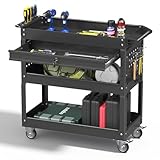
The best compact shop storage cart for most small workshops is a narrow, locking three-drawer steel cart about 27 inches wide, 18 inches deep, and 35 inches high; choose a lighter three-tier utility cart when open access matters more than security, or a two-shelf service cart when you regularly move heavy tools.
Small shops do not need the cart with the most drawers—they need one that uses vertical space without blocking a walkway, bench, or machine infeed. The comparisons below focus on outside dimensions, usable storage, caster behavior, and stability rather than drawer count alone.
As an Amazon Associate we earn from qualifying purchases at no extra cost to you.


Contents
- Quick comparison of compact shop carts
- Best choices by workshop situation
- Head-to-head: open utility cart versus steel drawer cart
- What the dimensions mean in a real shop
- Casters, maneuverability, and stability
- Capacity: calculate usable storage, not advertised volume
- Durability and ownership realities
- Bottom line
- Related Guides
Quick comparison of compact shop carts
| Cart type or example | Approx. outside size | Storage arrangement | Typical load | Best use |
|---|---|---|---|---|
| IKEA RÅSKOG utility cart | 17.75 W × 13.75 D × 30.5 H in. | Three open steel baskets | About 44 lb total | Hand tools, abrasives, glue, and frequently used supplies |
| WEN 73002 two-shelf service cart | About 32 W × 16 D × 34 H in. | Two open shelves | Up to 500 lb, depending on configuration | Portable power tools, hardware bins, and heavier loads |
| 27-inch three-drawer steel rolling cart | About 27 W × 18 D × 35 H in. | Three drawers plus lower shelf or cabinet | Roughly 300–500 lb total | General-purpose woodworking storage |
| Seville Classics UltraHD rolling cabinet | About 24 W × 18 D × 36 H in. | Drawers and enclosed lower storage | Varies by model; commonly several hundred pounds | Compact tool security and dust reduction |
| 26-inch four-drawer steel service cart | About 26 W × 18 D × 34–36 H in. | Four shallow or medium drawers | Typically 300–500 lb total | Small tools that need individual organization |
Dimensions are useful planning figures, not a substitute for the current manufacturer specification. Caster stems, handles, drawer pulls, and lids can add several inches, so measure the fully assembled cart before committing to a tight location.
Best choices by workshop situation
| Your situation | Most suitable choice | Why |
|---|---|---|
| Less than 18 inches of available floor depth | IKEA RÅSKOG-style three-tier cart | Its narrow footprint fits beside benches and machines, and the baskets remain accessible from both sides. |
| You move clamps, routers, drills, or a benchtop planer | Two-shelf steel service cart | Large shelves accept bulky tools and a higher load rating reduces concern about overloaded drawers. |
| You want one cart for layout, hand tools, and finishing supplies | 27-inch three-drawer steel cart | Drawers protect small items while the lower shelf holds cases, glue, or a shop vacuum hose. |
| Your shop is dusty or shared with other household storage | Enclosed rolling cabinet | Doors and drawers reduce airborne dust and make it harder for supplies to be misplaced. |
| You need the lowest-cost organization | Open utility cart with removable bins | The cart is inexpensive to equip and can be reconfigured without buying drawer accessories. |
Head-to-head: open utility cart versus steel drawer cart
Open carts win on access and footprint
A three-tier cart such as the RÅSKOG is exceptionally efficient where every inch matters. At roughly 17.75 inches wide and 13.75 inches deep, it occupies about 1.7 square feet of floor area. That is small enough to park beside a workbench without consuming a full standing position.
The open baskets also make it easy to see sanding discs, marking tools, router bits, and bottles at a glance. The trade-off is limited protection. Fine dust settles directly on the contents, and the shallow baskets encourage piles rather than deliberate organization. A cart this light may also roll or tip if a heavy item is placed high and the cart is pushed over a threshold.
Drawer carts win on organization and center of gravity
A compact steel cart approximately 27 by 18 inches uses more floor space—about 3.4 square feet—but gives small tools a defined home. Put layout tools in the top drawer, measuring and marking accessories in the second, and heavier hand tools in the lowest drawer. The lower shelf can hold a cordless-tool case or a small parts organizer.
Steel drawer carts are usually more stable because their weight is concentrated low in the frame. They are still not miniature workbenches: pressing hard with a plane or chisel can make a narrow cart roll unless the casters are locked or the cart is positioned against a solid surface. Check whether the listed load rating applies to the entire cart or to each drawer; those figures are not interchangeable.
What the dimensions mean in a real shop
Use the cart’s complete operating envelope, not only its cabinet dimensions. A cart listed as 18 inches deep may need 21 to 24 inches of clearance once a handle, drawer pull, or open door is included. Leave at least 2 inches beside a stationary object so the cart can be pulled out without scraping it. In a main walkway, preserve approximately 30 inches of clear passage; 36 inches is more comfortable when two people may pass.
For a machine area, measure the longest stock you feed into the machine and keep the cart outside that line. A cart can fit perfectly under a bench yet become an obstruction when boards are being cut or jointed. Locking casters help the cart stay put, but they do not make a storage cart safe to leave in a lumber path.
Casters, maneuverability, and stability
- Four swivel casters: Turn easily in a confined space, but the cart can wander when pushed quickly.
- Two swivel and two fixed casters: Track more predictably over distance, though they require a wider turning arc.
- Locking swivel casters: The most useful arrangement for a shop cart. Engage both wheel and swivel locks before opening several drawers.
- Larger wheels: Wheels around 4 inches in diameter handle cords, floor joints, and small thresholds better than 2-inch casters.
- Wide wheel stance: A broad base matters more than a tall handle for resisting side-to-side tipping.
Test stability on paper before buying. If a 35-inch-high cart is only 16 inches deep, it has a tall, narrow proportion; avoid storing a cast-iron tool, full paint can, or dense hardware bin on the top shelf. Put the heaviest contents at the bottom and keep the upper shelf below shoulder height.
Capacity: calculate usable storage, not advertised volume
Suppose a drawer measures 23 inches wide, 15 inches deep, and 2 inches high. Its gross volume is 690 cubic inches:
23 × 15 × 2 = 690 cubic inches
Dividers, rounded corners, slides, and the clearance needed to open the drawer can reduce practical capacity by roughly 15 to 25 percent. That leaves about 520 to 585 cubic inches of useful space. A drawer that appears large enough for a tool collection may therefore hold only two layers of cases or one layer of loose tools with dividers.
Open shelves are more forgiving for bulky objects, but bins become essential. Choose bins that are smaller than the shelf depth by at least 1 inch, leaving room to grip them. Otherwise the cart’s nominal shelf area is not the same as accessible shelf area.
Durability and ownership realities
On an inexpensive cart, casters and drawer slides usually show wear before the frame does. Fine sawdust works into wheel bearings and slide channels, while overloading a drawer bends slides or makes the drawer sag. Vacuum loose dust from tracks rather than washing it into the mechanism. Wipe steel surfaces dry after cleaning, particularly in an unheated garage where condensation can cause rust.
Do not use a rolling cart as a clamping station unless the manufacturer explicitly supports that use. Repeated lateral force loosens caster fasteners and racks the frame. Check bolts after the first few weeks, then at the start of each season. Replace damaged casters as a matched pair on the same end so the cart does not lean.
Drawer liners are worthwhile in woodworking shops. They stop chisels and measuring tools from sliding, reduce noise, and keep abrasive grit from scratching the drawer bottom. Avoid storing uncured finishes, oily rags, or leaking glue directly on a wood or plastic shelf; use a removable tray that can be cleaned or replaced.
Bottom line
Choose a narrow three-tier utility cart when floor space and instant access are the priorities. Choose a 27-inch steel drawer cart when you want the best balance of organization, stability, and compactness. Choose a two-shelf service cart for heavy or bulky equipment, and an enclosed cabinet when dust control and security matter more than maximum accessibility.
Before ordering, verify the assembled width, depth, height, wheel diameter, drawer dimensions, and total load rating. The best compact shop storage cart is the one that fits its parking space with clearance, rolls over your actual floor, and keeps its heaviest contents low enough that it remains stable when fully loaded.