What's inside
As an Amazon Associate I earn from qualifying purchases. This post may contain affiliate links at no extra cost to you.
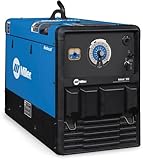
The best gasoline welding machine for most portable work is a mid-range engine drive in the 200–260 amp class: models like the Miller Bobcat 265 or Lincoln Ranger 250 deliver enough output for 1/4-inch stick welding, run a full day on a single tank, and double as a jobsite generator for grinders and tools. The right pick depends less on brand loyalty and more on matching amperage, duty cycle, and generator watts to the work you actually do — and that’s where most buyers either overspend or undersize.
As an Amazon Associate we earn from qualifying purchases at no extra cost to you.

Contents
What a Gasoline-Powered Welding Machine Actually Does for You
An engine-driven welder combines a combustion engine, a welding power source, and an auxiliary generator in one frame. Unlike a shop welder, it needs no electrical supply — which makes a gasoline powered welding machine the standard choice for fence repair, farm equipment, pipeline work, remote construction, and emergency fabrication. The auxiliary power (typically 4,000–11,000 watts) also runs angle grinders, lights, chop saws, and even small air compressors, so the machine often replaces a separate generator on the truck.
Gasoline engines start more easily in cold weather and cost less upfront than diesel equivalents, though diesel wins on fuel economy and engine life for daily commercial use. For a machine running a few hours per week, gas is usually the smarter buy.
The Five Numbers That Decide the Right Machine
Before comparing models, fix these criteria against your jobs:
- Output amperage. Stick welding 1/8-inch 7018 rod needs roughly 90–120 amps; 5/32-inch rod needs 140–180; heavier structural work pushes past 200. Buy at least 20% more amperage than your routine work requires.
- Duty cycle. A “250A @ 40% duty cycle” rating means four minutes of welding per ten at that amperage. At lower amps the cycle rises — most quality engine drives hit 100% duty cycle around 150–200 amps, which covers most field rod sizes continuously.
- Generator watts (continuous, not peak). An angle grinder draws 1,200–1,800W; a chop saw 1,800–2,200W; a compressor 3,000W+. If you’ll weld and grind simultaneously, you need machines with independent auxiliary power circuits.
- Fuel consumption. Expect roughly 0.8–1.5 gallons per hour at welding load for a 225–265A gas machine. Over a year of 500-hour use, a half-gallon-per-hour difference is 250 gallons — real money.
- Weight and mounting. Compact units around 350–450 lbs can be carried on a trailer or small truck bed; full-size machines at 600+ lbs need a dedicated skid or truck mount.
Head-to-Head: The Leading Gasoline Engine Drives
| Model | Weld output | Duty cycle at max | Auxiliary power (continuous) | Fuel tank | Weight | Best for |
|---|---|---|---|---|---|---|
| Miller Bobcat 265 | 265A DC | ~100% at 200A | 11,000W | 12 gal | ~425 lbs | Heavy field work, multi-process |
| Miller Bobcat 225 | 225A DC | 100% at 225A | 10,500W | 12 gal | ~425 lbs | Stick-focused crews, farm repair |
| Lincoln Ranger 250 GXT | 250A AC/DC | 100% at 250A | 10,000W | 12 gal | ~460 lbs | AC-capable stick, structural work |
| Lincoln Ranger 305 G | 305A DC | 100% at 300A | 9,500W | 12 gal | ~510 lbs | High-amp gouging and MIG feeders |
| Hobart Champion Elite 225 | 225A DC | 100% at 225A | 9,000W | 11 gal | ~450 lbs | Value-focused owner-operators |
| Hobart Champion 145 | 145A DC | 100% at 140A | 4,000W | 5 gal | ~200 lbs | Light-duty home and ranch use |
Specifications reflect published manufacturer ratings; always verify current figures for the exact model year before purchase.
How to Read These Numbers for Your Job
If your heaviest routine weld is 5/32-inch 7018 on gate hinges and trailer frames, the 225-amp machines run at 100% duty cycle all day — the Hobart Champion Elite 225 or Bobcat 225 are the efficient choice. If you run an LN-25 style wire feeder for MIG field work, or air-arc gouge worn bucket edges, step up to the Ranger 305 G or Bobcat 265 for headroom. The small Champion 145 makes sense only if your welding is genuinely light — its 4,000W auxiliary won’t run a large grinder and weld at the same time.
Decision Matrix: Match the Machine to Your Situation
| Your situation | Recommended class | Why |
|---|---|---|
| Weekend ranch/farm repair, occasional use | 145–200A compact (e.g., Hobart Champion 145) | Lower cost, lighter, easy engine maintenance |
| Regular farm welding + running grinders | 225A class (Champion Elite 225, Bobcat 225) | Full duty cycle at common rod sizes, ~10kW auxiliary |
| Structural/contract work, AC rods needed | 250A AC/DC (Ranger 250 GXT) | AC output runs 7018 AC and reduces arc blow |
| Wire feeder, gouging, heavy plate | 265–305A (Bobcat 265, Ranger 305 G) | Headroom for high-amp processes without derating |
| Budget under ~$3,000–4,000 | Compact used or 145A new | New mid-range units typically run $4,500–$8,000+ |
Ownership Realities a Spec Sheet Won’t Tell You
- What wears first: carburetor fouling from stale fuel (use stabilizer if the machine sits), brushes on older designs, and battery maintenance. Budget for a carb clean every 1–2 years of intermittent use.
- Oil changes matter more than welding hours suggest: the engine runs whenever the welder idles. Track engine hours, not arc hours — many owners under-service by half.
- Idle-down features save real fuel: auto-idle drops RPM between welds. On a 500-hour year, that can cut fuel use 30–40% versus fixed-speed running.
- Common mistake: buying peak generator watts to “run the whole shop.” Auxiliary power shares the engine; large welds plus a big compressor will starve one or both. Sum your simultaneous loads honestly.
- Cold storage: drain fuel or run the carb dry over winter; a clogged jet is the most common no-start complaint in spring.
FAQ
Can a gasoline welding machine power my whole shop?
Partially. A 10,000–11,000W unit will run several tools or emergency home circuits, but running large welds simultaneously with big loads will cause voltage sag. Treat it as a capable jobsite generator, not a shop replacement.
Gasoline or diesel engine drive?
Gas for intermittent use (easier starting, lower price, simpler parts); diesel for daily commercial hours (better fuel economy, 2–3x engine life, required on many industrial sites).
What size do I need to run a wire feeder?
Most voltage-sensing suitcase feeders want a machine rated 250A+ with CV output. Check that the welder offers a CV mode — pure CC stick machines won’t run them properly.