What's inside
As an Amazon Associate I earn from qualifying purchases. This post may contain affiliate links at no extra cost to you.
A Miller inverter welder is the right choice if you need a lightweight, multi-process machine that runs on both 120V and 240V shop power — and the best model for most users is the Miller Multimatic 220 AC/DC, while dedicated TIG or stick users should look at the Maxstar or CST lines. This guide compares the main Miller inverter models by process, amperage, input power, and portability so you can match the machine to your actual projects.
As an Amazon Associate we earn from qualifying purchases at no extra cost to you.


Contents
Why an Inverter Welder, and Why Miller
Inverter welders convert input power electronically instead of relying on heavy copper transformers. The result is a machine that weighs a third of what a traditional transformer welder does, starts arcs more smoothly, and sips rather than gulps electricity — typically 20–30% more efficient on the same output. Miller has the widest inverter lineup in North America, covering everything from a 13 lb stick welder to 400-amp industrial multiprocess machines, and Auto-Line technology on most models lets them accept a broad range of input voltages without rewiring.
Miller Inverter Welder Comparison
| Model | Processes | Max Output | Input Power | Weight | Best For |
|---|---|---|---|---|---|
| Maxstar 161 STL | Stick, Lift-Arc TIG | 160A | 120V / 240V | 13 lb | Portable repair work, beginners |
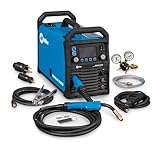
| Multimatic 215 | MIG, flux-core, stick, DC TIG | 230A | 120V / 240V | 38 lb | Home shops, auto restoration |
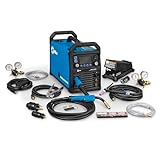
| Multimatic 220 AC/DC | MIG, flux-core, stick, AC/DC TIG | 230A | 120V / 240V | 56 lb | Aluminum TIG, one-machine shops |
| Millermatic 211 | MIG, flux-core | 230A | 120V / 240V | 38 lb | Dedicated MIG users |
| Dynasty 210 | AC/DC TIG, stick | 210A | 120–480V (Auto-Line) | 47 lb | Precision TIG, aluminum |
| CST 280 | Stick, Lift-Arc TIG | 280A | 208–575V (Auto-Line) | 41 lb | Field construction, pipe welding |
| XMT 350 | MIG, stick, TIG, gouging (with feeders) | 425A | 208–575V | 80 lb | Fabrication shops, crews |
All listed weights are for the power source alone — a spool of wire, a bottle, or TIG accessories add real carry weight. The Multimatic 215 and 220 also include Miller’s Auto-Set mode, which dials in wire feed speed and voltage from material thickness, cutting setup time for users who weld a few different thicknesses in a session.
Picking by Process First
Process should drive the decision before amperage does:
- MIG and flux-core only: The Millermatic 211 is the straightforward pick. Auto-Set, dual-voltage input, and enough output for 3/8 in. steel in a single pass. If you’re certain you’ll never need TIG, you save money and complexity versus a multiprocess unit.
- MIG plus occasional stick/TIG: The Multimatic 215 covers three processes for a modest step up in price. Its TIG is DC-only and lift-arc start, which handles steel and stainless but not aluminum.
- Aluminum TIG work: You need AC output with balance and frequency control. That means the Multimatic 220 AC/DC or the Dynasty 210. The 220 makes sense if you also MIG weld; the Dynasty is the better machine if TIG is 80% or more of your work.
- Field and structural stick: The CST 280 runs on nearly any voltage you’ll find on a jobsite, including generator power, and handles 3/16 in. electrodes continuously.
Match Amperage to Your Thickest Material
A rough planning rule for MIG and stick on mild steel: you need about 1 amp per 0.001 in. of thickness for single-pass work. That puts typical scenarios in context:
- Sheet metal and auto body (20–16 gauge): 40–80A — any model works, even on 120V
- Fabrication and repair up to 1/4 in.: 160–220A — needs 240V input on the smaller units
- Structural work at 3/8 in. and up: 250A+ — CST 280, XMT 350, or multiple passes on a 220-class machine
Worked example: welding 3/16 in. steel brackets calls for roughly 190A. The Multimatic 215 on a 240V circuit delivers that at about a 40% duty cycle — four minutes of arc time per ten, which suits bracket-and-fit-up work comfortably. Running the same job on 120V caps you around 140A, where you’d need to bevel and multi-pass. Duty cycle, not peak amperage, is usually what limits real productivity in a home shop.
Portability and Power Supply Realities
“Portable” means different things here. The Maxstar 161 is a shoulder-strap machine you can carry up a ladder. The Multimatic 220 moves around a shop on a cart but isn’t something you haul to a jobsite daily. The CST 280 hits the middle ground — jobsite-tough case, under 45 lb.
On input power, dual-voltage models (120/240V) are flexible, but 120V output is limited everywhere: expect roughly 90–140A usable. A dedicated 240V, 30A circuit is the single best shop upgrade if you buy anything above the Maxstar class. Generator use is supported on the Auto-Line models; plan on at least a 7,500-watt generator for clean output on the 200A-class machines.
Ownership Realities: What a Listing Won’t Tell You
- Consumables add up. MIG contact tips, nozzles, and liners are recurring costs — budget $50–$100 per year for hobby use, more for production. TIG collets, cups, and tungsten are cheaper per item but easy to run through while learning.
- The first thing to wear is the MIG liner. Feeding rusty or kinked wire, or bending the torch cable sharply, chews up liners fast. Symptoms are erratic feeding and burnbacks — replace the liner before blaming the machine.
- Dust is the killer on inverters. The cooling fans pull shop dust and grinding debris across the circuit boards. Blow out the case with dry, low-pressure air every few months of regular use — more often in a woodworking shop where fine dust is constant.
- Ground clamp quality matters. The included clamps work, but a poor ground shows up as arc instability that gets misdiagnosed as a settings problem. Upgrade to a brass clamp early.
- Common buyer mistake: paying for multiprocess capability you won’t use. A Millermatic 211 plus a separate gas bottle and a bottle of technique beats a neglected TIG torch gathering dust.
Quick Decision Matrix
| Your Situation | Best Pick |
|---|---|
| First welder, home shop, mixed tasks | Multimatic 215 |
| Only welding steel, MIG-focused, budget-conscious | Millermatic 211 |
| One machine for everything including aluminum TIG | Multimatic 220 AC/DC |
| TIG is your main process, precision work | Dynasty 210 |
| Field repairs, only 120V available, tightest budget | Maxstar 161 STL |
| Jobsite stick welding, generator power, heavy rods | CST 280 |
| Fab shop or crew running feeders all day | XMT 350 |
Frequently Asked Questions
Can a Miller inverter welder run on 120V household power?
Yes — the Maxstar 161, Multimatic 215, Multimatic 220, and Millermatic 211 all accept 120V input. Output is limited (roughly 90–140A depending on the model), which is fine for thin material and short welds but not for continuous heavy work.
Do I need the Dynasty 210, or is the Multimatic 220 enough for TIG?
For most mixed-use shops, the Multimatic 220’s AC/DC TIG is fully capable of clean aluminum welds. The Dynasty earns its premium with finer control — advanced AC waveforms, higher max frequency, pulsing refinement — which matters to dedicated TIG welders doing thin aerospace-style work or production aluminum.
Is a multiprocess welder worth it for a woodworking shop?
Usually yes. Woodworking shops need a welder for occasional jigs, brackets, and repairs rather than daily production. A machine like the Multimatic 215 covers MIG for quick jobs, stick for outdoor repairs on rusty steel, and DC TIG if you ever need it — without dedicating bench space to separate machines.