What's inside
- The best sawhorses for beginners: choose a folding pair for most home shops
- Folding vs. fixed: what matters in everyday use
- Choose by your workspace and project
- How to size a pair for beginner tasks
- Features worth paying for—and ones to check closely
- Ownership realities: what wears and what to maintain
- Bottom line
- The best sawhorses for beginners: choose a folding pair for most home shops
- Folding vs. fixed: what matters in everyday use
- Choose by your workspace and project
- How to size a pair for beginner tasks
- Features worth paying for—and ones to check closely
- Ownership realities: what wears and what to maintain
- Bottom line
As an Amazon Associate I earn from qualifying purchases. This post may contain affiliate links at no extra cost to you.
Contents
- The best sawhorses for beginners: choose a folding pair for most home shops
- Folding vs. fixed: what matters in everyday use
- Choose by your workspace and project
- How to size a pair for beginner tasks
- Features worth paying for—and ones to check closely
- Ownership realities: what wears and what to maintain
- Bottom line
The best sawhorses for beginners: choose a folding pair for most home shops
The best sawhorses for beginners are a pair of folding, height-matched horses with a working height around 28–32 inches and a clearly stated capacity that comfortably exceeds the load you plan to support. They’re quick to store and versatile for cutting plywood, assembling projects, and setting up a temporary work surface. Choose fixed wooden horses instead if you have room to leave them out, want a simple build-it-yourself option, or need a rigid base that won’t depend on folding joints.
Folding vs. fixed: what matters in everyday use
Neither style is automatically more stable. A well-braced fixed horse has fewer moving parts, but a sound folding model can be steady when its legs are fully opened, locking mechanisms are engaged, and all four feet sit on a level surface. Capacity figures also need context: a manufacturer’s rating may describe a static load distributed across the pair, not a heavy object dropped onto one corner or a person standing on top.
As an Amazon Associate we earn from qualifying purchases at no extra cost to you.
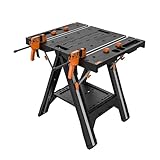
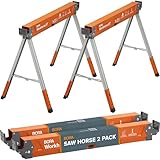
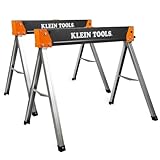

For beginner tasks, compare these practical ranges. Specifications vary by model, so confirm the product label or manual before buying. The figures below are typical ranges, not ratings for every sawhorse in a category.
| Type | Typical working height | Typical pair capacity | Setup time for a pair | Folded or storage footprint | Best suited to |
|---|---|---|---|---|---|
| Light-duty folding plastic | 28–32 in. | 400–1,000 lb. | About 1–2 min. | Often 3–6 in. thick per horse | Occasional cutting, light assembly, small storage areas |
| Heavy-duty folding steel or composite | 28–36 in. | 1,000–2,500 lb. | About 2–4 min. | Often 4–8 in. thick per horse | Frequent projects, heavier stock, adjustable-height needs |
| Fixed wooden, braced | Usually built to a chosen height; commonly 28–32 in. | Depends on design and materials; do not assume a rating | Ready immediately if kept assembled | Roughly 18–24 in. wide per horse; does not fold | A dedicated shop, DIY builds, repairable shop furniture |
Choose by your workspace and project
| Your situation | Better starting choice | Why |
|---|---|---|
| Apartment, shared garage, or limited closet space | Folding pair | Stores flat and can be carried out only when needed. |
| Weekend projects such as trim, shelves, or garden repairs | Folding pair with a top channel or clamp-compatible design | Quick setup and useful support for different stock widths. |
| Repeated work in a dedicated garage shop | Fixed, braced pair—or robust folding pair | Fixed horses can be left ready and repaired; folding models remain easier to move. |
| Cutting sheet goods or supporting long boards | Two matching horses, plus a suitable sacrificial work surface when needed | Matching height keeps the work level; a broad panel needs support along its span. |
| Uneven driveway or jobsite ground | Wide-footed, rigid model with a secure leg lock | Foot contact and resistance to racking matter more than a large advertised capacity. |
How to size a pair for beginner tasks
For a comfortable starting height, stand naturally and bend your elbows to about a right angle. A workpiece supported around that height is often convenient for marking and assembly, though sawing ergonomics and personal stature differ. If you will mostly cut lumber with a handsaw, a somewhat lower surface may feel more controlled. Adjustable folding horses can help, but check that both are set to exactly the same height and lock securely.
Capacity should be treated as a ceiling, not a target. If a 4-by-8-foot plywood sheet weighs about 50–70 lb., that is not the only load to consider: a person leaning on the panel, a tool, and uneven support can concentrate force. Pick a pair whose documented capacity is comfortably above the expected total, and follow the manufacturer’s stated load distribution. Never use a sawhorse as a ladder or stand on it unless the maker explicitly rates it for that purpose.
For sheet goods, place the horses far enough apart to support the panel without letting the ends sag, while keeping the cut line clear of the legs. If the cut will pass through the panel, put sacrificial strips or a sacrificial sheet beneath it so the saw blade does not strike the horses. Plan the support before cutting: a panel that tips as the offcut separates can pinch a blade or fall.
Features worth paying for—and ones to check closely
- Positive leg locks: Open each horse fully and confirm that locks engage rather than merely stopping the legs from moving outward.
- Wide, non-slip feet: They improve contact on hard floors, though no foot design makes a sloped or loose surface safe.
- Top channels or replaceable caps: A groove can locate round stock; replaceable sacrificial caps let you make shallow cuts without damaging the frame.
- Clamp compatibility: Slots or a clamp-friendly top help secure stock. Check that clamps do not interfere with folding parts.
- Matching height and low wobble: Compare the pair on a flat floor before use. A small height mismatch can make long material rock.
- Carry handles and manageable weight: A heavy pair may be stable but inconvenient if you regularly move it between storage and work areas.
Ownership realities: what wears and what to maintain
On folding models, hinges, pins, leg locks, and feet are the parts to inspect first. Dust and paint can hide damage or stop a latch from seating fully; brush debris away and check the mechanism before each setup. Replace worn feet or caps only with compatible parts, and retire a horse with a cracked frame, bent leg, loose pivot, or lock that will not stay engaged.
Fixed wooden horses avoid folding hardware but still need sound joints and bracing. Wood can loosen at fasteners, split near a joint, or become slick with finish and sawdust. Tighten loose hardware, replace damaged braces, and keep the feet level. If you build your own, use straight, sound lumber and a design with diagonal bracing; do not infer a safe load from appearance alone.
A common mistake is to judge stability by pushing down on the center of an empty horse. Instead, set both horses on the actual work surface, lock them, and apply a gentle sideways check before loading. Then secure the workpiece with clamps where appropriate. A heavy load placed off-center can tip even a high-capacity model.
Bottom line
For most first-time buyers, a folding pair with a clearly documented capacity, a comfortable fixed or adjustable height, and positive leg locks is the most useful starting point. It suits occasional repairs and small projects without taking over a garage. Pick fixed braced horses if they can stay assembled in a dedicated workspace and you prefer simple, repairable shop furniture. In either case, prioritize level feet, matched height, secure locks, and support positioned for the cut—not the biggest capacity number on the label.