What's inside
- Best budget shop air cleaners at a glance
- Our picks by shop situation
- 1. WEN 3410: best low-cost air cleaner
- 2. WEN 3415: best budget upgrade for more coverage
- 3. JET AFS-1000C: best for controls and ownership convenience
- 4. JET AFS-1000B: best for frequent shop use
- How much airflow do you actually need?
- Filter quality versus dust collection
- Noise, operating cost, and controls
- Maintenance mistakes that shorten service life
- Final recommendation
- Best budget shop air cleaners at a glance
- Our picks by shop situation
- 1. WEN 3410: best low-cost air cleaner
- 2. WEN 3415: best budget upgrade for more coverage
- 3. JET AFS-1000C: best for controls and ownership convenience
- 4. JET AFS-1000B: best for frequent shop use
- How much airflow do you actually need?
- Filter quality versus dust collection
- Noise, operating cost, and controls
- Maintenance mistakes that shorten service life
- Final recommendation
As an Amazon Associate I earn from qualifying purchases. This post may contain affiliate links at no extra cost to you.
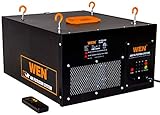
The best budget shop air cleaner for most small woodworking shops is the WEN 3410: it provides useful three-speed airflow, a timer, and a replaceable inner filter at a relatively low price. Choose the larger WEN 3415 when your shop is closer to 600 square feet, or step up to the JET AFS-1000C when quieter operation, better controls, and heavier construction matter more than the lowest purchase price.
As an Amazon Associate we earn from qualifying purchases at no extra cost to you.


Contents
- Best budget shop air cleaners at a glance
- Our picks by shop situation
- 1. WEN 3410: best low-cost air cleaner
- 2. WEN 3415: best budget upgrade for more coverage
- 3. JET AFS-1000C: best for controls and ownership convenience
- 4. JET AFS-1000B: best for frequent shop use
- How much airflow do you actually need?
- Filter quality versus dust collection
- Noise, operating cost, and controls
- Maintenance mistakes that shorten service life
- Final recommendation
Best budget shop air cleaners at a glance
| Model | Published maximum airflow | Filter arrangement | Recommended shop size | Typical market range | Best for |
|---|---|---|---|---|---|
| WEN 3410 | 1,000 CFM | 5-micron outer filter; finer inner filter | Up to about 400 sq. ft. | $150–$220 | Lowest-cost small-shop solution |
| WEN 3415 | 1,044 CFM | 5-micron outer filter; finer inner filter | About 400–600 sq. ft. | $180–$260 | More airflow and larger coverage |
| JET AFS-1000C | 1,044 CFM | Outer prefilter and inner fine-particle filter | Up to about 600 sq. ft. | $300–$450 | Better controls and build quality |
| JET AFS-1000B | 1,000 CFM | Two-stage replaceable filtration | Up to about 600 sq. ft. | $350–$500 | Frequent use and long-term ownership |
Airflow figures are manufacturer maximums, generally measured with clean filters and little restriction. Real airflow falls as filters load with dust, so use the figures for comparing models rather than treating them as guaranteed room performance.
Our picks by shop situation
| Your situation | Best choice | Why |
|---|---|---|
| Small garage, occasional projects, tight budget | WEN 3410 | Good basic airflow without paying for premium controls |
| Medium shop or frequent sanding | WEN 3415 | More effective circulation and a larger working envelope |
| You want remote control and timer convenience | JET AFS-1000C | More refined controls and stronger overall construction |
| The cleaner will run most days | JET AFS-1000B or AFS-1000C | Higher initial cost can be justified by easier maintenance and durability |
| Very fine dust from sanding or routing | A two-stage unit with the finest compatible inner filter | Filter quality matters more than headline CFM alone |
1. WEN 3410: best low-cost air cleaner
The WEN 3410 is the sensible starting point for a hobbyist who needs better air circulation after using a table saw, router, planer, or random-orbit sander. Its three-speed motor is rated at approximately 400, 600, and 1,000 CFM. The lower settings reduce noise when you are working nearby, while the highest setting is useful for clearing a shop after a dusty session.
Its timer is particularly valuable at this price. You can leave the cleaner running after shutting down the tools without having to remember to return to the shop. The unit is designed for ceiling or overhead mounting, and its compact rectangular housing works well in a one-car garage.
The limitation is refinement. The outer filter is commonly specified around 5 microns, while the inner filter captures finer material. That is suitable for general shop circulation, but it does not replace dust collection at the tool. The remote and control system are basic, and replacement filters should be budgeted for rather than treated as an occasional surprise.
2. WEN 3415: best budget upgrade for more coverage
The WEN 3415 is the better choice when the 3410 would need to run constantly at full speed. Its published maximum is about 1,044 CFM, with lower speed settings for quieter operation and reduced energy use. The difference in maximum airflow is modest on paper, but the larger model is a more comfortable fit for a medium-size shop and frequent sanding.
Choose it when your work area is roughly 400 to 600 square feet, especially if the ceiling is high or the cleaner will be mounted near one end of the room. Positioning matters: a unit mounted in a corner may clean the air near itself while leaving a stagnant zone behind a machine. Suspend it where the intake and exhaust have a clear path across the room.
The 3415 remains a value product, so check filter availability before buying. A cheap cleaner that cannot get replacement filters several years later becomes an awkward disposable appliance. Keep the outer filter clean and it will protect the finer inner filter, which is usually the more expensive consumable.
3. JET AFS-1000C: best for controls and ownership convenience
The JET AFS-1000C is not the cheapest option, but it is one of the strongest choices for a woodworker who will use an air cleaner several times a week. It offers roughly 550, 785, and 1,044 CFM settings, a timer, and remote-control convenience. Those controls make it easier to run the unit at low speed while working and switch to a longer high-speed cycle afterward.
Its two-stage filter arrangement is more important than the brand name: the outer filter catches larger dust, while the inner filter handles finer particles. This design reduces the load on the final filter and makes routine maintenance less expensive than repeatedly replacing a single fine filter.
The main trade-off is price. If you only work in the shop once or twice a month, the additional cost may not return much practical value. If the cleaner will be operated for hundreds of hours each year, easier controls, sturdier construction, and more predictable parts support can justify the premium.
4. JET AFS-1000B: best for frequent shop use
The JET AFS-1000B is an older-style, substantial air-filtration unit aimed at regular shop use. Its airflow is in the same approximately 1,000-CFM class as the other picks, so it does not magically clean a room faster simply because it costs more. Its advantage is the combination of a two-stage filter system, solid housing, and practical timer operation.
It makes sense for a dedicated workshop where the machine will be mounted permanently and run after most work sessions. For a portable garage setup, its size and price are harder to justify. Compare the cost and availability of replacement outer and inner filters before choosing it over the newer AFS-1000C.
How much airflow do you actually need?
A useful sizing estimate is to calculate air changes per hour:
Air changes per hour = airflow × 60 ÷ room volume.
For example, a 20-by-20-foot shop with an 8-foot ceiling contains 3,200 cubic feet. A cleaner moving 1,000 CFM at its rated maximum would theoretically provide:
1,000 × 60 ÷ 3,200 = 18.75 air changes per hour.
Real results will be lower because of filter loading, air leakage, furniture, and the difference between rated and delivered airflow. Still, this calculation shows why a 1,000-CFM unit is generally adequate for a small garage when positioned correctly. In a larger or divided shop, two smaller units can distribute air more evenly than one powerful unit in a corner.
Filter quality versus dust collection
An air cleaner removes suspended dust; it does not capture the pile of chips leaving a planer or the concentrated cloud produced at a sanding station. Connect each machine to a properly sized dust collector first. Use the overhead cleaner as the second line of defense for fine dust that escapes the tool hood.
Pay attention to the filter’s stated particle rating, but do not compare ratings from different manufacturers as if they were always measured under identical conditions. A filter’s surface area, sealing around the frame, and condition all affect performance. A nominal “5-micron” outer filter can still be useful because it protects the finer inner filter from quickly clogging.
Noise, operating cost, and controls
All of these machines are audible on high speed. The practical comparison is whether the low setting is comfortable enough to leave running while you work. A lower speed also uses less electricity and usually produces less vibration. Remote controls and timers have a direct benefit: they make it more likely that the cleaner will run for the needed post-work period.
As a simple operating-cost example, assume a 200-watt setting, an electricity rate of $0.16 per kilowatt-hour, and 500 hours of use per year:
0.2 kW × 500 hours × $0.16 = $16 per year.
A higher-speed setting might use more power, but filter replacement is often the larger ownership cost. Running the cleaner for an extra hour is usually cheaper than allowing a dirty filter to restrict airflow and overwork the motor.
Maintenance mistakes that shorten service life
- Do not operate without filters installed. Dust can reach the motor and contaminate the room instead of being captured.
- Clean the outer filter regularly. Vacuum it carefully from the clean side outward when the manufacturer’s instructions allow it; aggressive compressed air can damage the media and spread dust.
- Replace rather than endlessly wash disposable filters. Washing can deform the material, enlarge gaps, or leave it damp inside the housing.
- Inspect the filter seal. A warped frame or loose gasket creates a bypass route that can matter more than a small difference in advertised CFM.
- Keep intake and exhaust clear. Leave space around the housing and avoid mounting the intake directly over a machine that throws chips.
- Use a post-work timer. A 30- to 60-minute run after sanding is more useful than running the cleaner briefly at the beginning of the day.
Final recommendation
Buy the WEN 3410 for a small, occasional-use shop where price is the deciding factor. Choose the WEN 3415 for more floor area or heavier hobby use. The JET AFS-1000C is the best balanced upgrade when remote control, timer convenience, and long-term ownership matter. Whichever model you choose, install it where air can circulate, maintain the outer filter, and continue using source dust collection at every tool.