What's inside
- Best generators for home backup: quick recommendations
- Comparison of usable backup power
- Size the generator around essential loads
- Choosing by situation
- Fuel type, runtime, and operating cost
- Transfer switches and safe connection
- Noise, placement, and carbon monoxide
- Ownership realities: maintenance matters more than brochures
- Bottom line
- Best generators for home backup: quick recommendations
- Comparison of usable backup power
- Size the generator around essential loads
- Choosing by situation
- Fuel type, runtime, and operating cost
- Transfer switches and safe connection
- Noise, placement, and carbon monoxide
- Ownership realities: maintenance matters more than brochures
- Bottom line
As an Amazon Associate I earn from qualifying purchases. This post may contain affiliate links at no extra cost to you.
The best generators for home backup depend on which loads you need to run: an inverter generator suits quiet, occasional refrigerator-and-device backup; a dual-fuel portable generator offers more output and fuel flexibility; and a large conventional generator is the better fit for frequent outages or several 240-volt loads. For most homeowners, a 2,000–3,000-watt inverter generator is the sensible starting point, while homes needing a well pump, electric water heater, or central HVAC should move to a professionally installed standby or large portable system.
As an Amazon Associate we earn from qualifying purchases at no extra cost to you.


Contents
- Best generators for home backup: quick recommendations
- Comparison of usable backup power
- Size the generator around essential loads
- Choosing by situation
- Fuel type, runtime, and operating cost
- Transfer switches and safe connection
- Noise, placement, and carbon monoxide
- Ownership realities: maintenance matters more than brochures
- Bottom line
Best generators for home backup: quick recommendations
- Best quiet essential-load choice: Honda EU2200i. Its 1,800-watt rated output and inverter power suit a refrigerator, internet equipment, lights, chargers, and a small appliance, provided starting surges are managed.
- Best flexible fuel choice: Champion 2500-watt dual-fuel inverter generators. These provide gasoline or propane operation, useful when stored gasoline is undesirable or unavailable.
- Best mid-size portable option: Westinghouse iGen4500DF. Its approximately 3,700-watt gasoline running output gives more headroom for refrigerators, freezers, sump pumps, and selected kitchen loads.
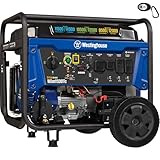
- Best high-output portable option: DuroMax XP13000HX. Its gasoline/propane capability and 120/240-volt output are aimed at larger loads, but its size, noise, fuel consumption, and installation requirements make it unsuitable for casual plug-in use.
- Best automatic whole-home approach: a permanently installed standby generator. Generac, Kohler, and Briggs & Stratton offer residential standby systems in several capacities. These require professional gas, electrical, pad, and transfer-switch work.
Comparison of usable backup power
“Running watts” or “rated watts” is the number that matters for continuous use. Surge or starting watts only describes the short burst available for motor-driven equipment such as refrigerators, pumps, furnaces, and power tools. A generator advertised as “2,200 watts” may deliver only 1,800 watts continuously.
| Generator or type | Rated output | Peak output | Fuel and approximate runtime | Transfer-switch suitability | Noise and portability |
|---|---|---|---|---|---|
| Honda EU2200i | 1,800 W | 2,200 W | Gasoline; about 8 hours at 25% load on its 0.95-gallon tank | Usually used with a manual inlet and properly rated interlock or transfer equipment; verify local code | About 48–57 dB(A) depending on load; approximately 47 lb |
| Champion 2500-W dual-fuel inverter class | About 1,850–2,500 W, depending on model and fuel | About 2,500–3,150 W | Gasoline or propane; commonly roughly 10–12 hours at light load on gasoline | Generally a portable inlet solution rather than automatic standby operation | Typically around 53–60 dB(A); roughly 40–50 lb |
| Westinghouse iGen4500DF | About 3,700 W on gasoline | About 4,500 W | Gasoline or propane; approximately 12–18 hours at 25% load, depending on fuel and conditions | Can feed a suitably rated manual transfer arrangement; not a substitute for an automatic standby system | About 52–59 dB(A); approximately 90–100 lb |
| DuroMax XP13000HX | About 10,500 W on gasoline and lower on propane | About 13,000 W on gasoline | Gasoline or propane; often around 8–13 hours at moderate load | 120/240-volt connection supports approved transfer equipment when installed correctly | Approximately 70 dB(A) or more; over 200 lb |
| Residential standby generator | Typically 10,000–26,000 W | Designed for continuous household transfer rather than a portable surge rating | Natural gas or liquid propane; runtime depends mainly on fuel supply and load | Automatic transfer switch is the normal configuration | Usually quieter than a large portable at a distance, but permanently installed and site-dependent |
Figures vary by revision, fuel, altitude, temperature, and test method. Check the exact owner’s manual before buying, especially for receptacle ratings, propane output, and transfer-switch approval.
Size the generator around essential loads
Make two lists: appliances that must run and appliances that can wait. Add their running watts, then add the largest starting surge rather than adding every surge at once. A practical example looks like this:
| Load | Running watts | Possible starting watts |
|---|---|---|
| Refrigerator | 150 W | 1,200 W |
| Chest freezer | 100 W | 800 W |
| Gas furnace blower | 600 W | 1,500 W |
| Internet equipment and LED lights | 150 W | 150 W |
| Sump pump | 800 W | 2,000 W |
| Total | 1,800 W | 5,650 W individually listed |
This home should not automatically buy a 5,650-watt generator. The motors do not necessarily start simultaneously, and a generator’s surge rating is not a guarantee that every combination will start. A 3,500–4,500-watt inverter or portable generator may work if the furnace, sump pump, refrigerator, and freezer are staggered. If the sump pump is critical and starts under difficult conditions, a larger unit or a soft-start device may be the safer choice.
Electric resistance heaters, clothes dryers, ovens, tank water heaters, and central air conditioners consume far more power. A 1,500-watt space heater alone can use most of a small inverter generator’s capacity. Never connect a portable generator to a house receptacle with a homemade “backfeed” cord.
Choosing by situation
| Your situation | Most suitable choice | Why |
|---|---|---|
| Short outages, apartment or small home, limited storage | 1,800–2,200-watt gasoline inverter | Compact, relatively quiet, and sufficient for refrigeration, communications, lighting, and charging |
| Occasional outages and concern about gasoline storage | 2,000–4,500-watt dual-fuel inverter | Propane stores well; gasoline provides easier cold starting and often more output |
| Well pump, sump pump, freezer, furnace, and kitchen circuits | 3,500–7,000-watt portable generator | More starting capacity and the possibility of a 30-amp inlet and transfer equipment |
| Frequent outages or need for automatic operation | Professionally installed standby generator | Automatic transfer, weather-rated installation, and better integration with gas or propane service |
| Workshop with a table saw, dust collector, or compressor | Large generator sized for the largest motor, or a dedicated workshop power plan | Motor starting current can overwhelm a small home-backup generator; avoid running tools while critical household loads are active |
Fuel type, runtime, and operating cost
Gasoline is widely available and usually gives the highest output, but it degrades in storage. Use a suitable stabilizer, rotate stored fuel, and keep it in approved containers outside living areas. Propane does not become stale in the same way and is convenient for emergency storage, but cold weather, regulator limits, and lower output can matter.
Runtime estimates are often quoted at 25% load, which is lighter than many real backup situations. For example, a 0.95-gallon tank running eight hours at a light load uses about 0.12 gallons per hour. At 900 watts, that is approximately 7.5 kilowatt-hours of output per gallon. If gasoline costs $4 per gallon, fuel costs about $0.53 per kilowatt-hour before maintenance. A heavily loaded generator will consume fuel much faster, so a larger generator operated lightly is not automatically more economical than a smaller, well-matched one.
Transfer switches and safe connection
A transfer switch or listed interlock prevents generator power from energizing utility lines. This is essential for line-worker safety and protects the generator from improper current paths. A portable generator may connect through a 30-amp or 50-amp inlet, but the inlet, breaker, cable, interlock, and generator receptacle must all be compatible.
Most small inverter generators are used with extension cords to individual appliances. Use outdoor-rated, heavy-gauge cords, keep connections dry, and avoid long undersized cords that cause voltage drop. A 120/240-volt generator can supply a properly wired panel connection, but only when the generator, inlet, neutral arrangement, and transfer equipment support it. Have a licensed electrician install permanent connections.
Noise, placement, and carbon monoxide
Inverter generators are usually the best neighbors because their engines slow down at light load. A difference between 53 and 70 dB(A) is substantial: decibels are logarithmic, not a simple percentage scale. Place any fuel-burning generator outdoors, far from doors, windows, vents, and garages, with exhaust directed away from the building. Carbon monoxide can accumulate even when a generator seems well ventilated. Install working carbon-monoxide alarms inside the home and follow the manufacturer’s clearance instructions.
Ownership realities: maintenance matters more than brochures
- Change engine oil at the first service interval and thereafter according to the manual; small engines often need more frequent attention when used under heavy load.
- Inspect the air filter, spark plug, fuel lines, recoil starter, wheels, and electrical connections before storm season.
- Run the generator periodically under a meaningful load. Brief no-load starting does not confirm that it will carry a refrigerator or pump.
- Old gasoline, a clogged carburetor, and a neglected fuel shutoff are common causes of failure after months of storage.
- Keep the unit level and protected from rain without enclosing it. Never operate it in a shed, garage, porch, or improvised enclosure.
- For a standby generator, budget for annual inspection, battery replacement, oil service, and professional testing of the automatic transfer switch.
Bottom line
Choose the smallest generator that can reliably start your largest essential motor while leaving roughly 20% capacity for changing loads. The Honda EU2200i is a strong quiet choice for basic essentials; a dual-fuel inverter adds storage flexibility; a 3,500–4,500-watt portable unit covers a broader set of household circuits; and a large portable or standby generator is justified only when pumps, HVAC, 240-volt appliances, or frequent outages demand it. The generator itself is only half the backup system—the fuel plan, safe connection, carbon-monoxide protection, and maintenance routine determine whether it will actually help when the power fails.