What's inside
- Quick picks by baking situation
- What matters most when choosing a dough mixer
- Head-to-head: planetary, bowl-lift, spiral, and rotating-bowl designs
- Recommended mixers in more detail
- Noise, counter space, and attachment decisions
- Ownership realities: cleaning, wear, and common mistakes
- How to choose in five minutes
- Quick picks by baking situation
- What matters most when choosing a dough mixer
- Head-to-head: planetary, bowl-lift, spiral, and rotating-bowl designs
- Recommended mixers in more detail
- Noise, counter space, and attachment decisions
- Ownership realities: cleaning, wear, and common mistakes
- How to choose in five minutes
As an Amazon Associate I earn from qualifying purchases. This post may contain affiliate links at no extra cost to you.
The best dough mixers for home bakers are the Ankarsrum Assistent Original for frequent large batches, the KitchenAid Artisan 5-Quart for general-purpose baking, and a compact spiral mixer for serious bread making in limited batches.
As an Amazon Associate we earn from qualifying purchases at no extra cost to you.


Contents
- Quick picks by baking situation
- What matters most when choosing a dough mixer
- Head-to-head: planetary, bowl-lift, spiral, and rotating-bowl designs
- Recommended mixers in more detail
- Noise, counter space, and attachment decisions
- Ownership realities: cleaning, wear, and common mistakes
- How to choose in five minutes
Quick picks by baking situation
| Best for | Recommended type or model | Typical useful capacity | Approximate market range | Main reason to choose it |
|---|---|---|---|---|
| Occasional bread and everyday baking | KitchenAid Artisan 5-Quart tilt-head | 1 loaf or a small batch of rolls | $300–$500 | Versatile attachments and compact footprint |
| Frequent family-size bread batches | KitchenAid bowl-lift 6- or 7-quart mixer | 2–3 loaves, depending on dough | $450–$800 | More bowl capacity and a sturdier frame |
| High-hydration dough and frequent bread baking | Ankarsrum Assistent Original | Up to approximately 5 kg of dough | $750–$900 | Powerful bottom-drive design and excellent large-batch control |
| Small, dense dough batches | Compact spiral mixer | Approximately 0.5–2 kg of dough | $350–$900 | Efficient gluten development with less heat and scraping |
| Lowest-cost occasional use | Basic 4- to 5-quart stand mixer | One small loaf or pizza dough | $150–$300 | Lower entry price, provided expectations remain modest |
What matters most when choosing a dough mixer
Capacity is about flour and dough, not bowl volume
A large bowl does not automatically mean that a mixer can knead a large batch. Dense dough places much more load on the motor and transmission than cake batter. As a practical sizing guide, a 500 g flour recipe usually produces about 800–900 g of dough after water and other ingredients are added. A 1 kg flour recipe commonly becomes 1.6–1.8 kg of dough.
For reliable home use, choose a mixer whose stated dough capacity is comfortably above your normal batch. A 5-quart tilt-head mixer is usually most comfortable with one modest loaf, pizza dough, or a small batch of rolls. A 6- or 7-quart bowl-lift mixer is better for two loaves, but the exact limit varies with hydration and flour type. Whole-grain and stiff bagel doughs should be treated as heavier workloads than the same weight of white, high-hydration dough.
Motor strength and transmission matter more than advertised watts
Published wattage is not a dependable head-to-head measure because brands measure electrical input differently. Look instead for a substantial metal drive system, a stable base, a speed control that does not stall under load, and a manufacturer’s specific dough-capacity guidance.
Planetary mixers such as KitchenAid models move the dough hook around the bowl while the hook rotates. They are versatile, but the dough hook may climb, leave flour in the corners, or require a pause for scraping. The Ankarsrum uses a rotating bowl and a bottom-mounted roller or dough hook. This arrangement distributes heavy dough across the bowl and is particularly comfortable for large or wet batches.
Spiral mixers use a fixed bowl and a spiral hook that turns through the dough. They are often the most efficient design for bread, pizza, and enriched dough, but they are less useful for whipping, creaming butter, or general kitchen attachments.
Kneading performance is workload-specific
The best dough mixers do not simply spin quickly. They should knead without excessive bowl movement, overheating the dough, or forcing the user to hold the machine in place. A mixer that performs well with brioche may still struggle with stiff whole-wheat or bagel dough.
For lean bread dough, a controlled low speed followed by a moderate speed is usually more useful than a high top speed. For enriched dough containing butter, eggs, or sugar, the mixer needs enough torque to incorporate fat gradually. For pizza dough, bowl clearance and consistent dough pickup are more important than a long list of speed settings.
Head-to-head: planetary, bowl-lift, spiral, and rotating-bowl designs
| Design | Typical bowl size | Strengths | Limitations | Best match |
|---|---|---|---|---|
| Compact planetary tilt-head | 4.5–5 qt | Good all-rounder; many attachments; easy access to the bowl | Can struggle with stiff dough; smaller batches may not reach the hook efficiently | Occasional bakers and mixed baking tasks |
| Planetary bowl-lift | 6–7 qt | Heavier frame, larger batches, better stability | Taller, heavier, and less convenient to move | Families and frequent batch baking |
| Spiral mixer | 5–12 qt commonly | Strong gluten development and efficient dough handling | Usually no whisk or beater; dedicated footprint | Bread and pizza specialists |
| Rotating-bowl mixer | 7 L commonly | Handles wet and large dough batches well; flexible roller and hook system | Different technique; attachments cost extra and the machine is wide | Frequent bread bakers wanting one versatile machine |
Recommended mixers in more detail
KitchenAid Artisan 5-Quart: best general-purpose choice
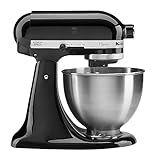
The Artisan tilt-head is a sensible choice when dough is only part of the workload. Its 5-quart stainless-steel bowl, dough hook, flat beater, and wire whisk cover bread, cakes, cookies, and whipped mixtures. The front power hub supports a broad range of optional attachments, including pasta rollers, food grinders, and vegetable slicers.
Its main compromise is heavy dough. A single moderate loaf or pizza batch is a reasonable target, while repeated stiff dough batches can produce more vibration, heat, and wear than a larger bowl-lift or spiral machine. The roughly 14-inch height and approximately 24-pound weight are manageable for many counters, but measure beneath cabinets before buying.
KitchenAid 6- or 7-quart bowl-lift: best for larger mixed batches
A bowl-lift KitchenAid is better suited to bakers who regularly make two loaves, several pizzas, or large cookie batches. The bowl-lift frame is generally more stable than a tilt-head design, and the larger motor-and-transmission platform is intended for heavier workloads. It retains the familiar beater, whisk, dough-hook, and front-hub attachment ecosystem.
These machines occupy more vertical and horizontal space, and their bowls are less convenient to remove when the head cannot tilt away. They also need enough clearance to lift the bowl and insert the attachment. Choose this format when stability and batch size matter more than easy storage.
Ankarsrum Assistent Original: best for frequent bread baking
The Ankarsrum Assistent Original has a 7-liter stainless-steel bowl and a design built around a rotating bowl, dough roller, dough scraper, and dough hook. Its manufacturer lists capacity up to approximately 5 kg of dough, although sensible working capacity depends on dough stiffness and recipe. A separate smaller bowl with whisk and beater attachments expands its usefulness for cakes and meringues.
This is an excellent fit for someone who makes bread several times a week or routinely mixes dough for a large household. The controls allow gradual speed adjustment, and the open bowl makes it easy to add ingredients or observe hydration. Its trade-offs are a higher price, a broad footprint, a learning curve, and fewer universally available accessories than KitchenAid’s system.
Compact spiral mixer: best for bread specialists
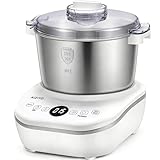
A compact spiral mixer is worth considering when bread quality and kneading efficiency are more important than making cakes. Models from specialist manufacturers such as Famag are available in small domestic sizes, with stainless-steel bowls and capacities commonly suited to roughly 0.5–2 kg of dough.
The spiral hook usually develops gluten efficiently while keeping the dough relatively cool. The fixed bowl and dedicated mechanism also reduce the need for scraping. However, most compact spiral mixers are poor substitutes for a general stand mixer: they typically lack a whisk, flat beater, and broad attachment system. Check minimum batch requirements carefully, because some larger spiral machines do not handle a single small loaf well.
Noise, counter space, and attachment decisions
All dough mixers become louder under load, but the type of noise is informative. A steady mechanical hum is preferable to repeated knocking, belt squeal, or sudden speed changes. Planetary mixers can transmit vibration through a countertop; spiral and rotating-bowl machines may sound quieter at the same dough load but can occupy more surface area.
Before purchasing, measure three dimensions: the storage footprint, the operating height with the head raised or bowl lifted, and the clearance needed to remove the bowl. A mixer that weighs 25–35 pounds is unlikely to be used regularly if it must be lifted from a low cabinet every time.
Buy attachments only for tasks you will perform repeatedly. A pasta roller can justify the KitchenAid system for some households, while a bread-only baker may gain more from spending that money on a dough tub, accurate scale, or spare bowl. Attachment ports also add convenience, not kneading power.
Ownership realities: cleaning, wear, and common mistakes
- Do not exceed the dough limit: dense dough can wear gears, belts, and bearings faster than cake mixtures.
- Use the correct attachment: the dough hook is designed for kneading; a flat beater is not a safe long-term substitute for stiff dough.
- Keep flour out of the motor housing: add flour gradually and avoid shaking bags directly over ventilation openings.
- Hand-wash where required: some coated beaters and aluminum attachments are not dishwasher-safe and may discolor or corrode.
- Inspect the sacrificial parts: planetary mixer gear systems may include a replaceable safety gear designed to fail before more expensive components.
- Watch dough temperature: prolonged kneading can warm dough, especially in a warm kitchen or with a high-speed planetary mixer.
- Recheck attachment clearance: a hook or beater that scrapes the bowl can damage the bowl and strain the machine.
How to choose in five minutes
- Estimate your largest normal batch in grams of flour, then convert it to total dough weight.
- Decide whether you need cakes, whipped cream, and attachments, or mainly bread and pizza.
- Choose a machine with at least 25% more stated capacity than your usual workload.
- Measure the counter, cabinet clearance, and storage route before considering motor specifications.
- For occasional one-loaf baking, choose a compact planetary model; for frequent large batches, choose a bowl-lift, rotating-bowl, or spiral design.
For most households, the KitchenAid Artisan is the most balanced option, provided batches stay modest. Choose a larger bowl-lift model when stability and quantity come first. Choose the Ankarsrum for frequent, varied bread baking, and a compact spiral mixer when dedicated dough performance outweighs attachment versatility.