What's inside
As an Amazon Associate I earn from qualifying purchases. This post may contain affiliate links at no extra cost to you.
Contents
Which Hobby TIG Welder Should You Buy? The Short Answer
For most home shops, the best hobby TIG welder in 2026 is a dual-voltage AC/DC inverter machine in the 180–225 amp range — enough to weld aluminum up to about 3/16″, steel up to 1/4″, and thin sheet down to 24 gauge without tripping a household breaker. The Lincoln Electric Square Wave TIG 200 remains the benchmark for reliability, the Primeweld TIG225X offers the most features per dollar, and the Miller Diversion 180 is the simplest path for beginners. If you only weld steel and chromoly, a DC-only machine like the YesWelder TIG-205DS cuts the price dramatically.
Below we break down what actually matters when comparing compact TIG welders: your wall power, amperage range, AC/DC capability, duty cycle, and how much bench space the machine eats.
As an Amazon Associate we earn from qualifying purchases at no extra cost to you.

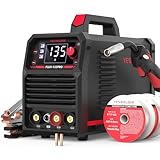


What Actually Matters in a Hobby TIG Welder
Household Power: 120V vs. 240V
This is the first filter. A true 240V-only machine needs a dedicated circuit — typically a 30–50A breaker with a NEMA 6-50 or 14-50 receptacle, which is fine if your shop already has one for a table saw or dust collector. Dual-voltage machines (120V/240V via adapter plug) let you start on a standard outlet, but expect roughly half the output on 120V: most units top out around 90–140A, which limits you to about 1/8″ steel and thin aluminum.
Practical rule: if you plan to weld aluminum at all, run 240V. Aluminum at 1/8″ wants 130–160A with AC, and no hobby machine delivers that on a 15A household circuit.
Amperage Range — Both Ends Matter
Buyers obsess over max amps, but the low end determines whether you can weld thin material. A machine that won’t go below 15–20A will blow through 24-gauge sheet and 0.035″ tubing. Look for a minimum of 10A or less for sheet-metal and small-part work. On the high end, 200A covers 1/4″ steel and 3/16″ aluminum — realistic ceilings for hobby work.
AC/DC: The Aluminum Question
DC-only welders handle steel, stainless, chromoly, and titanium — everything except aluminum and magnesium. AC capability adds roughly $300–500 to the price but unlocks aluminum, which matters enormously if you’re building bicycle frames, fuel tanks, or brackets. If aluminum isn’t in your plans, DC-only is the smart budget move.
Duty Cycle: The Spec Everyone Misreads
Duty cycle is rated at a specific amperage — a “60% duty cycle” machine at 200A might be 100% at 120A. For hobby work (short beads, lots of fit-up time between welds) even a 20–40% rating at max output is plenty. Duty cycle only becomes limiting on long continuous beads like trailer seams. Compare ratings at the amperage you’ll actually use, not the marketing headline.
Storage Footprint
Inverter TIG welders run 14–38 lbs and roughly the size of a toaster oven to a carry-on suitcase. The real footprint is the supporting cast: a TIG torch is a garden hose that can’t be coiled tightly, argon bottles (40–80 cu ft for hobby use) need to stand upright and chained, and filler rod wants dry storage. Budget a 2’×2′ corner for the cart plus gas, not just the machine’s shelf dimensions.
Head-to-Head: Six Compact TIG Welders Compared
| Model | AC/DC | Voltage | Amps (TIG) | Duty Cycle | Weight | Footprint | Typical Price |
|---|---|---|---|---|---|---|---|
| Lincoln Square Wave TIG 200 | AC/DC | 120/240V | 10–200A | 25% @ 200A | 46 lbs | 14×10.5×19 in | $1,800–2,200 |
| Miller Diversion 180 | AC/DC | 115/230V | 10–180A | 35% @ 150A | 50 lbs | 20×9.5×15 in | $2,000–2,400 |
| Primeweld TIG225X | AC/DC (pulse) | 120/240V | 10–225A | 40% @ 225A | 42 lbs | 24×9×17 in | $850–1,000 |
| Everlast PowerTIG 200DV | AC/DC (pulse) | 120/240V | 5–200A | 35% @ 200A | 40 lbs | 24×9×17 in | $1,000–1,300 |
| Eastwood TIG 200 AC/DC | AC/DC | 120/240V | 10–200A | 60% @ 190A (240V) | 37 lbs | 18×8×14 in | $800–1,000 |
| YesWelder TIG-205DS | DC only | 110/220V | 15–205A | 60% @ 205A | 13 lbs | 13×6×9 in | $200–300 |
Duty cycles listed at rated output on 240V; all figures approximate — verify current spec sheets before buying, as manufacturers revise these machines frequently.
The Standouts
Primeweld TIG225X is the value pick: pulse, adjustable AC balance and frequency, 225A of output, and a CK-style torch — features that cost $1,000 more elsewhere. The trade-off is a shorter warranty track record than the big two and a control panel with a learning curve.
Lincoln Square Wave TIG 200 wins on simplicity and dealer support. The interface is deliberately minimal — ideal if you want to weld rather than program. It lacks adjustable AC frequency, which only matters on thin aluminum.
YesWelder TIG-205DS is the proof that DC-only machines have gotten shockingly cheap. At 13 lbs it stores in a drawer. No foot pedal on the base version, no AC, and a 15A low end — but for chromoly frames and steel brackets, it’s a third the price of everything else here.
Eastwood TIG 200 splits the difference: real AC/DC with a 60% duty cycle near rated output, a digital display, and a footprint small enough for a shelf under a workbench.
Match the Machine to Your Situation
| Your Situation | What to Buy | Why |
|---|---|---|
| First welder, steel only, tight budget | DC-only inverter (YesWelder TIG-205DS class) | Cheapest entry; add AC later if aluminum becomes a need |
| Bicycle frames, chromoly, thin steel tubing | AC/DC with <10A minimum (Everlast 200DV) | Low-end amperage matters more than max output |
| Aluminum repairs, tanks, boat parts | 200A+ AC/DC with AC balance (Primeweld TIG225X, Square Wave) | Aluminum needs AC and 140A+ for anything over 1/8″ |
| Garage with only 120V outlets, no electrician visit | Dual-voltage DC or AC/DC machine | You’ll get ~120A on 120V — fine for 1/8″ steel, limiting for aluminum |
| Welder lives on a shelf; pull it out monthly | Sub-20 lb unit or compact AC/DC (Eastwood) | Footprint and setup time beat extra features |
| Want dealer service and long warranty | Lincoln or Miller | Local repair support vs. ship-back warranty service |
Ownership Realities Listings Don’t Mention
- The argon bottle is the hidden cost. An 80 cu ft cylinder plus fill runs $250–400 upfront, refills $40–70. A hobbyist welding a few weekends a month gets roughly 8–12 hours of arc time per fill at 15–20 CFH.
- Consumables wear faster than you think. Tungsten electrodes ($15–30 per 10-pack), cups, collets, and gas lenses are per-project costs. Contaminating a tungsten — every beginner’s ritual — means a regrind or a new one. Budget $50–100/year.
- The foot pedal is the first upgrade. Many budget machines ship torch-switch only. Amperage control at the foot transforms thin-material work; check whether the machine supports a pedal and what it costs before buying.
- What fails first: torch hoses (rubber cracks near the handle), ground clamp springs, and push-fit gas fittings. The power board in an inverter is generally reliable; the wear items are cheap and user-replaceable.
- Dirty aluminum defeats any machine. Most “this welder can’t do aluminum” complaints are prep failures — a dedicated stainless brush and acetone wipe matter more than AC frequency settings.
Frequently Asked Questions
Can I run a hobby TIG welder off a generator?
Yes, if the generator delivers clean 240V power rated well above the welder’s draw — plan on a 7,500W+ generator for a 200A machine. Inverter welders are sensitive to dirty power; undersized generators are a common cause of erratic arcs.
How much argon does TIG welding use?
Typical flow is 15–20 cubic feet per hour. An 80 cu ft bottle gives roughly 4–5 hours of actual arc time — which sounds low but stretches across months of hobby projects, since you spend far more time fitting and tacking than welding.
Is AC/DC worth the extra money?
Only if you’ll weld aluminum. If your projects are steel, stainless, or chromoly, DC-only machines deliver equal weld quality for a third to half the price.
What breaker do I need for a 200A TIG welder?
On 240V, most 200A-class inverters draw 25–35A input — a 40A circuit with a NEMA 6-50 outlet covers nearly all of them. Have an electrician confirm wire gauge for your run length; it’s typically a half-day job.