
As an Amazon Associate I earn from qualifying purchases. This post may contain affiliate links at no extra cost to you.
A track saw is the single tool that transforms sheet-goods work from a two-person struggle into a one-person job. You clamp a guide rail to the panel, set your depth, and pull the saw forward — you get a dead-straight, splinter-free cut that a table saw cannot match without a full outfeed setup. Festool owns this category so thoroughly that most of the competition simply imitates their interface. The real buying problem is not whether Festool makes good saws; it is which Festool saw solves your specific cutting pattern without forcing you to pay for features you will never touch.
The difference between the right and wrong choice comes down to three things: cutting depth versus the material you actually work in, whether you need a scoring blade for veneered or lacquered panels, and how much rail length your jobs demand. This guide sorts the current Festool lineup by those factors, using published specs, list prices, and recurring themes from owner reviews to help you match the tool to the task.
As an Amazon Associate we earn from qualifying purchases at no extra cost to you. Product prices and availability are accurate as of the date shown and are subject to change.



Quick Picks
| Product | Best for | Price |
|---|---|---|
| TS 75 EQ-F-Plus-FS with 75″ Rail | Full-sheet crosscuts in one pull | $1,224 |
| TS 55 FEQ-F-Plus | Lowest entry price into the track system | $669 |
| TS 55 FEQ-F-Plus-FS with 55″ Rail | Ready-to-cut bundle for most cabinet shops | $818 |
| TS 75 EQ-F-Plus US | Deeper cuts with no rail included | $979 |
| TSC 55 KSEB Basic (Bare Tool) | Cordless cuts at job sites | $599 |
| TS 60 KEB-F-Plus-FS with 55″ Rail | Mid-range depth without the TS 75 price | $998 |
| TSV 60 KEB-F-Plus-FS with 75″ Rail | Flawless cuts on finished or veneered stock | $1,304 |
| 110″ Guide Rail with Connector | Extending an existing rail for large panels | $109.99 |
How We Picked
We ranked these models on four criteria that dominate owner satisfaction across the Festool line: maximum cut depth for your typical panel thickness, whether the scoring function is present or absent, included rail length versus the need to buy one separately, and total system cost for a working setup. Battery compatibility and dust-extraction integration were treated as secondary because every model here connects to Festool’s standard extraction ecosystem.
The 8 Best Festool Track Saw in 2026
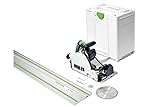
1. Festool TS 75 EQ-F-Plus-FS with 75-Inch Guide Rail
This bundle is the one-stop answer for a cabinetmaker who slices full 4×8 sheets alone. The 75-inch rail clears most sheet dimensions in a single pass, and the TS 75 head itself delivers noticeably deeper plunge cuts than the TS 55 line, which matters when you are breaking down thick hardwood panels or doubled-up plywood. Owners consistently praise the anti-kickback module and the near-zero dust escape when paired with a cleanvac. The main tradeoff is weight and cost; the 75 head feels heftier on long overhead cuts, and at $1,224 you are committing to the largest footprint in the lineup. Skip this if your work rarely exceeds standard 3/4-inch sheet goods and a shorter rail would suffice.
- Pro: 75-inch rail handles full-width sheets without repositioning.
- Pro: Deeper cut capacity than the TS 55 for thick stock.
- Con: Highest price in the list and heavier in hand.
2. Festool 576708 TS 55 FEQ-F-Plus
If you already own a Festool guide rail or plan to purchase one separately, this bare saw is the most affordable way to join the track-saw system at $669. The FEQ designation means it lacks the scoring blade, which is a conscious cost decision rather than an omission of quality. Owners who cut raw plywood and dimensional lumber report that the single-blade setup produces clean edges without needing the secondary scoring pass. The tradeoff appears the moment you slice a finished or melamine-faced panel; without the scoring unit you may see minor chipping on the top surface. Skip this if you work primarily with veneered or pre-finished stock and have no separate rail to borrow from a colleague’s setup.
- Pro: Lowest entry price into the Festool track system.
- Pro: Lighter than the TS 75 head, easier for extended overhead cuts.
- Con: No scoring blade limits finish-quality cuts on coated surfaces.
3. Festool TS 55 FEQ-F-Plus-FS with 55-Inch Guide Rail
At $818 this bundle represents the sweet spot for the typical small-shop owner who needs a complete cutting solution without the TS 75 premium. The 55-inch (1400mm) rail covers most crosscuts on standard sheet goods, and the saw head shares the same build quality as the pricier FEQ-F-Plus-FS variants minus the scoring module. Owner feedback highlights the simplicity: unbox, clamp the rail, make your first cut. The one recurring complaint is that the 55-inch rail forces a mid-cut repositioning on full-width 48-inch panels when you are cutting along the long grain. Skip this if your primary workflow involves long rip cuts across the full sheet length and budget permits the 75-inch rail combo.
- Pro: Best value when you need both saw and rail immediately.
- Pro: Proven track-saw interface that owners describe as intuitive.
- Con: 55-inch rail requires repositioning on full-width long rips.
4. Festool 576118 TS 75 EQ-F-Plus US
This is the bare TS 75 saw head priced at $979, aimed at shop owners who already have a Festool rail and want to upgrade cutting depth without buying the bundle. The TS 75 head gives you more plunge capacity than the TS 55, making it suitable for thick hardwood slabs, doubled plywood, or deep dado-style track cuts. Owners who already run the 55 system describe the upgrade as transformative for sheet-breaking on dense materials. The con is straightforward: you are paying a premium over the TS 55 head without gaining a scoring blade, so finish-quality cuts on coated stock remain a limitation. Skip this if you do not already own a compatible rail and would need to buy one separately anyway.
- Pro: Deeper cut capacity suits thick stock and layered panels.
- Pro: Compatible with existing Festool rails, avoiding bundle overhead.
- Con: No scoring function despite the TS 75 price tier.
5. Festool 577991 TSC 55 KSEB Basic Cordless Track Saw (Bare Tool)
Cordless track saws historically lagged in cut quality, but this TSC 55 Basic at $599 closes most of that gap for on-site carpenters who cannot drag a shop-vac and extension cord to a framed wall. The bare-tool pricing makes sense if you already run Festool 18V battery packs. Owners praise the ability to make full-depth cuts in 3/4-inch plywood on battery power, and the compact form factor fits tight framing cavities where a corded saw and cable become hazards. The tradeoff is run-time: heavy production cutting will drain a single battery before the job is done, and the bare tool excludes rail, charger, and batteries from the box. Skip this if you cut in a fixed shop with ready power and extraction.
- Pro: True cordless mobility for jobsite and framing work.
- Pro: Lowest price in the list for a Festool saw head.
- Con: Battery-only run time limits sustained production cutting.
6. Festool TS 60 KEB-F-Plus-FS US with 55-Inch Guide Rail
The TS 60 head sits between the TS 55 and TS 75 in cut depth while keeping a similar form factor, and this $998 bundle packages it with the 55-inch rail. The KEB designation includes the scoring function, which means you get chip-free edges on veneered, lacquered, or melamine panels without the price jump of the 75-inch rail combo. Owners transitioning from a TS 55 FEQ report that the scoring blade makes the difference for visible edges on furniture work. The rail length limitation remains identical to other 55-inch combos: full-width rips demand a mid-cut reset. Skip this if your work is raw dimensional lumber where scoring adds cost without benefit.
- Pro: Scoring blade delivers clean cuts on finished and veneered surfaces.
- Pro: Mid-range depth between TS 55 and TS 75 in one bundle.
- Con: 55-inch rail still requires repositioning on long full-width cuts.
7. Festool TSV 60 KEB-F-Plus-FS with 75-Inch Guide Rail
At $1,304 this is the most complete track-saw package Festool sells: the scoring TSV 60 head combined with the long 75-inch rail. If you cut finished furniture panels at full sheet width and demand splinter-free results on both faces, this is the configuration that removes every compromise. Owner feedback centers on the scoring function’s reliability across repeated cuts and the rail’s ability to span a 48-inch panel in one clamped setup. The obvious downsides are price and weight; this is a professional investment and not a casual-woodworker purchase. Skip this if your material is always raw or you can manage with a 55-inch rail and accept occasional repositioning.
- Pro: Scoring blade plus 75-inch rail eliminates both common compromises.
- Pro: One-pass full-sheet cuts with chip-free finished edges.
- Con: Highest total cost in the lineup and heaviest single bundle.
8. 110-Inch Track Saw Guide Rail with Connector for Festool
This third-party 110-inch rail at $109.99 addresses a specific pain point: extending your reach for oversized panels, long rips, or continuous cuts beyond what a 75-inch Festool rail covers. The integrated connector lets you join it to an existing Festool rail end-to-end, effectively turning two shorter rails into one long track. Owners who run production sheet-breakdown operations call it a cost-saving alternative to buying a second genuine Festool rail at multiples of this price. The concern is consistency at the joint; some report a subtle ridge where the connector meets the rail edge, which can cause a momentary hesitation in the saw’s glide. Skip this if you never cut panels longer than 75 inches and prefer to stay within the single-rail ecosystem.
- Pro: Extends cutting capacity well beyond any single Festool rail.
- Pro: Fraction of the cost of an additional OEM rail.
- Con: Connector joint may create a momentary catch during the glide.
Buying Guide
Cut Depth vs. Your Material
Match the saw’s maximum plunge depth to the thickest stock you regularly break down. The TS 55 line handles standard 3/4-inch sheet goods with margin, but doubled panels, 1-1/2-inch hardwoods, or deep dado cuts benefit from the TS 75 head’s increased capacity. If your work is limited to 1/2 to 3/4-inch plywood and MDF, the TS 55 depth is sufficient and the TS 75 premium buys headroom you may never use.
Scoring Blade: When It Pays
A scoring function scores a shallow kerf on the top surface before the main blade completes the cut, eliminating tear-out on veneers, melamine, and pre-finished panels. The FEQ models lack it; the F-Plus-FS and TSV designations include it. If you cut raw or paint-grade stock where the top edge gets planed, sanded, or painted, you save money skipping scoring. If finished edges are visible, scoring is not optional.
Rail Length and Job Geometry
The 55-inch (1400mm) rail fits most crosscuts on 4×8 sheets but requires repositioning on long grain rips. The 75-inch rail clears full width in one pass. The 110-inch third-party option extends beyond standard sheet dimensions for oversized panels or continuous cuts. Consider your most common panel orientation before choosing a bundled rail length, because swapping rails mid-job breaks your workflow more than the cost of buying longer upfront.
Our Verdict
Top pick: Festool TS 55 FEQ-F-Plus-FS with 55-Inch Guide Rail at $818. It is the most balanced entry into the system for a typical cabinet shop that cuts raw and paint-grade panels, and the price-to-completeness ratio is hard to beat.
Budget pick: Festool TSC 55 KSEB Basic at $599. For cordless jobsite cuts or a first track saw without rail overhead, nothing else in the list undercuts this price.
Situation pick: The TSV 60 with 75-inch rail wins outright if your work demands chip-free finished edges on full-width panels — no other combination eliminates both compromises simultaneously.
FAQ
Do I need the scoring blade for plywood?
For raw or paint-grade plywood, the main blade alone produces a clean edge that sanding or painting will hide. Scoring becomes necessary when the top face is veneered, melamine, or lacquered and must stay visible without rework.
Can third-party guide rails damage the saw?
Most reports indicate no mechanical damage; the concern is a subtle ridge at connector joints that creates a momentary drag on the glide. Using a connector with care and checking for a flush seam before production cuts minimizes the risk.
Is the TS 55 or TS 75 better for hardwood?
Thick hardwood stock above roughly one inch benefits from the TS 75’s deeper plunge capacity. For standard 3/4-inch hardwood sheet goods, the TS 55 cuts without issue at a lower price and lighter weight.
Can I use the cordless TSC 55 with any rail?
Yes. The TSC 55 KSEB is rail-compatible with the same Festool guide system, so existing 55- or 75-inch rails work without adapters.