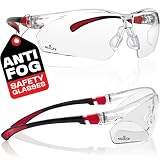
Our Top Picks
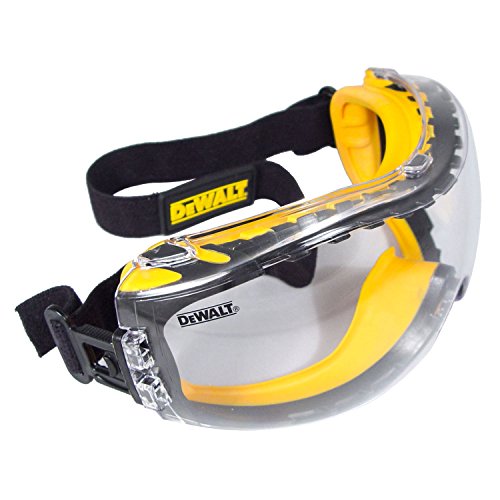 DEWALT DPG82-11 Concealer Clear Anti-Fog Dual Mold SafetyOne Size7.2 x 3.8 x 4 Inches0.1 PoundsCheck on Amazon

What's inside
As an Amazon Associate I earn from qualifying purchases. This post may contain affiliate links at no extra cost to you.
The MAGID Y50 is the most woodshop-ready pair in this group for everyday cutting and routing: a clear-lens, side-shield design that is described as meeting ANSI Z87.1, and one that is easy to pair with a dust mask. For sanding, finishing and any task that throws fine dust, the DEWALT Concealer goggle is the better pick because a goggle seals around the eyes in a way glasses cannot. In woodworking, safety glasses are impact-rated eyewear that stop chips, splinters and fragments. The key markings to look for are Z87 or Z87+ on the lenses and frame, not marketing words on the package.
Contents
Quick List
- NoCry Clear Wraparound Safety Glasses – best for an adjustable fit with anti-fog lenses
- DEWALT DPG82-11 Concealer Goggle – best for sanding and fine dust
- TICONN 1PK Anti-Fog Safety Glasses – best for a single lightweight pair
- TICONN 3PK Clear Safety Glasses – best for keeping spares at every machine
- HPYNPES Over-Spec Anti-Fog Safety Glasses – best for wearing over prescription glasses, a runner-up until certification is confirmed
- MAGID Y50 Safety Glasses (Coyote Tan) – best for general cutting with built-in side shields
Which One Is Right for You?
| If you… | Choose |
|---|---|
| Spend long days at the saw and want a general-purpose pair with side shields | MAGID Y50 (Coyote Tan) |
| Sand, sweep or run a dust collector and need a sealed fit | DEWALT DPG82-11 Concealer |
| Want adjustable temples and nose pads to dial in the fit | NoCry Clear Wraparound |
| Need one reliable, lightweight pair | TICONN 1PK Anti-Fog |
| Want spares to leave at the bandsaw, drill press and router table | TICONN 3PK Clear |
| Wear prescription glasses and need an over-spec style | HPYNPES Over-Spec (confirm Z87.1 marking first) |
If you only buy one thing from this list, buy the pair you will actually wear every time. A pair that fogs, slides down your nose or pinches your temples will end up in a drawer, and no safety rating helps there. Pair a comfortable frame with the habit of putting it on before you walk into the shop, and keep spares at each station so a lost pair is never an excuse.
It also helps to think about the number of pairs you need. A hobbyist working alone may do fine with one dependable pair and a goggle for dusty jobs. A shop with a helper, a student or a visitor benefits from extras so nobody ends up without protection. Keeping two or three styles on hand, for example a pair of glasses and a goggle, lets you pick the best match to the task without compromise.
All 6 Picks in Detail
1. NoCry Clear Wraparound Safety Glasses – Best for an adjustable fit
As an Amazon Associate we earn from qualifying purchases at no extra cost to you.

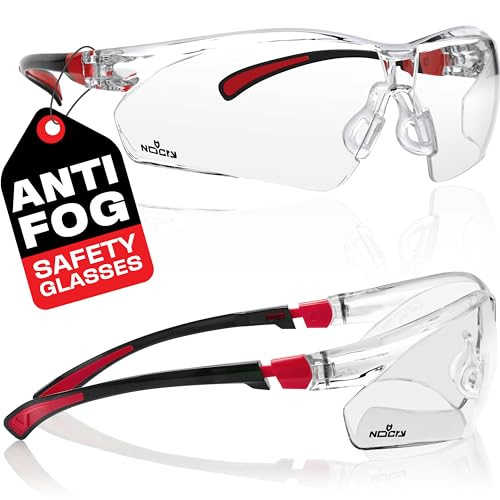
These NoCry glasses are a clear wraparound design with anti-fog and scratch-resistant lenses, adjustable temples and nose pads. The listing states ANSI Z87 certification, and the company’s own product pages describe the current line as ANSI Z87.1 rated, with full-spectrum UV protection. Adjustable temples and soft nose pads help with a stable fit when you lean over a bench or look down at a cut, which is why they suit a woodshop. NoCry also sells related models with side shields and over-glasses styles, so check you have the clear wraparound listing.
It suits woodworkers who share glasses with a partner or who have a face shape that rarely fits standard frames, because the nose pads and temples can be changed in a minute. It is also a sensible choice if you wear a respirator and want to tune the glasses upward to leave a gap for airflow.
- Clear wraparound polycarbonate lens, per the listing
- Anti-fog and scratch-resistant coatings
- Adjustable temples and adjustable nose pads
- ANSI Z87 certification stated in the title; look for Z87+ markings, confirm on listing
- UV protection stated
Pros
- Fit can be tuned to your face
- Wraparound lens gives wide coverage
Cons
- Open sides compared with a goggle in fine dust
- Anti-fog coatings wear with cleaning
Compared with the MAGID Y50, the NoCry is more adjustable; the Y50 brings permanent side shields and a classic work-glasses shape.
2. DEWALT DPG82-11 Concealer Goggle – Best for sanding and fine dust
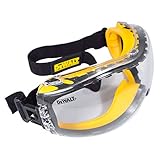
The Concealer is a goggle rather than a pair of glasses, so it forms a seal around the eyes with soft dual-injected rubber and an elastic strap. That seal keeps dust, chips and airborne particles from sneaking around the edges, which is where open-sided glasses fall short during sanding, sweeping or running a dust collector. Retail descriptions list an anti-fog clear polycarbonate lens, scratch resistance and ANSI Z87.1 compliance, but dust and splash ratings are reported inconsistently between sellers, so read the markings printed on the goggle itself.
It suits anyone who sands, sweeps up or empties a dust collector, and it is a good second item to hang next to a regular pair. Because goggles run warmer, many users keep the Concealer for the dustiest tasks and switch to glasses for quick cuts.
- Goggle with a dual-mold rubber seal and elastic strap
- Clear anti-fog lens with a scratch-resistant coating, per retailers
- ANSI Z87.1 per retailers; check the printed markings
- Dust and splash rating varies by seller; confirm on the product
- Small-medium size per some listings; confirm on listing
Pros
- Sealed fit for sanding and dusty work
- Brand familiar to many shop owners
Cons
- Less breathable than glasses and can feel warm
- May not fit over all prescription frames
When the task is fine dust, the Concealer beats every glasses-style pick here; for general shop wear, the NoCry or TICONN is lighter.
3. TICONN 1PK Anti-Fog Safety Glasses – Best for one lightweight pair

The TICONN single pair is a lightweight, adjustable-arm design stated to meet ANSI Z87.1, with UV eye protection, anti-fog treatment and scratch-resistant lenses. The brand describes polycarbonate lenses and offers clear, yellow and gray versions; this listing is the clear anti-fog style. A single pair is a good starting point when you want to try the shape before buying in bulk, and the light frame suits long sessions. Reports from users on related listings suggest the fit may suit larger heads better than very small ones.
It suits hobbyists, students and anyone who wants a no-fuss pair to leave on the bench. The arms adjust, so you can set the length once and expect the fit to be the same every day.
- Anti-fog clear polycarbonate lens
- ANSI Z87.1 stated in the listing name
- UV protection stated
- Adjustable arms and lightweight frame
- Single pair; confirm pack size on listing
Pros
- Light enough for all-day wear
- Stated Z87.1 certification
Cons
- Open sides compared with goggles
- Fit may be generous on small faces
It is a simpler, lighter alternative to the NoCry, which has the more detailed nose-pad adjustment.
4. TICONN 3PK Clear Safety Glasses – Best for spares at every machine
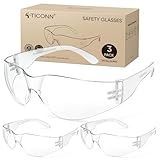
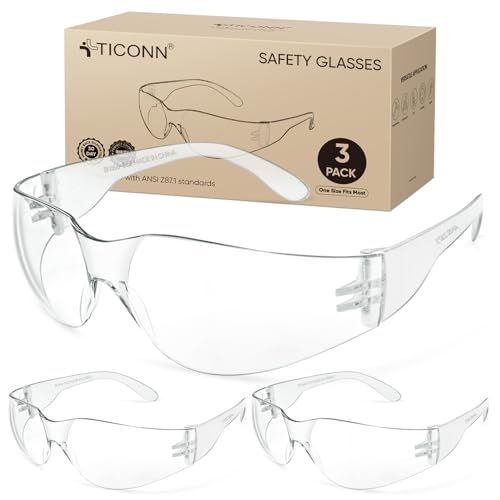
The three-pack is the practical version of the same idea: three pairs of clear safety glasses stated to meet ANSI Z87.1, with UV400 protection, scratch-resistant lenses and impact resistance. Having a pair hung at the table saw, the router table and the workbench removes the temptation to skip protection because you left your glasses somewhere else. The listing title does not mention anti-fog, so if fogging is a concern, check the product page or choose the anti-fog single pair instead.
It suits a shop with several stations, a classroom or a family workshop where the glasses tend to wander off. Buying three at once keeps the same fit and look across the shop, and it makes it easy to tell visitors where to find a spare pair.
- Pack of three clear lenses
- ANSI Z87.1 stated in the listing name
- UV400 protection and scratch-resistant lenses, per the title
- Impact resistance stated; confirm Z87+ marking on the product
- Anti-fog not stated in the name; confirm on listing
Pros
- Spare pairs around the shop
- Same stated certification as the single pair
Cons
- No anti-fog claim in the title
- All three pairs share the same fit
If anti-fog performance matters most, the TICONN 1PK or the NoCry fits better; if you want redundancy, this is the one.
5. HPYNPES Over-Spec Anti-Fog Safety Glasses – Best for wearing over prescription glasses, a runner-up

This listing is a multi-pack of clear, anti-fog wraparound glasses designed to fit over regular eyeglasses, with a wide field of view. The listing name says “Industrial Approved” but does not state ANSI Z87.1, so it is placed here as a runner-up until you can verify the markings. For woodworking, a pair that is not marked Z87 or Z87+ should not be relied on for impact protection. Over-glasses styles are bulkier, and the lens must be stable enough that the inner glasses do not press on the shield.
It suits people whose prescription frames do not fit under standard glasses and who want a wide, protective lens in front. If you choose it, inspect the lenses for any printed Z87 or Z87+ mark; a prescription safety frame is the more dependable long-term answer for a daily woodworker.
- Over-spec design intended to fit over prescription glasses
- Clear, anti-fog, wraparound polycarbonate lens per retail copy
- Multi-pack; confirm pack count on listing
- ANSI Z87.1 not stated in the name; confirm markings on the product
- Adjustable temple length per retail copy
Pros
- Useful for people who cannot wear regular safety glasses
- Wide field of view
Cons
- Certification not clearly stated in the listing
- Bulkier and more prone to fogging than slim frames
Use it only after you confirm Z87 markings; otherwise choose the MAGID Y50 or a prescription safety glasses pair.
6. MAGID Y50 Safety Glasses (Coyote Tan) – Best for general cutting with side shields
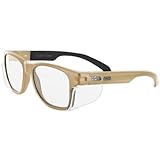
The Y50 is a long-running industrial design with permanent side shields, a clear polycarbonate lens and a metal-free nylon frame. The listing states ANSI Z87.1, and retailers describe the Y50 as a Z87+ high-impact design with scratch-resistant and UV-blocking lenses. The coyote tan frame is a styling choice. It is a good all-purpose pair for sawing, drilling and routing, though it is not a sealed goggle, so fine-dust tasks still call for a goggle.
It suits woodworkers who want one durable pair for the table saw, drill press, router and miter saw. The side shields mean you do not have to think about the gap at the temples, and the frame is simple enough to clean quickly.
- Clear polycarbonate lens with permanent side shields
- ANSI Z87.1 stated in the listing
- Metal-free nylon frame, per retailers
- Universal fit; one pair per listing
- Coyote tan frame
Pros
- Built-in side coverage
- Simple, proven shape
Cons
- Not a sealed goggle for fine dust or splashes
- Limited adjustment compared with adjustable models
Compared with the NoCry, the Y50 is less adjustable but gives guaranteed side shields; the Concealer remains the choice for sealed protection.
Specs Compared
| Eyewear | Style | Certification stated | Lens | Fit features |
|---|---|---|---|---|
| NoCry Clear Wraparound | Wraparound glasses | ANSI Z87 in title; confirm Z87+ marking | Clear, anti-fog, scratch-resistant | Adjustable temples and nose pads |
| DEWALT DPG82-11 Concealer | Sealed goggle | ANSI Z87.1 per retailers; confirm markings | Clear, anti-fog | Elastic strap, dual-mold seal |
| TICONN 1PK | Glasses | ANSI Z87.1 | Clear, anti-fog, scratch-resistant | Adjustable arms |
| TICONN 3PK | Glasses, 3 pairs | ANSI Z87.1 | Clear, UV400; anti-fog not stated | Confirm on listing |
| HPYNPES Over-Spec | Over-glasses wraparound | Not stated; confirm on listing | Clear, anti-fog | Adjustable temples |
| MAGID Y50 (Coyote Tan) | Glasses with side shields | ANSI Z87.1 | Clear polycarbonate | Fixed side shields |
How We Chose These
This guide comes from research, not from wearing the glasses in a shop. We began with the six eyewear listings in the current catalog set and read the listing names, manufacturer pages and retailer specification fields. The criteria were the stated impact standard, lens coatings, side coverage or a sealed fit, adjustability, and how clearly each listing describes what you receive. Where a listing does not state a certification, we say so and mark the item as a runner-up. We do not make claims about fog performance or lens durability beyond what manufacturers and retailers state, and we recommend checking markings on the product itself.
What to Look For
Read the markings: Z87 versus Z87+
ANSI Z87.1 is the American standard for occupational eye and face protection. Eyewear that meets the basic impact requirement is marked Z87, and eyewear that passes the high-velocity, high-mass impact tests carries Z87+. The mark appears on the frame and often on the lens. A listing that says “ANSI approved” in the title without the printed mark on the product is not proof. For a woodshop, Z87+ is the better target because flying chips and kickback fragments can be fast.
Glasses, goggles and face shields
Glasses protect against frontal impacts and, with side shields, some angled debris. Goggles seal around the eyes and are better for fine dust, sanding and finishing sprays. Face shields add protection for the whole face and are standard for lathe turning and some bandsaw tasks, but they are worn over glasses or goggles, not instead of them. For most shop tasks, glasses with side shields are the baseline, and goggles are the step up for dust.
Dust and splash markings on goggles
Goggles can carry additional markings such as D3 for droplets and splashes, D4 for dust, and D5 for fine dust. If your work includes sanding or running a dust collector, a D4 or D5 marking is relevant. Listings sometimes show different ratings for the same model, so read the markings on the goggle itself rather than relying on a retail description.
Lens coatings and fogging
Anti-fog coatings help in humid shops and when wearing a mask, but they wear with repeated cleaning. Clean lenses with water and a soft cloth rather than dry-wiping them, which can scratch the surface and strip coatings. If you wear a respirator or dust mask, a snug nose pad and a design with more airflow can reduce fogging more than a coating alone.
Match eye protection to the task
Different woodworking jobs create different hazards, and the right eyewear changes with them. Crosscutting and ripping on a table saw or miter saw throw chips forward and sideways, so glasses with side coverage are the baseline. Routing and shaping can fire small fragments at high speed from an unexpected angle, which is where Z87+ high-impact markings matter. Sanding, sweeping and emptying a dust collector create a fog of fine particles that glasses with open sides cannot keep out, so a sealed goggle is better. Turning on a lathe adds the risk of a blank or a bowl coming apart, and a full face shield over safety glasses is the standard setup. Chiseling and splitting, even by hand, can send chips at the face, and so can nailing or stapling into hard material, so wear eye protection for hand tools as well as power tools.
Wearing glasses with a dust mask or respirator
The most common cause of fogging in a woodshop is warm, moist breath escaping upward from a mask. Choose a mask with a good nose seal and seat the glasses over the nose clip so air is directed down instead of up. A snug nose pad on the glasses helps, and a lens with an anti-fog coating adds another layer. Goggles and respirators are also designed to be worn together, but check that the straps do not interfere with each other and that the goggle seal still touches the skin around the eyes. If you notice that the seal lifts when you turn your head, adjust the straps or choose a different shape.
Lens color and light levels
Clear lenses are the right default in a workshop because shop lighting is usually moderate and you need to see the grain, the pencil line and the blade. Yellow or amber lenses can increase contrast in dim light, and gray lenses cut glare outdoors, but both reduce the light reaching your eyes and may be wrong for a dim garage. If you work in a space with a lot of glare from windows or from bright work lights, consider an anti-glare option, but keep clear lenses available for detail work.
Fit, prescriptions and replacement rules
Fit should be snug without pinching. The frame should not touch your eyelashes, and the temple arms should not squeeze your head. If you wear prescription glasses, use over-glasses styles or prescription safety eyewear, because normal street glasses are not impact-rated. Replace safety glasses with deep scratches, cracks, loose side shields or frames that have taken a hard hit. A worked rule of thumb: if you notice glare or distortion when looking at a light bulb through the lens, the surface is too scratched and it is time for a new pair.
Questions
What does Z87+ mean on safety glasses?
The plus sign marks eyewear that passed the high-impact tests in the ANSI Z87.1 standard. For woodworking, it is a good marker because it signals protection against faster, heavier fragments than the basic Z87 tests.
Do I need goggles for sanding?
Goggles with a dust marking provide a better seal than glasses, so they are a good idea for fine-dust work. Many woodworkers wear both a respirator and goggles during sanding or sweeping.
Can I wear safety glasses over prescription glasses?
Yes, with over-glasses styles designed for it. Make sure the over-glasses pair is marked as meeting the standard, and that it fits without pressing the inner frame into your face.
How do I stop safety glasses from fogging?
Choose an anti-fog lens, adjust the nose pads for airflow, and clean the lens correctly. In heavy fog conditions, a vented goggle may work better than glasses.
How often should I replace safety glasses?
Replace them when the lens is scratched, cracked or distorted, the frame is loose, or after a significant impact. A damaged pair no longer provides the same protection.
Are tinted lenses okay in a woodshop?
Clear lenses are the safest choice indoors because they let in the most light. Tinted lenses are better suited to outdoor work, and the listings in this guide are clear.
Update History
- October 20, 2026 – Initial publication; product set drawn from current catalog listings.
- Check the product page for current specifications and availability before buying.
Sources
- Manufacturer product and specification pages for NoCry, DEWALT, TICONN and MAGID
- Retailer listing titles and specification fields for the six listed eyewear products
- ANSI Z87.1 marking descriptions as cited on manufacturer and retailer product pages