Key takeaways
- The best earmuffs for loud workshops compared: passive and Bluetooth picks, how NRR and SNR differ, and how to estimate real-world noise reduction.
What's inside
As an Amazon Associate I earn from qualifying purchases. This post may contain affiliate links at no extra cost to you.
The Dr.meter Large noise-reducing earmuff is the pick for a pure, no-electronics workshop: it is a passive muff with a large adjustable band, and its listing advertises 35 dB of reduction, the highest figure of the six. If you want music, podcasts or calls while you work, the PROHEAR 033 and the Kalence models add Bluetooth, and the ZOHAN adds a long battery claim at a lower noise rating. Earmuffs for loud workshops are over-the-ear hearing protectors with a seal around each ear and a headband that holds them in place. The most important number is the Noise Reduction Rating (NRR), and the listing figure is not always the label figure.
Contents
Quick List
- PROHEAR 033 Bluetooth with AM/FM Radio – best for radio and wireless audio in the shop
- Dr.meter Large (XL) Noise-Reducing Earmuffs – best for a passive, high-reduction muff with a large fit
- Kalence Bluetooth 6.0 with Microphone (black) – best for calls and long battery life
- ZOHAN EM037 Bluetooth 6.0 – best for a simple rechargeable Bluetooth muff
- 4X Sound Amplification Electronic Earmuffs (gel pads) – best for hearing conversation while still protected
- Kalence Bluetooth 6.0 (rechargeable, 30dB) – best for a second Kalence option with the same 120-hour claim
Which One Is Right for You?
| If you… | Choose |
|---|---|
| Want no battery, no radio and the biggest stated reduction | Dr.meter Large (XL) |
| Like to listen to AM/FM radio or stream music while you cut | PROHEAR 033 |
| Take calls from the shop and need a built-in microphone | Kalence Bluetooth 6.0 with Mic |
| Want a straightforward rechargeable pair for mowing and woodworking | ZOHAN EM037 |
| Work with others and want to hear speech without removing protection | 4X Sound Amplification Earmuffs |
| Want a second Kalence for a partner or a different color | Kalence Bluetooth 6.0 (yellow option) |
For a shop with a table saw, planer or dust collector, begin with the noise level, not the features. Passive earmuffs have no batteries to charge and no electronics to fail, and they are the simplest way to get dependable reduction. Add Bluetooth only if you will use it, because wireless audio tempts people to turn the volume up inside the muff.
Consider who else will use the muffs. A shop shared with a helper, a teenager or a visitor benefits from an adjustable band that fits several head sizes and from a simple design that anyone can use without learning a pairing routine. A solo woodworker who spends long days at the bench might value a lighter electronic pair with a good battery and a radio, as it makes repetitive work more pleasant. Whatever you pick, keep a spare pair of foam earplugs on the bench so you can double up for the loudest tasks.
All 6 Picks in Detail
1. PROHEAR 033 Bluetooth with AM/FM Radio – Best for radio and wireless audio
As an Amazon Associate we earn from qualifying purchases at no extra cost to you.

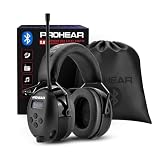
The PROHEAR 033 is a Bluetooth 5.4 hearing protection headset with a built-in AM/FM radio, a rechargeable battery and an NRR stated at 25 dB in its listing. The brand’s own materials describe a 48-hour Bluetooth playtime, and retailer pages note an LCD radio display and station presets. It is a good fit for a garage woodshop where background audio is part of the routine. Because the NRR is 25, it sits at the middle of the group in reduction; if your tools are very loud, consider pairing it with earplugs.
- Bluetooth 5.4 with a built-in AM/FM radio
- Stated 25 dB NRR in the listing name
- Rechargeable battery with a stated 48-hour playtime
- Designed for mowing, workshops and snowblowing
- Battery capacity and weight vary between listing versions; confirm on listing
Pros
- Radio works with no phone nearby
- Clear NRR figure stated in the title
Cons
- Lower stated reduction than the 30 dB-class listings
- Battery claims differ between listing versions
Compared with the ZOHAN EM037, the PROHEAR adds a radio and a longer track record in this category, while the ZOHAN leans on its long battery claim.
2. Dr.meter Large (XL) Noise-Reducing Earmuffs – Best for passive, high-reduction fit on large heads

Dr.meter’s large earmuff is a passive protector marketed to adults with larger heads, with a listing that advertises 35 dB of noise reduction. Product pages for the brand list this class of muff as SNR 35 dB with a lower NRR in the high 20s, so treat the 35 figure as the European single-number rating rather than a US NRR and check the label before relying on it. There is no battery or Bluetooth, which is exactly the appeal: nothing to charge, pair or replace. It is positioned for shooting ranges, yard work and workshops.
- Passive earmuff with no electronics
- Listing advertises 35 dB; the NRR is likely lower, confirm on listing
- Extra-large band and cups for bigger heads
- Foam-lined ABS-style cups; confirm materials on listing
- No Bluetooth, radio or microphone
Pros
- Highest advertised reduction among the six
- No battery or pairing to manage
Cons
- No audio features at all
- Advertised figure may be SNR rather than NRR
For a bigger head and a pure protection role, it beats the Bluetooth models; if you want music, move to the Kalence or PROHEAR.
3. Kalence Bluetooth 6.0 with Microphone – Best for calls and long battery life

This Kalence model is a rechargeable Bluetooth 6.0 hearing protector with a built-in microphone, a claimed 120-hour working time and a 30 dB figure in the listing. Retail copy and independent product write-ups note that the 30 dB number is commonly an SNR, with the US NRR closer to the mid-20s, so verify the label. The microphone makes it useful for answering calls or giving voice commands without taking the muffs off, and large buttons are described as glove-friendly. It is aimed at mowing, workshops, construction and snowblowing.
- Bluetooth 6.0 with built-in microphone
- Stated 120-hour working time on the listing
- 30 dB listed; NRR may be lower, confirm on listing
- Rechargeable battery, wired audio option; confirm on listing
- Black colorway shown
Pros
- Microphone for hands-free calls
- Very long stated battery runtime
Cons
- The 30 dB figure needs checking against the label
- Two similar Kalence listings can confuse buyers
Next to the PROHEAR, the Kalence swaps the radio for a microphone and a longer stated battery life.
4. ZOHAN EM037 Bluetooth 6.0 – Best for a simple rechargeable Bluetooth muff

The ZOHAN EM037 is sold as a Bluetooth 6.0 hearing protector with a 25 dB NRR, a 1100 mAh rechargeable battery and a stated 120-hour playtime. The brand sells several versions of this model, with different battery sizes, Bluetooth versions and SNR claims, so double-check that the listing you buy matches the specs you want. The design is straightforward: ABS cups with sound-absorbing foam, a headband and a charging cable. It suits light to moderate shop noise, or a second pair for visitors.
- Bluetooth 6.0 on this listing
- 25 dB NRR stated in the title
- 1100 mAh rechargeable battery; 120-hour playtime stated
- Includes a charging cable; confirm contents on listing
- Related EM037 listings differ in battery and Bluetooth version
Pros
- Clear NRR statement and long battery claim
- Simple, uncluttered design
Cons
- 25 dB is on the lower side for the loudest tools
- Similar listings can be confused with this one
It matches the PROHEAR’s 25 dB NRR but drops the radio in favor of a longer claimed runtime.
5. 4X Sound Amplification Electronic Earmuffs – Best for hearing conversation while protected

This listing is an electronic earmuff with 4X sound amplification, gel ear pads, Bluetooth 6.0 and a stated 30 dB NRR with a rechargeable battery. Amplification in this kind of muff is meant to pick up quiet sounds, such as speech, while the electronics limit loud impact noise, so it can help you talk with a helper without taking the muffs off. The listing does not state how quickly the electronics clamp down on loud noise, so ask the seller or check the product page for the shutoff behavior. A stated NRR of 30 is high; confirm it on the label.
- 4X sound amplification for quiet sounds, per the listing name
- Gel ear pads for comfort and seal
- Bluetooth 6.0 with rechargeable battery
- 30 dB NRR stated in the listing; confirm on listing
- Battery size and runtime truncated in the name; confirm on listing
Pros
- Lets you hear speech while the shop is running
- Gel pads can improve comfort and seal
Cons
- Electronics add complexity and a battery to manage
- Brand and shutoff details are thin on the listing
If you do not need amplification, the Kalence and PROHEAR give a similar feature set with clearer battery claims.
6. Kalence Bluetooth 6.0 (rechargeable, 30dB) – Best for a second Kalence option

This second Kalence listing has the same headline features as the first, including Bluetooth 6.0, a claimed 120-hour working time and a 30 dB figure, but without the microphone mention in the title. Retail pages show a yellow colorway for this listing, which makes it easy to spot on a shelf and helps visitors find their own pair. The same caution applies: the 30 dB number should be verified against the NRR on the label, and listings for similar models sometimes conflict.
- Bluetooth 6.0 with rechargeable battery
- Stated 120-hour working time
- 30 dB figure; NRR may be lower, confirm on listing
- Microphone not mentioned in the name; confirm on listing
- Colorway may be yellow; confirm on listing
Pros
- Same long battery claim as the other Kalence
- Bright color is easy to see in a shop
Cons
- Near-identical to another Kalence listing
- Rating figure needs checking
Choose this one only if the color or listing details suit you better than the first Kalence, since the feature sets are close.
Specs Compared
| Earmuff | Type | Stated reduction | Audio features | Battery |
|---|---|---|---|---|
| PROHEAR 033 | Electronic Bluetooth | 25 dB NRR | Bluetooth 5.4, AM/FM radio | Rechargeable, 48 hr stated |
| Dr.meter Large (XL) | Passive | 35 dB listed; likely SNR, confirm on listing | None | None |
| Kalence Bluetooth 6.0 with Mic | Electronic Bluetooth | 30 dB listed; confirm NRR | Bluetooth 6.0, microphone | Rechargeable, 120 hr stated |
| ZOHAN EM037 | Electronic Bluetooth | 25 dB NRR | Bluetooth 6.0 | 1100 mAh, 120 hr stated |
| 4X Amplification Earmuffs | Electronic, amplifying | 30 dB NRR listed; confirm on listing | 4X amplification, Bluetooth 6.0 | Rechargeable; confirm on listing |
| Kalence Bluetooth 6.0 (30dB) | Electronic Bluetooth | 30 dB listed; confirm NRR | Bluetooth 6.0 | Rechargeable, 120 hr stated |
How We Chose These
This page is the result of desk research rather than wearing the earmuffs in a shop. We began with the six hearing protectors in the current catalog set and compared the listing names, manufacturer pages and retailer specification fields for each. We focused on the stated noise reduction and which standard it refers to, whether the muff is passive or electronic, audio and microphone features, stated battery life, and how clearly the listing describes what you get. Because noise ratings on some listings mix NRR and SNR, we mark any figure we could not confirm and tell you to check the label. We do not cite decibel measurements of our own.
What to Look For
Understand NRR, SNR and what they mean for you
NRR is the US Noise Reduction Rating found on labels under the American standard. SNR, the Single Number Rating, comes from the European standard and tends to be a few decibels higher for the same product. A listing that says “30 dB” without naming the standard is often using SNR. Real-world protection is lower than the label number because of imperfect seals, glasses, hair and headband pressure. As a common field rule, subtract 7 from the NRR and divide by two to estimate the reduction in A-weighted workplace readings.
Worked example: a planer running at roughly 95 dBA, with a muff labeled NRR 25, gives (25 minus 7) divided by 2, which is 9 dB. The estimated level at the ear is about 86 dBA. A muff labeled NRR 29 would estimate around 84 dBA. Because the target is generally to stay under 85 dBA across a full day, stacking foam plugs under the muffs is smart when tools run well above 95 dBA.
Know your tool noise
Typical woodworking tools such as table saws, routers, planers and dust collectors commonly run in the 90s and can reach above 100 dBA, and exposure risk depends on both level and time. A phone sound-level app gives a rough idea, though it is no substitute for a calibrated meter. Short bursts matter less than a full afternoon of planing, so be conservative: wear protection every time a loud tool runs, not just for long sessions.
Passive versus electronic muffs
Passive muffs rely on cup mass, foam and the seal, and they are the most dependable. Electronic muffs add microphones and circuits that amplify quiet sounds and cut off loud ones, and Bluetooth models add wireless audio. Electronics are useful, but they bring batteries, charging and more failure points. If your priority is dependable protection, a passive muff is the simpler answer.
Bluetooth and music safety
Music inside a muff can mask warning sounds, such as a changing motor note or a coworker shouting. Keep the volume low enough that you can still hear a normal voice, and consider leaving one ear aware in settings that allow it. Avoid listening at high volume to compensate for noise; the entire point of the muffs is to reduce exposure. Check the battery status before starting work so the muffs do not go silent mid-task.
Head size, band design and long-session comfort
Comfort decides whether a muff gets worn for a whole afternoon or pushed to the neck after twenty minutes. Look at clamping force, cushion softness and weight. A heavier muff with a wide band spreads pressure better than a light one that pinches, and a padded headband helps if you wear the muffs for hours. People with larger heads should look for an extended band, such as the one advertised on the Dr.meter Large, while smaller heads may find a standard band sits better. Gel cushions can feel cooler and seal well over glasses arms, but they may run warm in summer, and foam cushions are lighter and breathe a little better. If the cups press on your ears or the band leaves marks, fit is wrong and protection will suffer.
Wired inputs, microphones and call quality
Some electronic muffs include a wired audio jack as a backup, which is handy when the battery runs low or when you want to avoid Bluetooth pairing glitches. A built-in microphone is helpful for short calls, but in a loud shop the microphone may pick up as much machine noise as voice. Treat it as a convenience for answering the phone, not as a communication system. If you need to talk with another person in the shop, look at amplification models that let speech come through at a safe level, or step away from the noise before you speak.
Battery life, charging and storage
Stated runtimes in the dozens or even over a hundred hours are best-case figures that depend on volume and features. Plan to charge the muffs on a regular schedule so they are ready, and store them in a dry place away from sawdust and heat. Lithium batteries do not like being left in a hot truck or a freezing garage, so if your shop swings widely in temperature, bring the muffs inside. Replace the unit if the battery swells, the case warps or the charging port becomes damaged.
Habits that make protection work
The best muff is the one that is on your head before the saw starts. Keep a pair hanging at each loud station so putting them on becomes automatic, and make it a rule that the muffs go on before the machine does. Give your ears a quiet break after a long session, and be aware that ringing or muffled hearing after work is a sign you had too much exposure; if it happens repeatedly, tell a hearing professional. Clean the cups with a damp cloth, let them dry, and keep them out of dust. Finally, remember that a single unprotected burst from a router or nailer can undo a lot of careful habits, so treat the quick cuts the same as the long ones.
Fit, seals and charging safety
Muffs only work when the cushions seal against the head. Glasses arms, long hair and beards can break the seal, and large heads need a muff with enough band extension. Keep the cushions clean and replace them when they harden or crack. Charge the battery with the supplied cable on a clear, non-flammable surface, away from sawdust piles and finishing supplies, and do not leave it charging unattended.
Questions
What does NRR mean on earmuffs?
NRR stands for Noise Reduction Rating, the US label figure that estimates how many decibels a protector cuts under laboratory conditions. Real-world reduction is usually lower, so treat it as a ceiling rather than a promise.
Is 30 dB the same as NRR 30?
Not necessarily. Many listings use 30 dB to refer to SNR, the European rating, which typically runs a few decibels above the US NRR on the label. Look for the NRR printed on the product or in the manufacturer specifications.
Can I wear earmuffs and earplugs together?
Yes, and it is recommended in very loud environments. Combined protection does not add up simply, but it does improve on either alone.
Are Bluetooth earmuffs safe in a workshop?
They are reasonable when used responsibly. Keep the volume low enough to hear warning sounds, and do not let the audio tempt you to skip protection or crank the volume up.
How often should I replace the ear cushions?
Replace them when they harden, crack, flatten or no longer seal against your head. A yearly check is a sensible habit for regular users.
Do electronic earmuffs work if the battery dies?
Most still provide passive protection with the electronics off, but check the manufacturer’s guidance, because some features such as amplification stop working without power.
Update History
- October 20, 2026 – Initial publication; product set drawn from current catalog listings.
- Check the product page for current specifications and availability before buying.
Sources
- Manufacturer product and specification pages for PROHEAR, Kalence, ZOHAN and Dr.meter
- Retailer listing titles and specification fields for the six listed earmuffs
- ANSI S3.19 and EN 352 rating references as cited on manufacturer and retailer product pages