What's inside
- What this guide covers
- What a pergola kit includes
- Types of pergola kits
- Materials compared
- Sizing and placement
- Shade, roofs and canopies
- Construction details that matter
- Foundations, anchoring and permits
- Care and weather
- Common mistakes
- Who should choose what
- Buying checklist
- Frequently asked questions
- Conclusion
As an Amazon Associate I earn from qualifying purchases. This post may contain affiliate links at no extra cost to you.
Short answer: the best pergola kit is the one sized for your patio or garden with room to walk around it, built from a material you are willing to maintain, and engineered with clear anchoring instructions for your type of surface. For most homeowners who love the look of timber, a freestanding or attached wooden kit made from rot-resistant lumber with thick posts, bolted joinery and real footing or anchoring instructions is the safest starting point. Before you buy, check local permit and HOA rules, locate underground utilities, and be realistic about your snow and wind conditions, because a pergola is a structure that has to stand up to weather.
Contents
- What this guide covers
- What a pergola kit includes
- Types of pergola kits
- Materials compared
- Sizing and placement
- Shade, roofs and canopies
- Construction details that matter
- Foundations, anchoring and permits
- Care and weather
- Common mistakes
- Who should choose what
- Buying checklist
- Frequently asked questions
- Conclusion
Our Top Picks


What this guide covers
- What a pergola kit includes
- Types of pergola kits
- Materials compared
- Sizing and placement
- Shade, roofs and canopies
- Construction details that matter
- Foundations, anchoring and permits
- Care and weather
- Common mistakes
- Who should choose what
- Buying checklist
- FAQ
- Conclusion
What a pergola kit includes
A pergola is an open outdoor structure with posts supporting beams and cross rafters, sometimes with a lattice or slatted top. A kit packages the main pieces so that you can assemble it without sourcing every board yourself. Depending on the kit, you might receive precut posts, beams, rafters, brackets, post bases, screws or bolts, and instructions. What is almost never included is the foundation material, concrete, tools, paint or stain, and shade fabric. Read the item list carefully, because a kit that appears cheap may leave out hardware you will need to buy separately.
Kits differ in how much work remains. Some arrive with boards precut and predrilled; others expect you to cut lengths, notch beams and drill holes. Some are designed for assembly by two people in a day, while larger or heavier ones need help and lifting equipment. A kit can save time, but it cannot replace planning, so treat the box as the beginning of a project, not the end of one.
Types of pergola kits
Freestanding pergolas
Four or more posts stand on their own footings or anchor plates. They can sit on a lawn, patio, gravel area, or a deck designed to support them. Freestanding structures are flexible in placement and do not attach to your house, which avoids penetrating siding or roof flashing. They do rely entirely on their posts and anchoring for stability.
Attached pergolas
One side is fastened to your house with a ledger board or brackets, with posts on the outer side. They create a shaded extension of living space and need fewer posts. The attachment must be done properly, with fasteners into structural framing and flashing to keep water out of the wall. If you are not confident in that work, hire a qualified contractor.
Gazebo-style and four-post garden pergolas
Smaller square or rectangular kits suited to dining areas or garden seating. They are easier to place but offer less coverage.
Carport-style and walkway pergolas
Long, narrow designs for covering paths or driveways. Spans and loads are different, so confirm the intended use.
Pergolas with adjustable or louvered roofs
These have movable slats that open or close for sun and rain control. They are more complex, may include motors or other mechanisms, and need careful reading of care and warranty information.
Arbors and small garden arches
Not quite pergolas, but sometimes grouped with them. They suit entryways and climbing plants but are not meant for seating areas.
Comparison of pergola kit types
| Type | Best for | Advantages | Considerations |
|---|---|---|---|
| Freestanding | Gardens, lawns, patios away from the house | Flexible location; no wall attachment | Needs solid footings or anchoring on all posts |
| Attached | Patios and decks beside the house | Extends living space; fewer posts | Correct ledger attachment and flashing essential |
| Small garden or four-post | Dining spot, hot tub corner, garden seating | Easier to place and assemble | Limited coverage |
| Walkway or long-span | Paths, driveways, long terraces | Covers a line of travel | Longer spans need heavier members |
| Louvered or adjustable | People who want weather control | Adjustable shade | Mechanisms add complexity and maintenance |
Materials compared
This is a woodworking site, so wood gets the most attention, but you should know the alternatives to make a fair decision.
Cedar and redwood
These rot-resistant softwoods are the most popular for pergolas because they weather attractively and resist decay and insects better than ordinary lumber. They are relatively light and easy to cut. Expect to pay more than for treated pine, and expect color changes toward gray unless you stain or seal.
Pressure-treated pine and fir
These are commonly available and suited to ground contact when rated for it. They can twist or check as they dry, so look for straight, dry stock where possible. They accept paint and stain well once dry.
Hardwoods and tropical species
Dense woods are strong and long-lasting but heavy, expensive and harder to drill and cut. They need pilot holes for fasteners, and sourcing should be responsible and verifiable.
Vinyl and fiberglass
Low-maintenance and uniform in color, with no painting required. They can be less rigid over long spans and may fade or become brittle over time. Look for internal reinforcement in the posts and beams.
Aluminum and steel
Strong and durable with minimal upkeep. They can feel more modern and industrial, can heat up in sun, and powder coating may chip. Steel needs rust protection.
Material comparison
| Material | Look | Upkeep | Main trade-off |
|---|---|---|---|
| Cedar or redwood | Natural, warm | Periodic sealing or staining | Higher cost than treated pine |
| Pressure-treated softwood | Plain, paintable | Seal or stain; watch for checking | Can warp while drying |
| Dense hardwood | Rich, formal | Oil or let weather | Weight, cost, difficult to cut |
| Vinyl or fiberglass | Clean, uniform | Wash occasionally | Less rigid, limited color options |
| Aluminum or steel | Modern, slim | Occasional touch-up | Heat and finish chipping |
Sizing and placement
Start with how you want to use the space. A dining table for four with chairs pushed back needs roughly a ten-foot square area, while a pair of lounge chairs and a small table can fit in less. Mark the footprint with stakes and string or with chalk on a patio, then place your furniture inside it and walk around. You want to be able to pull out chairs and move around without brushing a post.
Consider the height as well. Standard clearances are usually adequate for adults, but taller people, ceiling fans and hanging lights all benefit from more height. For an attached pergola, check the height of windows, rooflines and gutters so the structure does not block them or trap water.
Think about the sun. In the northern hemisphere, a pergola on the south or west side of a patio gives the most shade during hot afternoons, while the orientation of the slats affects how much light passes through at different times of day. Watch your yard at different hours before choosing a spot. Also consider views, privacy, trees overhead, the direction of prevailing wind, and the distance from your grill, fire pit or any heat source. Keep open flames and fuel-burning appliances clear of wood and fabric, following the appliance manufacturer’s clearance guidance.
Shade, roofs and canopies
An open-rafter pergola gives dappled shade, not rain protection. How much shade you get depends on the spacing and depth of the rafters and any cross slats. Tighter spacing blocks more sun but also reduces airflow and light. If you want more cover, there are several options.
- Retractable fabric canopies slide along wires or tracks and can be pulled back in the evening or removed in wind. Fabric should be taken down in storms and snow.
- Shade sails or cloth panels are attached to the frame and tensioned. Make sure the frame is rated to take the added load and wind pull.
- Solid or polycarbonate roof panels turn the pergola into a covered structure, which can change permit requirements and structural loading, especially snow.
- Climbing plants such as grapes, wisteria or clematis offer natural shade, but a mature vine adds considerable weight and needs a sturdy structure and pruning.
- Outdoor curtains add privacy and block low sun.
Any covering adds wind sail effect, so a pergola that is stable in open form may need more bracing and anchoring once you cover it. Ask the manufacturer what accessories the kit is designed to carry.
Construction details that matter
Post size and spacing
Thicker posts resist racking and bending. Four-by-four posts are common for small structures, while larger spans and heavier covers call for six-by-six posts or heavier members. The wider the span between posts, the stronger the beam should be.
Joinery and bracing
Look for through-bolts, lag screws, notched beams that rest on posts, and diagonal knee braces at the corners. Braces stiffen the frame against wind. A kit that relies only on a few small screws in end grain is weaker than one with proper hardware.
Hardware quality
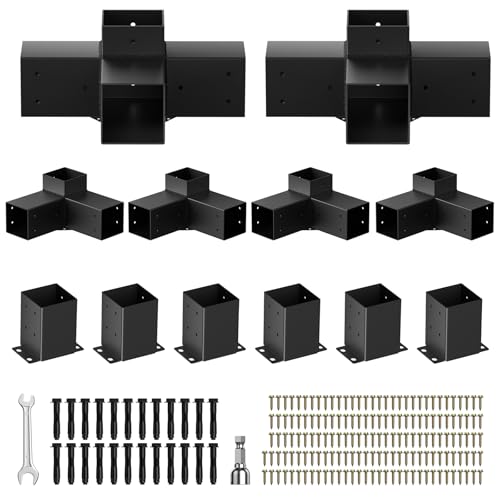
Choose corrosion-resistant fasteners, especially in coastal or wet climates, and make sure any metal in contact with treated lumber is rated for it, since some preservatives corrode ordinary steel. Brackets and post bases should be described as outdoor rated.
Rafter design
Rafters on top of the beams or notched into them both work. Consider the ends: decorative cutouts look good but expose more end grain to water, so sealing those cut ends before assembly helps them last.
Lumber quality and finish
Check photos and reviews for straight boards and tight knots. Kits that arrive unfinished let you choose your own stain or paint. Pre-finished kits save time but may still need touch-ups where holes are drilled and ends are cut. Always follow the finish manufacturer’s directions.
Documentation
A good kit includes a parts list, clear diagrams, hardware counts and guidance on footings and anchoring. If the instructions say little about foundations, consider that a flag.
Foundations, anchoring and permits
Check rules first
Many areas require a building permit for permanent outdoor structures, especially those attached to a house, above a certain size, or with a solid roof. Setbacks from property lines, easements and height limits can apply, and a homeowners association may have its own approval process and style rules. Call or visit your local building department and your HOA before you buy, because a permit may require drawings or specific footing depths.
Locate utilities
Before digging footings or driving anchors, contact your local underground utility locating service. Marks are free in many places and the wait is typically a few days. Also look for septic fields, irrigation lines, and low-voltage lighting cable, which are not always marked by utility services.
Foundation options
The right foundation depends on your soil, climate and the pergola’s design. Concrete footings that extend below the local frost line are the most robust choice for permanent freestanding structures in cold regions. Post bases that bolt to a concrete slab or patio with appropriate anchors suit existing hardscape if the slab is thick and sound enough to hold them. Surface-mount brackets on a deck require that framing be strong enough to resist uplift, and posts should be fastened to the structural framing, not just the decking. Do not simply set posts on pavers or lawn, as the structure may shift or lift in wind.
Wind, snow and uplift
Your local climate determines how much load the structure must withstand. In snowy regions, avoid adding solid covers without engineering confirmation. In windy areas, anchoring and bracing are critical. If your area has specific design requirements, a building official can tell you what the code expects.
Electrical and fire safety
If you add lighting, fans or outlets, use outdoor-rated products and have the wiring done or inspected by a licensed electrician when required. Keep heaters, grills and fire features at safe distances according to their manuals.
Assembly safety
Use a stable ladder, wear eye protection, and recruit helpers for posts and beams. Brace the structure temporarily while assembling, and do not work alone at height.
Care and weather
Wood outdoors needs a coat of protection. Clean the surface once or twice a year, then apply a sealer, stain or paint appropriate for exterior use. Re-coat on the schedule given by the finish manufacturer, paying attention to horizontal surfaces and end grain, which absorb the most moisture. Keep plants and mulch away from post bases to improve airflow. Check bolts and brackets at the start of each season, since wood movement loosens them over time. Replace any member showing soft spots, rot or deep cracks. Remove fabric covers ahead of storms, and clear heavy snow from solid covers if the manufacturer recommends it.
Common mistakes
- Skipping permits or HOA approval and facing removal orders later.
- Choosing a size by looks, then finding no room for chairs and circulation.
- Setting posts on loose pavers or soft soil without proper footings.
- Attaching to a house without flashing or structural fastening.
- Adding a heavy cover to a frame not designed for it.
- Using ordinary screws that corrode and stain the wood.
- Delaying the first coat of stain until the wood has weathered and split.
- Digging without locating utilities.
Who should choose what
- Confident DIYers with a flat patio: a wooden freestanding kit with detailed instructions.
- Homeowners who want a dining extension: an attached pergola, ideally installed or inspected by a pro.
- People who dislike maintenance: aluminum, vinyl or fiberglass kits, understanding the look differs.
- Gardeners who want climbing plants: a sturdy wood kit with generous post size and open rafters.
- Windy or snowy locations: a heavier-framed kit, deeper footings and a conversation with the local building office.
Buying checklist
- Measure the area and mark the footprint with furniture placed inside.
- Confirm permit, setback and HOA requirements.
- Arrange for utility marking before any digging.
- Compare post and beam dimensions to the span.
- Check what hardware, bases and brackets are included.
- Choose a foundation method suited to your soil and climate.
- Decide on shade strategy and confirm the frame can carry it.
- Plan finish products and maintenance schedule.
- Confirm delivery size and whether you need help unloading.
Frequently asked questions
Do I need a permit for a pergola?
Often, yes, especially for large, attached or roofed structures. Local rules differ, so ask your building department.
Can I put a pergola on a deck?
Possibly, if the deck framing can carry the loads and the posts are fastened to it properly. Ask a professional if unsure.
How deep should the footings be?
That depends on frost depth and local code. Ask your building office for the required depth.
Is a pergola the same as a gazebo?
No. Gazebos usually have a solid roof; pergolas typically have an open top.
How long does a wooden pergola last?
It depends on species, finish, climate and upkeep. Regular sealing extends life.
Can I add a rain cover?
Some kits support it. Check the manufacturer’s guidance, especially for snow and wind loads.
How hard is assembly?
Small kits suit two people in a weekend; larger ones take longer and may need professional help.
Which wood is best?
Cedar and redwood are popular for natural resistance; treated lumber is a common budget option.
Conclusion
Choose the pergola for your site, not the picture. Plan the footprint, confirm the rules, prepare a proper foundation and pick materials you will maintain. Related supplies include a wooden pergola kit, post base anchors, exterior wood stain and a retractable canopy. Check the listing for size and compatibility.
Disclosure: As an Amazon Associate we may earn from qualifying purchases at no extra cost to you.
Related guides
More from Amazon
Programs that pair well with the guide above. Offers and eligibility are set by Amazon and may change.
A free business account with business pricing and bulk-buying tools for work, shop or home office.
Create a business accountFree shipping on eligible items, Prime Video and more. Eligible new members can start with a free trial.
Start a Prime free trialAudiobooks and podcasts to listen to on the go. Eligible new members can start with a free trial.
Try Audible freeAd-free music streaming. Eligible new subscribers can start with a free trial.
Try Music Unlimited freeAs an Amazon Associate we earn from qualifying purchases.