Our Top Picks
What's inside
- Table of Contents
- Quick Verdict
- Bar Clamp vs Pipe Clamp at a Glance
- How Each Clamp Works
- Capacity and Length Flexibility
- Clamping Pressure and Panel Flatness
- Setup Speed and Ease of Use
- Cost Structure: What You Actually Buy
- The Bar Clamp Picks
- The Pipe Clamp Picks
- Who Should Buy a Bar Clamp
- Who Should Buy a Pipe Clamp
- FAQ
- Conclusion
As an Amazon Associate I earn from qualifying purchases. This post may contain affiliate links at no extra cost to you.
- Top Pick: BESSEY KRK2450 K Body REVO Parallel Clamp Kit
- Runner-up: JORGENSEN 24-Inch Parallel Bar Clamp, 2-Pack
- Also consider: Jorgensen Medium Duty Steel Bar Clamp Set, 24-Inch, 2-Pack
The short answer: choose a bar clamp if most of your glue-ups are cabinets, drawers, face frames and panels up to about four feet wide, and you want a clamp that is ready to work the moment you pick it up, with jaws that stay square to the bar. Choose a pipe clamp if you glue wide tabletops and long assemblies, because a pair of cast-iron fixtures on a length of black pipe can be made as long as the work demands, and extra capacity later means buying pipe, not whole clamps. Both designs have held panels together in workshops for generations; they differ in how length, pressure and convenience are packaged.
Below, we compare the two clamp types head to head, then look at five representative products — three bar clamps and two pipe clamps — with published specifications for each.
As an Amazon Associate, we earn from qualifying purchases.
Contents
- Table of Contents
- Quick Verdict
- Bar Clamp vs Pipe Clamp at a Glance
- How Each Clamp Works
- Capacity and Length Flexibility
- Clamping Pressure and Panel Flatness
- Setup Speed and Ease of Use
- Cost Structure: What You Actually Buy
- The Bar Clamp Picks
- The Pipe Clamp Picks
- Who Should Buy a Bar Clamp
- Who Should Buy a Pipe Clamp
- FAQ
- Conclusion
Table of Contents
- Quick Verdict
- Bar Clamp vs Pipe Clamp at a Glance
- How Each Clamp Works
- Capacity and Length Flexibility
- Clamping Pressure and Panel Flatness
- Setup Speed and Ease of Use
- Cost Structure: What You Actually Buy
- The Bar Clamp Picks
- The Pipe Clamp Picks
- Who Should Buy a Bar Clamp
- Who Should Buy a Pipe Clamp
- FAQ
- Conclusion
- Product and ASIN Reference
Quick Verdict
Bar clamps win on convenience and control. The bar, jaws and screw arrive as one finished tool, the sliding jaw parks anywhere along the rail, and parallel-jaw models press straight and square, which helps keep a panel flat while the glue sets. Pipe clamps win on reach and value at long lengths: a fixture set plus a pipe gives a clamp of almost any length, and the same fixtures ride on short pipes for small work or long pipes for a dining table. Many shops own both — bar clamps for everyday assembly, pipe clamps for oversize jobs.
Bar Clamp vs Pipe Clamp at a Glance
| Feature | Bar Clamp | Pipe Clamp |
|---|---|---|
| What you buy | Complete clamp: bar, fixed jaw, sliding jaw, screw | Fixture set only: fixed head and sliding tail stop |
| Bar or rail | Steel rail in a fixed length, commonly 12 to 50 in | Black iron pipe you supply, cut to any length |
| Capacity | Limited to the length of the bar | Limited only by the length of the pipe |
| Jaw styles | F-style pivoting jaw or parallel jaw | Cast-iron faces, roughly 1-3/4 in square on classic fixtures |
| Pressure ratings | About 600 lb for medium-duty F-style; 1,500 lb and up for parallel models | Set by the fixture and pipe stiffness; makers rarely publish a single rating |
| Setup | Slide the jaw, turn the handle | Thread the head on the pipe, slide the tail stop, turn the crank |
| Storage | Long bars need wall racks or a clamp cart | Pipes store in a corner; fixtures stack in a drawer |
| Cost pattern | Budget, mid-range and premium tiers per finished clamp | Budget to mid-range per fixture; pipe is a separate, inexpensive part |
How Each Clamp Works
A bar clamp mounts two jaws on a steel rail. One jaw is fixed at the end of the bar; the other slides along it and locks through a clutch mechanism or the friction of the screw itself. Turning the handle drives a threaded spindle that pushes the sliding jaw’s face against the work. In F-style clamps the jaw face is small and pivots slightly to seat on the stock. In parallel-jaw clamps the faces are large, stay parallel to each other and square to the rail, and spread pressure over a wide area.
A pipe clamp splits the same idea into two parts. The fixture set consists of a fixed head that threads onto one end of a standard black pipe and a tail stop that slides along the pipe and locks at any point through a stack of clutch discs. The pipe is the rail, and you supply it yourself — hardware stores will usually cut and thread it to length. Since pipe is a commodity part, capacity is whatever length you choose, and one fixture set can serve on several pipes of different lengths.
Capacity and Length Flexibility
This is the pipe clamp’s home ground. Bar clamps are sold in fixed capacities — 6, 12, 18, 24, 36 and 50 inches are common — and a 24-inch clamp will never close on a 30-inch panel. Covering every size means owning several lengths, and the long ones are the most expensive and the hardest to store.
Pipe clamps invert that problem. Buy fixtures once, then keep a small rack of pipes: short offcuts for drawer boxes, mid-length pipes for cabinet cases, and a pair of long pipes reserved for tabletops. Swapping fixtures between pipes takes a minute. The trade-off is stiffness. A long, thin pipe flexes more under load than a heavy steel rail, which is why most pipe clamp fixtures are made for 3/4-inch pipe rather than 1/2-inch: the larger pipe is noticeably stiffer across a wide panel, and makers consistently steer panel work toward the 3/4-inch size.
Clamping Pressure and Panel Flatness
Published ratings tell part of the story. Medium-duty F-style bar clamps are commonly rated around a 600 lb load limit. Parallel-jaw bar clamps go much higher on paper: BESSEY rates its K Body REVO line at up to 1,500 lb nominal clamping force, and Jorgensen rates its 24-inch parallel clamp at up to 2,200 lb. Pipe clamp makers generally do not publish a comparable force figure for their fixtures, because the result depends on the pipe and its length.
For glue-ups, though, raw force is rarely the deciding factor. Wood glue joints need firm, even pressure, not maximum pressure, and over-tightening any clamp can starve a joint or bow the assembly. What matters more is how the pressure is delivered. Parallel bar clamps press squarely and resist the tendency of a panel to cup or lift, which is why they are the default choice for fine cabinet work. Pipe clamps apply pressure slightly above the pipe’s centerline, and on wide panels woodworkers often alternate clamps above and below the panel to balance that offset — a standard technique that works well in practice.
Setup Speed and Ease of Use
A bar clamp is a grab-and-go tool. Slide the jaw close, set the clamp on the work, and turn the handle. Quick-release triggers on some parallel models make one-handed positioning even faster, and the whole clamp hangs neatly on a rack between jobs.
Pipe clamps ask a little more of you. The head must be threaded onto the pipe, the tail stop slid into rough position, and the assembly is heavier and less balanced in the hand, especially on long pipes. It becomes routine quickly, but for small, fast assembly work the bar clamp’s simplicity wins. Pipe clamps also leave black pipe marks on pale wood if the panel rests directly on the pipe, so many users lay a strip of wax paper or tape along the pipe during glue-ups.
Cost Structure: What You Actually Buy
With bar clamps, the price of admission is per finished clamp, and it climbs steeply with length and jaw sophistication. Budget F-style clamps sit at the entry tier, parallel-jaw clamps occupy the mid-range and premium tiers, and a full set of long parallel clamps is a serious investment.
Pipe clamps spread the spending differently. The fixtures themselves sit in the budget to mid-range tiers, and pipe is a low-cost commodity bought by the foot. The cost per inch of clamping capacity is far lower on the pipe side, and growing the collection is incremental: one more fixture set and one more pipe at a time. The hidden costs are your time in cutting and threading pipe, and the storage space for a bundle of pipes.
The Bar Clamp Picks
BESSEY KRK2450 K Body REVO Parallel Clamp Kit

BESSEY’s K Body REVO is the parallel clamp most often treated as the reference standard, and this kit bundles the two most useful sizes: two 24-inch and two 50-inch fixed-jaw REVO clamps plus a set of KP blocks, framing blocks that hold the clamps square and level during assembly. The jaws deliver pressure at 90 degrees to the rail across a large face, with removable, glue-repellent pressure caps and adjustable contact elements that keep stock off the serrated steel rail. The lower jaw reverses so the clamps double as spreaders.
Specs
- Type: Parallel-jaw bar clamp kit
- Contents: Two 24 in and two 50 in K Body REVO clamps, one set of KP blocks
- Throat depth: 3-3/4 in
- Nominal clamping force: Up to 1,500 lb
- Jaw features: Removable glue-repellent pressure caps; adjustable workpiece contact elements
- Handle: Two-component ergonomic handle
- Extras: Removable end stop; reversible jaw converts clamp to spreader
- Tier: Premium
JORGENSEN 24-Inch Parallel Bar Clamp, 2-Pack
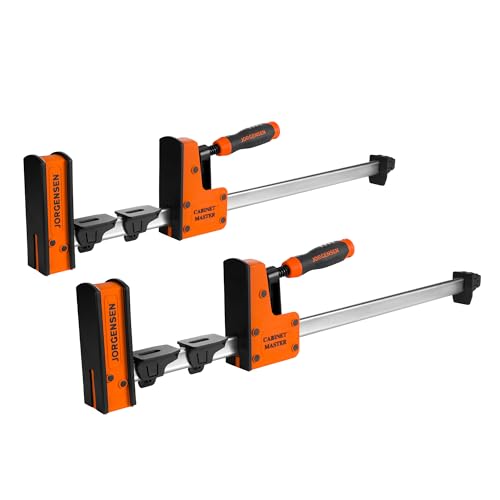
Jorgensen’s Cabinet Master style parallel clamp is the mid-range answer to the BESSEY: a 24-inch parallel-jaw clamp sold as a pair, rated by the maker at up to 2,200 lb of clamping force. The sliding jaw reverses without tools to convert the clamp into a spreader, and a quick-release trigger makes rough positioning fast against open glue time. The soft-grip handle and the included extras — replacement jaw pads and a 2-in-1 glue separator that doubles as a clamp stand — round out a package aimed squarely at cabinet and furniture glue-ups.
Specs
- Type: Parallel-jaw bar clamp
- Model: 99024AC
- Clamping capacity: 24 in
- Clamping force: Up to 2,200 lb (manufacturer rating)
- Pack count: 2 clamps
- Features: Quick-release trigger; reversible sliding jaw converts to spreader; soft-grip handle
- Included: Replacement jaw pads; 2-in-1 glue separator and clamp stand
- Tier: Mid-range
Jorgensen Medium Duty Steel Bar Clamp Set, 24-Inch, 2-Pack

This is the classic F-style bar clamp in its modern form: a fixed jaw and a sliding jaw on a flat steel bar, with a screw handle to draw the work tight. The 600 lb load limit is modest next to the parallel clamps above, but it is well matched to drawers, face frames, small panels and general assembly, and the pivoting jaw face forgives slight irregularities in the stock. Sold as a pair at a budget tier, it is the inexpensive way to put serviceable 24-inch clamps on the rack.
Specs
- Type: F-style steel bar clamp
- Part number: 93724A
- Clamping capacity: 24 in
- Load limit: 600 lb
- Pack count: 2 clamps
- Construction: Steel bar with sliding jaw and screw handle
- Tier: Budget
The Pipe Clamp Picks
BESSEY BPC-H34 H-Style Pipe Clamp

The BPC-H34 takes the traditional pipe clamp fixture and fixes its oldest annoyance: tipping over. Its H-shaped foot assembly stabilizes the fixture in two dimensions, and the extra-high base gives the crank handle clearance above the bench. The cast-iron jaws ship with soft protective pads, the clutch plates are zinc plated, and the spindle carries a black oxide coating. Like every pipe clamp, it is sold as a fixture only — thread it onto any length of 3/4-inch black pipe and the capacity is whatever the pipe allows.
Specs
- Type: Pipe clamp fixture (pipe sold separately)
- Model: BPC-H34
- Pipe size: 3/4 in black pipe
- Throat depth: 2-1/8 in
- Base: H-style foot assembly for dual-axis stability; extra-high base for handle clearance
- Jaws: Cast iron with soft protective pads included
- Hardware: Zinc-plated clutch plates; black oxide coated spindle
- Weight: About 2.88 lb per fixture
- Tier: Mid-range
PONY Deep-Reach Pipe Clamp Fixture Set, 2-Pack

Pony’s multiple-disc clutch is the original pipe clamp mechanism, and this deep-reach version stretches the jaw reach to 2.5 inches, useful when clamping stock with trim standing proud of the surface. The heads reverse on the pipe to work as a spreader, a trick few bar clamps of any kind can match at this length. Two cast-iron fixtures come in the pack; add two lengths of 3/4-inch pipe and you have a working pair of long clamps at a budget tier, ready for tabletops and wide panels.
Specs
- Type: Pipe clamp fixture set (pipe sold separately)
- Pipe size: 3/4 in black pipe
- Throat depth: 2.5 in (deep reach)
- Pack count: 2 fixtures
- Clutch: Multiple-disc clutch, locks at any point along the pipe
- Heads: Reversible; converts to spreader
- Material: Cast iron
- Tier: Budget
Who Should Buy a Bar Clamp
Choose bar clamps if your projects are mostly cabinets, drawers, boxes, face frames and panels under about four feet, and you value speed and square, even pressure over raw reach. Parallel-jaw models are the pick for visible furniture work where keeping a panel flat matters. F-style clamps remain the budget workhorses for general assembly. Bar clamps are also the better choice if you do not want to source, cut and store pipe before your first glue-up.
Who Should Buy a Pipe Clamp
Choose pipe clamps if you glue wide tabletops, doors and long casework, or if your clamp budget needs to stretch across many clamps at once. Fixtures plus pipe give the lowest cost per inch of capacity, the length is whatever you cut, and a modest set of fixtures on assorted pipes covers an outsized range of work. They are also the practical answer when a one-off project is simply longer than every bar clamp you own.
FAQ
Which is better for gluing up a wide tabletop?
For a one-off wide tabletop, pipe clamps are usually the practical choice, because you can cut pipe to span the panel exactly and the fixtures are inexpensive enough to line up several across the width. Parallel bar clamps in a long enough size do the same job with squarer pressure and no pipe to prepare, which is why shops that glue tabletops weekly often invest in them.
How many clamps do I need for a panel glue-up?
A common working rule is one clamp every 12 to 18 inches along the panel, alternating clamps above and below to balance pressure — so a four-foot tabletop typically wants four to six clamps. Pipe clamps simply make it cheaper to reach that count on wide work.
Do pipe clamps include the pipe?
No. Pipe clamps are sold as fixture sets — a fixed head and a sliding tail stop — and the pipe is bought separately at a hardware store, usually as 3/4-inch black pipe, which the store will often cut and thread to your lengths. Bar clamps, by contrast, are complete tools out of the box.
Can I mix bar clamps and pipe clamps on the same glue-up?
Yes, and many shops do. A frequent arrangement is parallel bar clamps at the ends of a panel, where their square jaws help keep the assembly aligned, with pipe clamps filling the middle spans. The only caution is to tighten gradually and evenly across all clamps so the panel closes up flat.
Conclusion
Bar clamps and pipe clamps solve the same problem from opposite directions. The bar clamp is the finished, self-contained tool: faster to use, squarer in its pressure, and priced accordingly, with parallel-jaw models at the top of the range. The pipe clamp is the modular system: a modest fixture purchase plus commodity pipe buys almost unlimited length at the lowest cost per inch, at the price of a little preparation. Cabinets and small furniture point to bar clamps; tabletops and long spans point to pipe clamps. Most complete shops eventually keep both on the rack.
Related guides
More from Amazon
Programs that pair well with the guide above. Offers and eligibility are set by Amazon and may change.
A free business account with business pricing and bulk-buying tools for work, shop or home office.
Create a business accountFree shipping on eligible items, Prime Video and more. Eligible new members can start with a free trial.
Start a Prime free trialAudiobooks and podcasts to listen to on the go. Eligible new members can start with a free trial.
Try Audible freeAd-free music streaming. Eligible new subscribers can start with a free trial.
Try Music Unlimited freeAs an Amazon Associate we earn from qualifying purchases.