Our Top Picks
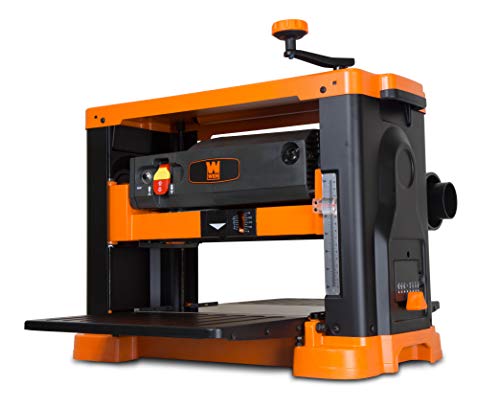 WEN PL1326 15-Amp 13-Inch Spiral Benchtop Thickness PlanerSpiral, 13-Inch, Single Speed81 PoundsCheck on Amazon
 Cutech 401120HI-IF 12-Inch Spiral Cutterhead Benchtop Jointer with12 inch w/ Cast Iron Fence34 x 23.75 x 13.25 InchesCheck on Amazon

What's inside
As an Amazon Associate I earn from qualifying purchases. This post may contain affiliate links at no extra cost to you.
Contents
Table of Contents
- The short answer
- What each machine actually does
- Head to head: the five differences that matter
- The milling sequence: how the two machines work together
- The five benchtop machines in this comparison
- Which one should you buy first?
- FAQ
- Conclusion
The short answer
A thickness planer and a jointer solve two different problems, and neither one substitutes for the other. A jointer flattens one face of a board and makes one edge straight and square, but it cannot make the opposite face parallel or bring a board to a uniform thickness. A thickness planer makes the face opposite a flat reference face parallel to it and brings the board to an exact, even thickness, but it follows the shape of whatever face rides against its bed, so it cannot flatten a cupped or twisted board on its own.
As an Amazon Associate, we earn from qualifying purchases.
If you mill rough lumber, the classic order is jointer first, planer second. If you mostly buy surfaced lumber and need consistent thickness for panels and table tops, a planer alone covers most of the work. The rest of this guide compares the two machine types on capacity, cutterheads, workflow and shop footprint, then lines up five benchtop examples: two thickness planers and three jointers from DEWALT, WEN, PORTER-CABLE, Wahuda and Cutech.
What each machine actually does
What a jointer does
A jointer is a pair of flat tables, an infeed table and an outfeed table, with a spinning cutterhead in the gap between them. The infeed table sits lower than the outfeed table by the depth of cut you set. As you push a board across, the cutterhead shaves the high spots off the bottom face until that face registers fully against the outfeed table. The result is one genuinely flat face. Turn the board on edge against the fence and the same process produces an edge that is straight and, with the fence set at 90 degrees, square to the flat face.
What a jointer cannot do is just as important. Because you guide the board by hand and the machine references only the face being cut, a jointer cannot make the second face parallel to the first, and it cannot produce a consistent thickness from one end of a board to the other. It also works within its width: a 6-inch benchtop jointer cannot face-flatten a board wider than 6 inches in a single pass.
What a thickness planer does
A benchtop thickness planer, sometimes called a lunchbox planer, works the other way up. The board rides on a bed under a cutterhead while feed rollers pull it through at a fixed rate. The cutterhead removes material from the top face until that face is parallel to the face resting on the bed, and the board comes out at a uniform thickness set by the head height. Raise or lower the head and you dial in finished dimensions such as 3/4 inch for drawer sides or 1/2 inch for box work.
The catch is that the planer copies the bottom face. Feed it a cupped board and you get a thinner cupped board, because the rollers press the board flat only while it is under the head and it springs back afterwards. That is why the standard milling sequence starts at the jointer: the planer needs one flat face to reference before it can do its job properly. A planer sled, a flat carrier board the workpiece is shimmed and fixed to, is the usual workaround when no jointer is available.
Head to head: the five differences that matter
1. The reference surface
This is the core difference. A jointer creates a reference: it generates flatness and squareness that did not exist before the cut. A planer uses a reference: it duplicates the geometry of the bottom face onto the top face. Everything else in this comparison follows from that single fact, including why shops that own both machines run the jointer first.
2. Width capacity and board size
Benchtop planers are wide machines. Nearly every model in this class takes stock 12-1/2 to 13 inches wide and up to 6 inches thick, which covers the great majority of furniture parts. Benchtop jointers are narrower: 6-inch models are the most common, with 8-inch and a few wider benchtop models above them. Face-jointing a 10-inch-wide board is routine work for a planer sled or a floor-standing jointer, but it is beyond a 6-inch benchtop jointer entirely. If your projects use wide boards, the planer’s width advantage matters, although you still need a flat first face from somewhere.
3. Cutterheads: straight knives vs spiral inserts
Both machine types come with two cutterhead styles. Straight-knife heads carry two or three long blades. They are simple and leave a clean finish, but a nick in one knife leaves a ridge along the whole board, and changing knives means resetting each blade to height. Spiral and helical-style heads carry many small staggered blades or carbide inserts arranged around the head. Each insert can be rotated to a fresh edge when it dulls, the shearing action tends to reduce tear-out on figured grain, and the cut is generally quieter. On the planer side, the DEWALT below uses a three-knife head while the WEN uses a 26-blade spiral head. On the jointer side, the PORTER-CABLE uses two straight knives while the Wahuda and Cutech use multi-insert spiral heads.
4. Depth of cut and material removal
A planer removes material across the full width of the board on every pass, typically up to 1/8 inch per pass on the models here, and it does so at a powered feed rate, so dimensioning a stack of rough boards to final thickness is fast, repeatable work. A jointer removes far less per pass, commonly up to 1/8 inch but usually set to 1/32 or 1/16 inch for control, and you supply the feed by hand. The jointer is a precision surfacing tool; the planer is the bulk dimensioning tool.
5. Footprint, weight and dust
Benchtop jointers are the lighter machines: the 6-inch models here weigh around 35 to 37 pounds and store on a shelf. Benchtop planers are heavier, roughly 80 to 92 pounds for the 13-inch models, and most shops give them a fixed stand or a dedicated bench spot. Both machines produce a large volume of chips. Planers typically include a dust port or chute, and the DEWALT adds fan-assisted chip ejection; jointers include a smaller dust port that connects to a shop vacuum or dust collector.
The milling sequence: how the two machines work together
For a rough board that needs to end up flat, square and at final thickness, the standard four-step sequence shows exactly where each machine earns its place:
- Joint one face on the jointer until it is flat across its full length and width.
- Joint one edge with that flat face against the fence, producing a straight edge square to the face.
- Plane to thickness with the jointed face down on the planer bed, so the planer cuts the top face parallel to it.
- Rip the second edge on the table saw with the jointed edge against the rip fence, then joint or trim it if a glue-ready edge is needed.
Skip step 1 and the planer faithfully preserves the cup or twist at a thinner size. Skip step 3 and you have one flat face and no way to make the board a consistent thickness. The two machines are complements, not rivals, which is why combination jointer-planer machines exist, and why the real buying question for most small shops is which one to buy first.
The five benchtop machines in this comparison
Side A: Thickness planers
DEWALT DW735 13-Inch Three-Knife Two-Speed Thickness Planer (Premium tier)
The DW735 is the reference point for benchtop planers. Its 15-amp motor drives a three-knife cutterhead at 10,000 RPM, and a two-speed gearbox lets you choose 96 cuts per inch for faster dimensioning or 179 cuts per inch for a finer finishing pass. The automatic carriage lock limits the head movement that causes snipe, a turret depth stop returns you to common thicknesses quickly, and fan-assisted chip ejection clears waste from the cutterhead. It is a premium-tier machine in this class, and at around 92 pounds it is one you park on a stand rather than carry around.
Specs
- Motor: 15 amp, corded electric
- Cutterhead: three-knife, 10,000 RPM
- Feed speeds: two, 96 or 179 cuts per inch
- Width capacity: 13 inches
- Thickness capacity: up to 6 inches
- Maximum depth of cut: 1/8 inch per pass
- Base: 19-3/4 inch cast aluminum
- Weight: about 92 lb
- Extras: automatic carriage lock, turret depth stop, fan-assisted chip ejection
WEN PL1326 15-Amp 13-Inch Spiral Benchtop Thickness Planer (Budget tier)
The PL1326 brings a spiral cutterhead to the budget tier. Instead of three long knives, its head carries 26 staggered, rotatable HSS blades, so a dull or nicked edge is fixed by rotating individual blades rather than swapping a full knife set. The 15-amp motor turns the head at over 10,000 RPM with a feed rate of 26 feet per minute, and the machine planes boards up to 13 inches wide and 6 inches thick. A heavy cast iron base, an onboard planing gauge, a depth stop and height-adjustable infeed and outfeed tables round out a spec sheet that matches the premium machines on capacity while undercutting them on tier.
Specs
- Motor: 15 amp, corded electric
- Cutterhead: spiral, 26 staggered rotatable HSS blades
- Cutterhead speed: 10,000 RPM
- Feed rate: 26 feet per minute
- Width capacity: 13 inches
- Thickness capacity: up to 6 inches
- Maximum depth of cut: 1/8 inch per pass
- Base: cast iron
- Weight: about 80.8 lb
- Extras: planing gauge, depth stop, adjustable dust port, infeed and outfeed tables
Side B: Benchtop jointers
PORTER-CABLE PC160JT 6-Inch Variable-Speed Benchtop Jointer (Budget tier)
The PC160JT is the straight-knife entry on the jointer side. Its two-knife cutterhead uses a jack-screw leveling arrangement that makes knife changes and height adjustments straightforward, and a built-in cutterhead lock holds the head steady during swaps. The variable-speed motor runs from 6,000 to 11,000 RPM, producing 12,000 to 22,000 cuts per minute, so you can match cutter speed to the size and hardness of the stock. At 35 pounds with a cast iron base, it is a genuine benchtop machine that can be lifted onto a bench when needed and shelved when not.
Specs
- Motor: 10 amp, corded electric
- Cutterhead: two-knife, jack-screw knife leveling
- Speed: variable, 6,000 to 11,000 RPM (12,000 to 22,000 cuts per minute)
- Cutting width: 6 inches
- Base: cast iron
- Dimensions: 32.1 x 12.4 x 11.2 inches
- Weight: 35 lb
- Extras: built-in cutterhead lock
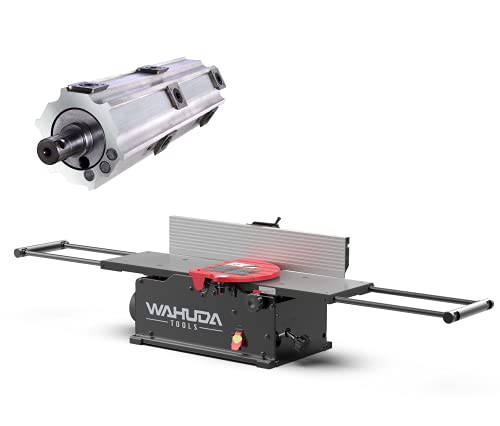
Wahuda Tools 8-Inch Benchtop Jointer, Spiral Cutterhead (Mid-range tier)
The Wahuda answers the main limitation of 6-inch benchtop jointers: width. Its 8-inch cutterhead flattens faces and edges on stock that a 6-inch machine cannot take in one pass. The spiral cutterhead uses four-sided carbide tips, so each insert offers four cutting edges before it needs replacing. Cast iron tables give a stable, flat reference surface, and pull-out table extensions add support for longer boards without a permanent footprint. A 10-amp motor keeps it on a standard household circuit.
Specs
- Motor: 10 amp, corded electric
- Cutterhead: spiral, four-sided carbide insert tips
- Cutting width: 8 inches
- Tables: cast iron, with pull-out extensions
- Model: 50180CC-WHD
Cutech 401120HI-IF 12-Inch Spiral Cutterhead Benchtop Jointer (Premium tier)
The Cutech is the outlier of the group: a benchtop jointer with a 12-inch cutting width, a capacity normally associated with floor-standing machines. Its spiral cutterhead carries 24 tungsten carbide inserts, and a 12-amp motor drives it. Cast iron tables and an extra-large 24 x 6 inch cast iron fence, supplemented by fence enhancement brackets, give wide boards the support and registration they need. It sits in the premium tier of benchtop jointers, and it is the pick here for shops whose stock regularly runs wider than 8 inches but which still cannot give floor space to a standing jointer.
Specs
- Motor: 12 amp, corded electric
- Cutterhead: spiral, 24 tungsten carbide inserts
- Cutting width: 12 inches
- Tables: cast iron
- Fence: 24 x 6 inch cast iron, with additional fence enhancement brackets
- Model: 401120HI-IF
Which one should you buy first?
Buy the planer first if you buy surfaced or S3S lumber, if your main frustration is boards of uneven thickness, or if you glue up panels and need every part at an identical finished thickness. Add a planer sled and you can also flatten one face of moderately cupped boards, which stretches the planer-only setup a long way.
Buy the jointer first if you buy rough-sawn lumber, work with reclaimed stock, or build with glue-ups where invisible seams depend on dead-straight, square edges. Edge jointing is the one job no planer, sled or table saw jig fully replaces, and it is the jointer’s home ground.
Buy both, in jointer-then-planer order, if milling rough lumber from start to finish is the goal. Within each type, match the cutterhead to your tolerance for maintenance: straight knives are simple and proven, while spiral heads with rotatable inserts cut figured wood more forgivingly and spread maintenance across many small edges instead of a few long ones.
FAQ
Can a thickness planer replace a jointer?
No, not completely. A planer makes faces parallel and thickness uniform, but it copies the shape of the face on its bed, so it cannot remove cup, bow or twist. A planer sled narrows the gap by giving the board a flat reference, and that workaround handles many boards, but a jointer still flattens a face faster and edge-joints in a way a planer cannot.
Can a jointer make boards a consistent thickness?
No. A jointer flattens one face and straightens one edge, but it references only the surface being cut and you feed the board by hand, so the opposite face does not end up parallel and thickness varies along the board. Consistent thickness is the planer’s job, using the jointed face as its reference.
What size jointer and planer should a small shop start with?
A 13-inch planer covers nearly all furniture stock and is the standard benchtop size. For the jointer, 6 inches is the common starting point and handles most board widths after ripping wide stock, while an 8-inch or wider benchtop model reduces how often you need to rip and re-glue boards just to flatten them.
Is a spiral cutterhead worth choosing over straight knives?
For most small shops, yes. Spiral heads cut with a shearing action that tends to reduce tear-out on figured or reversing grain, they run more quietly, and maintenance is rotating or replacing individual inserts rather than resetting full-length knives. Straight-knife heads remain a sound budget choice and leave an excellent finish on straight-grained stock.
Conclusion
The thickness planer vs jointer question resolves once you look at the reference surface: the jointer creates flatness and squareness, the planer creates parallelism and exact thickness. Shops that mill rough lumber need both, in that order. Shops that start from surfaced lumber can start with the planer alone and add the jointer when edge quality and rough stock savings justify it. Among the examples here, the DEWALT DW735 and WEN PL1326 show the two planer philosophies, three-knife and spiral, while the PORTER-CABLE PC160JT, Wahuda 8-inch and Cutech 12-inch jointers span the width range from a compact 6 inches to a benchtop-class 12 inches.
Related guides
More from Amazon
Programs that pair well with the guide above. Offers and eligibility are set by Amazon and may change.
A free business account with business pricing and bulk-buying tools for work, shop or home office.
Create a business accountFree shipping on eligible items, Prime Video and more. Eligible new members can start with a free trial.
Start a Prime free trialAudiobooks and podcasts to listen to on the go. Eligible new members can start with a free trial.
Try Audible freeAd-free music streaming. Eligible new subscribers can start with a free trial.
Try Music Unlimited freeAs an Amazon Associate we earn from qualifying purchases.