What's inside
- What Actually Makes Clothing Fire-Retardant for Welding
- Jackets vs. Pants vs. Coveralls: Where Each Fits
- Spec Comparison: Typical Options by Type
- Matching the Garment to Your Welding Conditions
- Closures and Design Details That Matter More Than Marketing
- Sizing, Ownership, and What Wears Out First
- Frequently Asked Questions
- What Actually Makes Clothing Fire-Retardant for Welding
- Jackets vs. Pants vs. Coveralls: Where Each Fits
- Spec Comparison: Typical Options by Type
- Matching the Garment to Your Welding Conditions
- Closures and Design Details That Matter More Than Marketing
- Sizing, Ownership, and What Wears Out First
- Frequently Asked Questions
As an Amazon Associate I earn from qualifying purchases. This post may contain affiliate links at no extra cost to you.
The best fire-retardant clothing for welders is typically a 9–12 oz treated-cotton or aramid-blend jacket for light MIG/TIG work, FR-treated coveralls for general fabrication, and split cowhide leather over an FR cotton base for stick welding, heavy spatter, and overhead positions — the right pick depends on welding process, amperage, and position more than on any single “best” garment.
As an Amazon Associate we earn from qualifying purchases at no extra cost to you.


Contents
- What Actually Makes Clothing Fire-Retardant for Welding
- Jackets vs. Pants vs. Coveralls: Where Each Fits
- Spec Comparison: Typical Options by Type
- Matching the Garment to Your Welding Conditions
- Closures and Design Details That Matter More Than Marketing
- Sizing, Ownership, and What Wears Out First
- Frequently Asked Questions
What Actually Makes Clothing Fire-Retardant for Welding
Two categories of FR fabric dominate welding PPE, and the distinction matters for durability:
- Treated cotton (FR cotton): Standard cotton or cotton blends chemically treated so the fabric self-extinguishes. Common weights run 7–12 oz. The treatment gradually washes out — most manufacturers rate it for 50–100 home washes, though industrial laundering strips it faster.
- Inherently FR fibers (aramids like Nomex, modacrylic blends): The fiber itself won’t burn, so protection never washes out. These cost 2–4× more but are standard in oil-and-gas and industrial settings where garments get laundered weekly for years.
Key standard to look for in the US: NFPA 2112 (flash-fire rated workwear) and ASTM F1506 / NFPA 70E if arc-flash protection is also required. A garment labeled “flame resistant” without a certification mark is a gamble. Leather isn’t chemically rated — it protects by mass and structure, which is why it remains the benchmark for spatter-heavy work.
Jackets vs. Pants vs. Coveralls: Where Each Fits
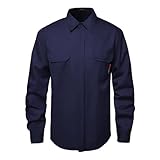
FR jackets (Lincoln Electric, Black Stallion, Revco, Tillman, Miller all make them) are the default for shop work. Most are hip-length, 9 oz treated cotton or a leather-sleeve/cotton-body hybrid. The hybrid design is worth noting: leather on the arms where spatter lands, breathable cotton across the torso.
FR pants matter more than beginners expect. Spatter rolls downhill — cuffs, boot tops, and lap folds are burn-through hotspots. Look for a no-cuff straight leg or an ankle-length cut that drapes over boots without catching slag in folds.
FR coveralls solve the gap problem entirely: no waistband for sparks to lodge in, full coverage including the chest pocket area where shirt tails ride up. The trade-off is ventilation — a 7–8.5 oz coverall runs noticeably hotter than separates, which is why heavy coveralls are mainly a winter or industrial-compliance choice rather than a hobbyist one.
Spec Comparison: Typical Options by Type
| Garment type | Typical fabric | Fabric weight | Closure | Coverage | Best for | Market price range |
|---|---|---|---|---|---|---|
| FR cotton jacket | Treated cotton | 9–12 oz | Snap or FR zipper + storm flap | Torso + arms, hip length | MIG/TIG, low-moderate amperage, bench work | $40–$90 |
| Hybrid leather-sleeve jacket | Cowhide sleeves + 9 oz cotton body | Mixed | Snap front, adjustable cuffs | Heavy protection on arms/shoulders | Stick welding, flux-core, moderate spatter | $70–$140 |
| Full leather jacket/cape sleeve | Split cowhide | Leather, heavy | Snap or buckle | Full upper body, bib apron options | Overhead welding, heavy gouging, cutting | $90–$180 |
| FR pants | Treated cotton or FR denim | 9–14.75 oz denim | Zipper fly, snap | Waist to ankle, no cuffs | All-position work, grinding + welding | $50–$110 |
| FR coveralls | Treated cotton or aramid blend | 7–9 oz | Two-way FR zipper, storm flap | Full body, ankle to neck | Industrial compliance, confined spaces, grinding bays | $70–$180 (cotton); $200+ (aramid) |
Matching the Garment to Your Welding Conditions
| Your situation | Recommended setup | Why |
|---|---|---|
| Hobbyist, occasional MIG under 200A, flat/horizontal position | 9 oz FR cotton jacket + FR pants or FR denim | Low spatter volume; cotton breathes and lasts years at hobbyist wash frequency |
| Stick/flux-core welding, daily shop use | Leather-sleeve hybrid jacket + 14 oz FR pants | Sleeves take the direct spatter hits; leather survives what burns holes in cotton |
| Overhead or vertical welding | Full leather cape sleeve or leather jacket + leather apron/bib | Spatter falls onto shoulders and chest — the only fabric-mass solution that works |
| TIG (low spatter, high heat exposure, dexterity needed) | Light 7–9 oz FR jacket, no leather required | TIG produces minimal spatter; comfort and arm mobility matter more |
| Industrial site with NFPA 2112 requirement or daily laundering | Aramid-blend coveralls | Treatment never washes out; cheaper than replacing treated cotton every 2–3 months |
| Hot climate / summer garage work | Lightweight 7 oz FR shirt + FR pants; skip coveralls | Heat stress is a real hazard; thin certified FR beats thick uncertified workwear |
Closures and Design Details That Matter More Than Marketing
- Snap closures vs. zippers: Snaps release fast if slag lands inside — you can rip the jacket open. Zippers are more secure against sparks entering but slower to shed. Best designs use an FR zipper behind a snapped storm flap.
- Internal vs. external pockets: External flap pockets trap spatter. Inside chest pockets keep contents from becoming ignition points; never carry a plastic lighter or pen in an FR garment.
- Collar design: A stand-up collar that snaps closed protects the neck — the most common burn location in overhead work, right where the helmet leaves a gap.
- Cuff adjustability: Cuffs must seal over gauntlet gloves. Gauntlets worn inside loose sleeves create a funnel that collects spatter against your wrist.
Sizing, Ownership, and What Wears Out First
FR garments should fit with room to move but no excess fabric. Baggy material catches sparks; tight material conducts heat faster when contacted. For jackets, size to allow a sweatshirt underneath — most welding jackets are cut for it, so your normal size usually works.
Durability realities worth knowing before buying:
- Treated cotton loses protection with washing. At 3 washes per week (industrial laundering), a 50-wash-rated garment is effectively expiring in under 4 months. Wash in cold water, no bleach, no fabric softener — softeners leave a flammable residue.
- What wears first: cuff edges, elbow fronts, and the chest pocket flap — exactly where spatter lands. Small holes can’t be safely patched with non-FR thread; retire or professionally repair the garment.
- Cost-per-use math: a $150 aramid coverall rated for 200+ washes costs under $0.75 per wash over its life; a $70 treated-cotton coverall retired at 50 washes costs $1.40 — the “expensive” option is cheaper for anyone laundering weekly.
- Common mistake: wearing a synthetic (polyester, nylon) base layer underneath. FR outerwear protects you until the synthetic layer melts against your skin. Cotton or merino wool base layers only.
Frequently Asked Questions
Is regular denim or a heavy work shirt safe enough for light welding?
No. Untreated cotton ignites and keeps burning; a single piece of spatter inside a cuff can smolder unnoticed. The price gap between a heavy work shirt and a certified FR shirt is roughly $20–$40 — not a place to economize.
Do I need leather for MIG welding?
For most MIG work under ~250 amps in flat positions, a 9–12 oz FR cotton or hybrid jacket is sufficient. Reserve full leather for spray-transfer MIG, stick, flux-core, overhead positions, and cutting/gouging where spatter is continuous and large.
Can I wash FR clothing at home?
Yes — mild detergent, no bleach or softener, warm or cool water, and wash FR garments separately from oily work clothes. Check the label’s rated wash count and track it if you launder frequently.
What should I wear under FR clothing?
Natural fibers only: cotton, wool, or FR-rated base layers. Synthetic athletic wear, compression gear, and polyester underwear defeat the entire system by melting at ~480°F — well below the temperature of a spatter contact point.