What's inside
As an Amazon Associate I earn from qualifying purchases. This post may contain affiliate links at no extra cost to you.
The best lawn edgers depend on how much border you cut: choose a cordless model for regular residential maintenance, an electric corded edger for the lowest running cost, or a gas edger for long, heavy-duty work without battery limits.
As an Amazon Associate we earn from qualifying purchases at no extra cost to you.


Contents
Our Top Picks
 CKLT Edger Lawn Tool 41in Border Edger with41" Assembly Required40 x 10 x 1.3 inches5.9 poundsCheck on Amazon

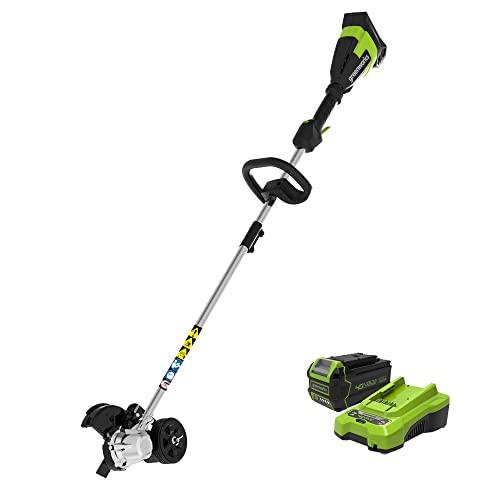
Best lawn edgers by situation
| Situation | Best choice | Why it fits | What to compromise on |
|---|---|---|---|
| Small yard and occasional edging | 12–13 amp corded electric | Low purchase cost, consistent power, minimal maintenance | You must manage a 50–100 ft extension cord |
| Average suburban yard | 40V–60V cordless | Good maneuverability and enough runtime for routine borders | Battery and charger can cost substantially more |
| Large property or neglected edges | Gas stick edger | Strong sustained power and quick refueling | More noise, vibration, fuel handling, and seasonal maintenance |
| Several cordless tools already owned | Edger from the same battery platform | A spare battery may be unnecessary | You are locked into that manufacturer’s battery system |
| Very precise decorative borders | Adjustable cordless or corded blade edger | Depth control and a guide wheel make straight lines easier | Lower cutting speed than a powerful gas unit |
Cordless vs. electric vs. gas lawn edgers
Cordless edgers: the best balance for most homeowners
Battery-powered edgers avoid both the extension cord and the fuel system. Models such as the EGO Power+ 56V edger, Greenworks 60V edgers, Ryobi 40V edgers, and Milwaukee M18 FUEL Edger are aimed at homeowners who want quick setup and controlled cutting. Their guide wheels and adjustable blades are particularly useful around sidewalks, driveways, and garden beds.
A typical cordless edger cuts approximately 1.5 to 2 inches deep, with a blade diameter near 8 inches and a cutting path around 5 to 8 inches. Depending on grass density, blade condition, and battery size, expect roughly 20 to 60 minutes of practical edging per charge. That is usually enough for a normal residential lot, but not necessarily for a large property with many separate borders.
The important specification is not voltage alone. A 56V battery rated at 2.5Ah stores about 140 watt-hours before operating losses are considered:
56V × 2.5Ah = 140Wh
If the edger averages 500 watts while cutting, the theoretical runtime is about 17 minutes. In real use, intermittent cutting and lighter loads can extend that figure. A larger 5.0Ah battery roughly doubles energy capacity, but also adds weight. Look for tool-free depth adjustment, a metal blade guard, a robust guide wheel, and a battery position that does not make the tool nose-heavy.
Corded electric edgers: inexpensive and dependable
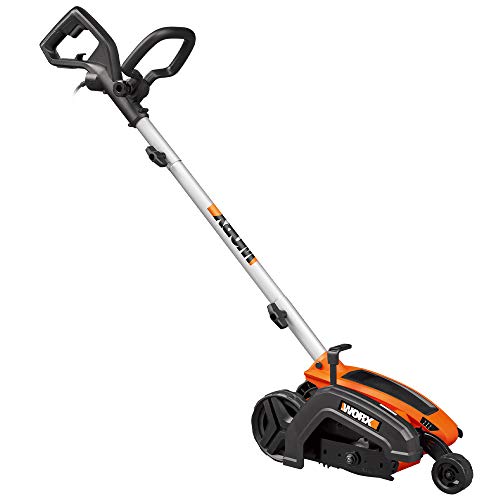
A 12–13 amp corded edger supplies continuous power and is often the sensible choice for a small or medium yard with an accessible outdoor outlet. The Worx WG896 is a recognizable example of this category, with a 12-amp motor, an 8-inch blade, and adjustable cutting depth. Comparable corded models commonly offer two or three depth positions and a cutting depth of about 1 to 1.5 inches.
Corded tools tend to be lighter than gas models and do not require batteries, gasoline, carburetor care, or charging. Their main limitation is maneuverability. A cord can snag on shrubs, drag across a driveway, or accidentally enter the cutting path. Use a properly rated outdoor extension cord, keep it behind your body, and maintain a deliberate route around the work area.
For a 100-foot border, a corded edger may be faster overall than a battery tool because there is no charging pause. For a yard with disconnected front and back areas, however, the cord’s setup time can outweigh its continuous runtime.
Gas edgers: the choice for demanding work
Gas stick edgers remain useful for long borders, thick turf, compacted soil, and commercial-style workloads. Examples include the STIHL FC 56 C-E and Echo PE-2620S. These machines typically use 21–25cc four-stroke or two-stroke-class engines, an 8-inch blade, and a maximum cutting depth close to 2.5 inches, depending on adjustment and model.
Gas power is not automatically more precise. The extra vibration and weight can make it harder to hold a perfectly consistent line, especially for a beginner. A gas edger becomes worthwhile when the work is too extensive for one or two batteries, or when the edge has become overgrown and requires repeated passes.
Ownership also includes fresh fuel, correct fuel mixture where applicable, air-filter cleaning, spark-plug inspection, and winter storage. A gas engine that sits with untreated fuel can be harder to start when you need it most.
Head-to-head specifications
| Edger type | Typical motor | Blade diameter | Typical depth | Practical runtime | Typical tool weight | Maintenance level |
|---|---|---|---|---|---|---|
| Cordless | 40V–60V brushless or brushed | 7–8 in. | 1.5–2 in. | 20–60 min per charge | 7–12 lb without battery | Low |
| Corded electric | 12–13 amp | 7–8 in. | 1–1.5 in. | Continuous | 6–10 lb | Low |
| Gas | 21–25cc engine | 8 in. | Up to about 2.5 in. | 30–90 min per tank | 13–18 lb | Moderate to high |
These are useful comparison ranges rather than guarantees. Thick grass, wet soil, deep roots, blade sharpness, and the operator’s pace can change performance significantly. A model with a narrow cutting width may require more passes, but can be easier to steer along curved beds.
What matters most when comparing the best lawn edgers
Blade depth and adjustment
Depth adjustment is more important than maximum depth. A shallow setting is appropriate for routine maintenance, while a deeper setting can reopen a neglected edge. Start shallow and increase gradually; forcing a full-depth cut through dense roots overheats electric motors and rapidly dulls blades. Levers that can be adjusted without tools are more useful than a high maximum-depth number that is awkward to access.
Cutting width and blade durability
Most walk-behind and stick edgers use an approximately 8-inch steel blade. Wider cutting assemblies remove more material per pass, but may be less nimble around tight curves. Check whether replacement blades are readily available and whether the blade is a standard shape or a proprietary part. The blade is a consumable, not a lifetime component.
Maneuverability and line control
A guide wheel keeps the blade at a repeatable distance from concrete. A curb-hopping feature or reversible guide wheel can help when edging along a sidewalk rather than a flower bed. Balance matters too: a heavy battery behind the handle may reduce fatigue, while a front-heavy design makes it harder to maintain a straight line.
Runtime and battery economics
Estimate your border length before buying. If you edge 300 feet and move at an average 2 feet per second, active cutting takes approximately 2.5 minutes. Adding stops, corners, repositioning, and a second pass can easily make the job 10–15 minutes. That is within the capability of nearly any healthy battery, but a neglected 1,000-foot property may justify a second battery or a gas model.
Durability and maintenance realities
- Blade wear: Contact with concrete, stones, and buried roots rounds the cutting edge. Replace a badly worn or bent blade rather than trying to compensate with extra pressure.
- Guard buildup: Grass and damp soil collect inside the blade guard. Disconnect the battery, unplug the tool, or stop the engine before clearing it with a brush.
- Guide-wheel wear: A loose or damaged wheel makes depth inconsistent and causes wandering. Check its axle and fasteners before each season.
- Electric-cord damage: Inspect the extension cord for cuts and flattened sections. Never use a damaged cord or tape over a serious split.
- Battery storage: Store batteries dry and away from extreme heat. Follow the battery maker’s charging and storage instructions rather than leaving a pack permanently on the charger.
- Gas storage: Use the engine manufacturer’s fuel guidance, keep the air filter clean, and prepare the fuel system for extended storage.
How to get a cleaner edge
- Mark or inspect the existing border and remove stones, wire, and thick debris.
- Set the blade shallow enough to make the first pass without bogging down.
- Keep the guide wheel firmly against the hard surface or use the bed edge as a visual reference.
- Walk at a steady pace instead of pushing faster when the motor loads up.
- Make a second pass only where the first cut is uneven or the edge needs additional depth.
- Brush debris from the guard and inspect the blade before storing the edger.
For most homeowners, a cordless model from an existing battery platform is the strongest all-around answer. Choose corded electric when the property is compact and an outlet is convenient; choose gas when the work is frequent, extensive, or unusually demanding. The best lawn edger is the one whose depth adjustment, guide wheel, runtime, and maintenance demands match the borders you will actually cut.