What's inside
As an Amazon Associate I earn from qualifying purchases. This post may contain affiliate links at no extra cost to you.
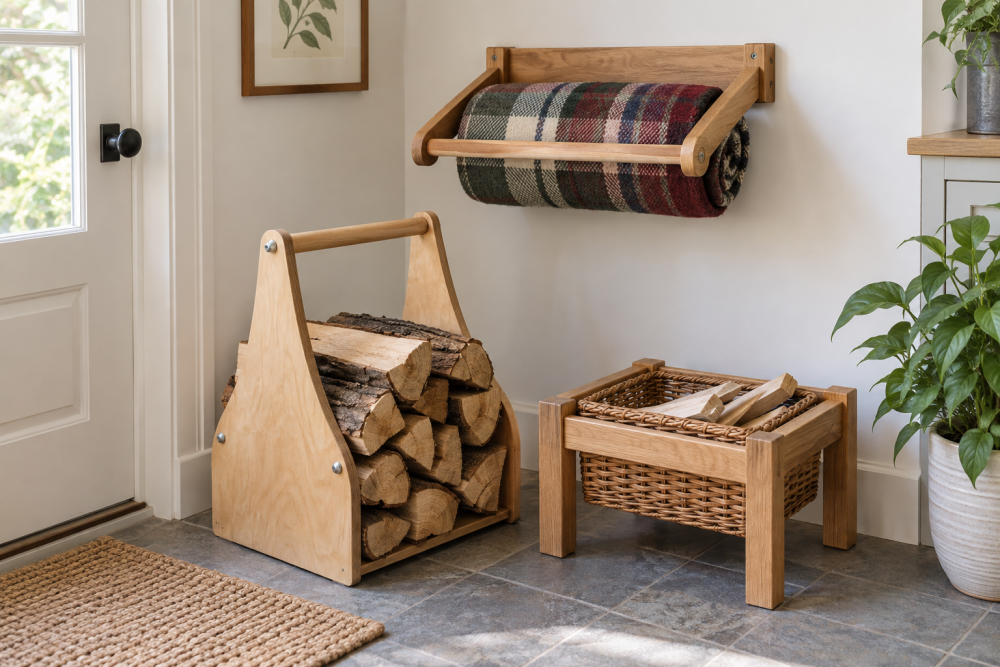
This carrier uses two plywood cheeks and a pair of pivoting handles to hold a short load of firewood. Set it down and the handles fold outward, so you can load it without balancing the wood against your legs. Lift it by the handles and the sides close around the bundle. It is a practical shop project, but not a substitute for a rated lifting device: keep loads modest and carry them with both hands.
Contents
How the carrier works
Each side panel has a handle pivoted near its top edge. The handles swing apart for loading and come together when lifted. Their lower ends press against the wood, while the plywood cheeks keep the bundle from spilling sideways. There is no latch; the load itself holds the carrier closed. That simplicity keeps the build cheap, but it means this design works best with split firewood of similar length, not loose kindling or oddly shaped rounds.
The dimensions below suit wood up to about 16 inches long and a moderate load of roughly 25 to 30 pounds. If your wood is longer, increase the panel length and handle spacing together. Do not simply make the panels taller: extra height adds weight and can make the carrier awkward to lift.
Materials and tools
Use 1/2-inch exterior-grade plywood for the cheeks. A 12-by-24-inch offcut is enough for both panels. Exterior glue in the plies handles damp wood better than interior-grade sheathing, but avoid panels with voids at the edges. For the handles, use straight 1-by-2 hardwood or clear softwood, cut into two 20-inch pieces. Hardwood is tougher at the pivots; sound pine is adequate for light loads and costs less.
Gather two 1/4-inch bolts, four washers, two locknuts, sandpaper, and exterior finish. A half-inch exterior plywood panel is a sensible purchase if you do not have a suitable offcut. For the pivots, choose 1/4-inch bolts with washers and locknuts; ordinary screws through the handle are not a reliable pivot.
Tools: jigsaw or circular saw, drill, 1/4-inch bit, measuring tape, square, and clamps. A jigsaw makes the curved panel ends easier, but a straight-sided panel works just as well.
Cut list and layout
| Part | Quantity | Finished size |
|---|---|---|
| Plywood cheeks | 2 | 6 inches high by 18 inches long |
| Pivot handles | 2 | 1 by 2 inches by 20 inches |
| Pivot hardware | 2 sets | 1/4-inch bolt, washers, locknut |
Mark each cheek as an 18-by-6-inch rectangle. Round the corners to about a 1-inch radius and sand them smooth; sharp corners catch on bark and clothing. On each panel, mark the pivot center 2 inches down from the top and 3 inches in from one end. Keep the locations mirrored so the handles sit squarely opposite each other.
Drill a 1/4-inch hole through each panel at the mark. Clamp the panels together while drilling if you can, which helps the holes line up. Ease the hole edges with sandpaper, but do not enlarge them into a slot.
Build the carrier
1. Cut the cheeks and handles to size. Check that the handles are straight and free of large knots, especially within 3 inches of the pivot hole. Round the handle ends and break the sharp edges with sandpaper.
2. Mark a pivot hole in each handle, 3 inches from one end and centered across its 1-inch face. Drill a 1/4-inch hole. That short end becomes the lower jaw that presses against the firewood; the longer end is the part you grip.
3. Assemble one handle to each cheek. Put a washer between the wood surfaces and another under the locknut. Tighten the nut until the handle has no sideways wobble but still swings freely. If it binds, loosen the nut slightly. Do not clamp the plywood hard enough to crush it.
4. Stand the carrier on its panels and swing the handles outward. Place two or three splits between the cheeks, then bring the handles together. The short handle ends should contact the outside pieces of wood. If they miss, shift the pivot position before carrying a full load; adding a bolt-on stop is possible, but it makes loading less forgiving.
5. Sand all surfaces and seal the plywood edges. A brush-on exterior paint or water-based exterior finish helps keep moisture out; bare plywood is acceptable if you store the carrier indoors and let it dry after use. Avoid a thick, slippery finish on the gripping areas.
Test safely and adjust
Test over the floor, not down stairs. Start with a few splits and lift only 2 or 3 inches. Check for panel flex, pivot movement, or wood slipping through the handles. Add weight gradually, stopping if the plywood bows noticeably, a bolt loosens, or a handle begins to split. Retighten the locknuts after the first few trips.
For a narrow bundle, the handles may close too far and pinch the wood. Add a small hardwood spacer block at the inside of each handle, secured with two screws, to limit travel. If the panels spread under load, the plywood may be too thin, damaged, or poorly supported by the wood bundle. Reduce the load rather than trusting a repair to make it safe for heavy lifting.
Material choices and trade-offs
| Choice | Best for | Trade-off |
|---|---|---|
| Exterior plywood cheeks | Low-cost, quick build | Edges can delaminate if left wet |
| Hardwood handles | Frequent use or heavier bundles | Costs more and takes longer to shape |
| Clear softwood handles | Occasional indoor firewood carrying | Knots and splits make quality uneven |
If you lack a saw, a jigsaw with wood-cutting blades is useful for rounding the panels, though a handsaw and rasp will do the job more slowly. Do not buy a new tool solely for this project if a lumberyard can make two straight cuts for you. The key is sound plywood, aligned pivots, and a light test load—not elaborate shaping.