What's inside
- Best budget quick-grip clamps at a glance
- Best overall: Irwin Quick-Grip medium-duty
- Best for frequent use: Bessey EZS
- Best for small projects: Pony Jorgensen 6-inch clamps
- Head-to-head: what matters beyond opening capacity?
- Choose by your workshop situation
- How many clamps should you buy?
- Durability and maintenance realities
- Final recommendation
- Best budget quick-grip clamps at a glance
- Best overall: Irwin Quick-Grip medium-duty
- Best for frequent use: Bessey EZS
- Best for small projects: Pony Jorgensen 6-inch clamps
- Head-to-head: what matters beyond opening capacity?
- Choose by your workshop situation
- How many clamps should you buy?
- Durability and maintenance realities
- Final recommendation
As an Amazon Associate I earn from qualifying purchases. This post may contain affiliate links at no extra cost to you.
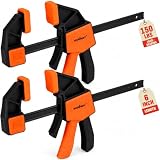
The best budget quick grip clamps for most woodworkers are the Irwin Quick-Grip 12-inch medium-duty clamps, while Bessey EZS 12-inch clamps are the better choice for heavier, more frequent use and Pony Jorgensen 6-inch clamps suit small projects and cramped benches.
A low price is useful only if the clamp holds square, releases reliably, and survives repeated trigger pulls. The important differences are not just the advertised opening capacity: compare throat depth, rail stiffness, trigger feel, pad quality, and how much pressure the clamp can apply before the work shifts.
As an Amazon Associate we earn from qualifying purchases at no extra cost to you.


Contents
- Best budget quick-grip clamps at a glance
- Best overall: Irwin Quick-Grip medium-duty
- Best for frequent use: Bessey EZS
- Best for small projects: Pony Jorgensen 6-inch clamps
- Head-to-head: what matters beyond opening capacity?
- Choose by your workshop situation
- How many clamps should you buy?
- Durability and maintenance realities
- Final recommendation
Best budget quick-grip clamps at a glance
| Clamp | Nominal capacity | Throat depth | Approx. weight | Best use | Typical market range |
|---|---|---|---|---|---|
| Irwin Quick-Grip Medium-Duty | 6, 12, or 18 inches | 2.25 inches | About 1.0–1.5 lb | General woodworking and assembly | $12–$25 each |
| Bessey EZS | 6, 12, or 18 inches | About 2.4 inches | About 1.3–2.0 lb | Frequent use and stronger clamping | $18–$35 each |
| Pony Jorgensen 6-inch bar clamp | 6 inches | About 2 inches | About 0.8–1.2 lb | Small boxes, edge work, and repairs | $10–$20 each |
| Generic light-duty trigger clamp | 4–12 inches | 1.5–2 inches | About 0.5–1.0 lb | Temporary positioning and light-duty work | $6–$15 each |
Specifications vary by exact size and version, so treat the figures above as practical comparison ranges rather than a substitute for the manufacturer’s current specification sheet. “Capacity” means the maximum opening, not the thickness the clamp can reliably hold under heavy pressure.
Best overall: Irwin Quick-Grip medium-duty
Irwin’s medium-duty Quick-Grip clamps are the safest starting point for a budget woodworking kit. They are widely available in useful sizes, operate with one hand, and use a familiar trigger arrangement that is easy to control while holding a board in position with the other hand.
The 12-inch version is the most versatile size for cabinet parts, small tables, face frames, jigs, and general glue-ups. The clamp’s roughly 2.25-inch throat reaches far enough for most narrow-to-medium stock, while the plastic pads help prevent ordinary dents in softwood.
What it does well
- The trigger advances the jaw in small increments, making final positioning easy.
- The fixed jaw can generally be reversed to use the tool as a spreader.
- Replacement or accessory pads are easier to find than for many unbranded clamps.
- A 6-inch pair is convenient for small assemblies, while 12-inch clamps cover more general work.
Where it falls short
These clamps are not substitutes for deep-reach bar clamps or parallel clamps. If you squeeze the trigger until the rail flexes, the work can move out of square and the plastic mechanism will wear sooner. Their real-world holding strength is appropriate for keeping parts together during glue curing, but not for forcing badly bowed boards into alignment.
Best for frequent use: Bessey EZS
The Bessey EZS costs more than the lightest budget options, but it is often the better value for a woodworker who clamps every week. Its rail and moving-jaw mechanism feel more substantial, and the trigger action is typically smoother under load than that of very inexpensive clamps.
Choose the 12-inch EZS for a general-purpose set. Its approximately 2.4-inch throat is similar to the Irwin’s, but the clamp is better suited to repeated assembly work where the trigger, rail, and jaw mechanism receive regular use. The pads are broad enough for most furniture parts, although sacrificial wood blocks are still advisable on finished or easily marked surfaces.
The trade-off is weight and price. A four-clamp set can cost noticeably more, and the extra mass is less convenient when you are positioning a large panel alone. For occasional workshop use, the price premium may not be worthwhile; for repeated cabinet or furniture assembly, it can reduce frustration and replacement costs.
Best for small projects: Pony Jorgensen 6-inch clamps
Short Pony Jorgensen trigger clamps are useful when a 12-inch body is simply too large. They fit inside small boxes, work well for attaching trim, and are easy to store in a shallow drawer. Their limited opening is not a weakness if the parts you build are small.
Use these clamps for positioning and moderate glue-up pressure rather than heavy correction. The shorter rail reduces flex compared with an equivalent long clamp, but the compact throat also limits how far the clamp can reach across a panel. A set of four 6-inch clamps is often more useful for small boxes than two long clamps that cannot fit comfortably around the work.
Head-to-head: what matters beyond opening capacity?
Clamp capacity
Opening capacity determines whether the jaws can reach around your work. Measure the assembled workpiece, then add clearance for protective pads. For a 10-inch-wide frame, a 12-inch clamp is usually a practical minimum; an advertised 12-inch opening leaves little room for angled jaws, blocks, or awkward access.
Throat depth
Throat depth determines how far the clamp can reach from an edge. Two clamps with the same opening can behave differently if one has a shallow throat. Around 2 inches is adequate for many frames and narrow boards. For wide tabletops or shelves, look for a deeper bar clamp rather than trying to make a quick-grip clamp reach beyond its design.
One-handed operation
Good trigger clamps advance smoothly without requiring excessive force. One-handed operation is most valuable during setup, when you need one hand to align a mitre or hold a cabinet part. Under high load, however, a trigger clamp can be harder to tighten precisely than a screw or parallel clamp.
Trigger durability
The trigger is usually one of the first components to show wear. Repeatedly forcing it after the jaw has stopped moving damages the internal ratchet or spring. A sturdy clamp should advance without grinding, release cleanly, and maintain its position when moderate pressure is applied. Keep dust out of the mechanism and do not use the trigger as a hammer.
Pad quality
Soft pads reduce dents, but very soft pads can tilt under pressure or detach from the jaw. Harder pads hold position better but may mark pine, veneer, or a freshly finished surface. Place thin plywood, leather, cork, or purpose-made clamp pads between the jaw and delicate work. This also spreads pressure and reduces slipping.
Real-world holding strength
Trigger clamps are strongest when the rail is short, the jaws are parallel, and the load is close to the clamp body. Holding strength drops as the clamp approaches full extension or when the jaws are twisted sideways. For ordinary edge-gluing, trim installation, and frame assembly, medium-duty models are adequate. For bending a warped board, clamping a large panel flat, or resisting substantial spring-back, use parallel clamps, pipe clamps, or bar clamps.
Choose by your workshop situation
| Your situation | Recommended choice | Reason |
|---|---|---|
| New woodworker with limited funds | Four 12-inch Irwin Quick-Grip clamps | Covers common assemblies without buying several sizes at once |
| Small boxes, toys, or repairs | Four 6-inch Pony Jorgensen clamps | Compact jaws fit narrow work and store easily |
| Weekly cabinet or furniture work | Four or six 12-inch Bessey EZS clamps | Better suited to repeated loading and frequent trigger use |
| Occasional light positioning | Generic light-duty clamps | Lower cost is acceptable when high pressure is not required |
| Wide panels or warped stock | Parallel, pipe, or deep-reach bar clamps | Quick-grip clamps lack the reach and rigidity needed |
How many clamps should you buy?
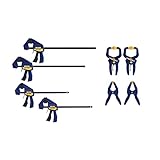
For a first general-purpose set, four 12-inch clamps are more useful than one clamp in four different lengths. Place two clamps near each end of a frame or panel, then add more if the glue line shows gaps. As an example, a 36-inch cabinet door with clamps spaced roughly every 9 to 12 inches may need four clamps across the assembly, depending on the joint and material.
A practical staged purchase is four 12-inch clamps first, two 6-inch clamps for small work, and then longer or stronger clamps only when a project demonstrates the need. This avoids paying for maximum capacity that rarely gets used.
Durability and maintenance realities
- Brush sawdust from the rail before retracting the moving jaw; abrasive dust increases wear.
- Wipe glue from pads while it is still flexible. Dried glue can make the jaws sit unevenly.
- Do not overtighten after the work is already secure. More pressure can crush fibers or bow a panel.
- Inspect the rail for burrs and the pads for cracks or hardening.
- Store clamps with the jaws partly open to reduce accidental pressure on the mechanism.
- Use protective blocks on softwood, veneer, and finished surfaces, regardless of the clamp brand.
When a clamp starts slipping, first check that the rail is clean and the jaws are aligned. If the ratchet skips under modest pressure after cleaning, replacement is usually more sensible than trying to repair a sealed trigger mechanism.
Final recommendation
For the best balance of price, capacity, and usability, buy four 12-inch Irwin Quick-Grip medium-duty clamps. Move up to Bessey EZS clamps if you use them frequently or value a more substantial mechanism, and choose 6-inch Pony Jorgensen clamps when compact size matters more than reach. Whichever model you select, match the clamp to the job: trigger clamps excel at positioning and normal glue-up pressure, but they should not be asked to replace heavy-duty clamps designed for large or distorted assemblies.