What's inside
- Best Salon Reception Desks
- Quick comparison: which desk specification fits your salon?
- Start with the room, not the desk
- Best layouts by salon type
- Storage and cable management details that matter
- Finishes: appearance versus salon maintenance
- Assembly requirements and a practical installation plan
- Durability and ownership realities
- Final buying decision
- Best Salon Reception Desks
- Quick comparison: which desk specification fits your salon?
- Start with the room, not the desk
- Best layouts by salon type
- Storage and cable management details that matter
- Finishes: appearance versus salon maintenance
- Assembly requirements and a practical installation plan
- Durability and ownership realities
- Final buying decision
As an Amazon Associate I earn from qualifying purchases. This post may contain affiliate links at no extra cost to you.
Contents
- Best Salon Reception Desks
- Quick comparison: which desk specification fits your salon?
- Start with the room, not the desk
- Best layouts by salon type
- Storage and cable management details that matter
- Finishes: appearance versus salon maintenance
- Assembly requirements and a practical installation plan
- Durability and ownership realities
- Final buying decision
Best Salon Reception Desks
The best salon reception desks combine a 42–48 inch working height, a 24–30 inch usable depth, lockable storage, concealed cable routing, and a finish that tolerates daily disinfecting without swelling or peeling.
For a compact salon, choose a narrow desk with a return or wall-mounted storage rather than sacrificing customer circulation. For a busy, high-traffic salon, prioritize a commercial-grade worktop, reinforced base, two-person assembly, and separate cable channels for payment equipment, computers, phones, and lighting.
As an Amazon Associate we earn from qualifying purchases at no extra cost to you.

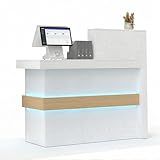


Quick comparison: which desk specification fits your salon?
| Salon situation | Recommended desk size | Best storage layout | Construction target | Typical market range in 2026 |
|---|---|---|---|---|
| Small studio or one-stylist salon | 36–48 in. wide × 20–24 in. deep | One lockable drawer, one cupboard, open equipment shelf | 18–25 mm laminate or veneered panel; adjustable feet | $250–$650 |
| Two- to four-station salon | 48–72 in. wide × 24–30 in. deep | Two drawer banks, central knee space, rear cable compartment | 25–30 mm commercial worktop; reinforced stretchers | $600–$1,400 |
| High-traffic salon | 60–84 in. wide × 28–34 in. deep | Lockable drawers, till compartment, printer shelf, closed rear storage | High-pressure laminate, solid edging, metal frame or plywood carcass | $1,000–$2,800 |
| Accessible reception counter | 60–84 in. wide; 30–36 in. lowered section | Storage positioned away from the lowered transaction area | Stable base with clear knee space and rounded edges | $900–$3,000 |
Start with the room, not the desk
A reception desk can fit against a wall and still make the entrance feel cramped. Measure the available wall length, door swing, electrical outlets, heating vents, and the path customers use to reach the waiting area. Then reserve at least 36 inches of clear circulation in front of the desk. Forty-two to 48 inches is more comfortable when clients queue, carry bags, or pass behind a seated receptionist.
Desk depth also affects movement. A 20–24 inch model works for a laptop, card reader, phone, and small receipt printer. A 28–34 inch model is more suitable when the desk must hold a monitor, keyboard, cash drawer, retail displays, appointment paperwork, and a second screen. Do not count the rear cable compartment or a thick countertop as usable work surface.
For a corner installation, a desk with a 90-degree return can provide more work area without extending far into the salon. Confirm whether the return is reversible before ordering. Fixed left-hand or right-hand returns are a common cause of awkward layouts.
Best layouts by salon type
Best for compact salons: the straight desk with vertical storage
A straight desk 36–48 inches wide is the most space-efficient choice for a single receptionist or stylist. Look for a shallow cupboard that accepts a small printer, a lockable drawer for cash and keys, and an open shelf for frequently used supplies. Wall-mounted shelves can hold appointment binders and retail stock without increasing the desk footprint.
Avoid oversized side panels and decorative overhangs. They consume floor area but do not improve the working position. A modest 24-inch depth is usually enough if the monitor is placed on a low-profile arm or riser.
Best for growing salons: the desk with a central knee space
For two people sharing reception duties, choose a 60–72 inch desk with a clear central knee space rather than placing two separate desks side by side. A shared worktop looks cleaner and leaves room for a second monitor, payment terminal, and booking materials. Put drawers at both ends so one person does not need to reach across the other’s chair.
Check the internal drawer dimensions, not just the number of drawers. A drawer at least 12 inches wide and 16 inches deep can hold forms, labels, and stationery. A shallow 3–4 inch drawer is useful for pens and cables, while a 6–8 inch drawer accommodates a cash box or larger accessories.
Best for high-traffic salons: the commercial counter with protected storage
Busy salons need a desk that withstands repeated contact, cleaning, and occasional impacts from bags or equipment. High-pressure laminate over a stable substrate is usually easier to maintain than a delicate open-pore wood finish. Solid ABS or hardwood edging protects the front corners, which are often the first areas to chip.
Use closed rear storage for stock, spare paper, and personal items. Open cubbies quickly collect dust and hair unless they are reserved for attractive retail products. A lockable till compartment is valuable even when the salon is mostly cashless because it can secure keys, documents, and backup devices.
Storage and cable management details that matter
Plan storage around frequency of use:
- Every few minutes: place the card reader, phone, keyboard, and appointment materials on the main worktop.
- Several times per day: use the top drawer or an easily reached shelf for labels, receipt rolls, pens, and cleaning cloths.
- Occasionally: keep spare cables, printer paper, and archived forms in a closed lower cupboard.
- Security-sensitive: store cash, keys, client documents, and backup devices in a lockable compartment.
Good cable management includes a 60–80 mm desktop grommet, a rear vertical cable duct, and a removable panel for access to power strips. One cable opening is rarely enough. Keep mains power separate from network and charging cables where possible, and leave a service loop of roughly 12 inches behind each device so equipment can be moved without unplugging everything.
Before drilling or assembling, identify where the power outlet is located. A desk with a closed back can block the socket and force cables across the floor. A recessed rear plinth or a 2–3 inch wall gap is much more practical.
Finishes: appearance versus salon maintenance
Laminate is the safest general-purpose finish for a reception desk. It resists staining, is available in wood-look and solid colors, and can be wiped frequently. Choose a matte or low-sheen surface because glossy finishes show fingerprints and fine scratches.
Veneered plywood or engineered wood gives a warmer appearance, but exposed edges must be sealed carefully. Water and cleaning solution can enter through poorly sealed joints and cause bubbling or edge lifting. Solid wood can be attractive and repairable, yet it needs more consistent humidity control and may show dents more readily.
Whatever the finish, avoid abrasive powders, soaking wet cloths, and strong solvents unless the manufacturer specifically approves them. Wipe spills promptly, particularly around the sink-adjacent reception area and the base of a sanitizer dispenser. Rounded front corners are safer for customers and less likely to splinter after repeated impacts.
Assembly requirements and a practical installation plan
Large reception desks often arrive as flat-packed panels. A compact desk may be assembled by one experienced person, but a 60-inch or larger unit usually needs two people to align panels and prevent tipping. Allow 60–120 minutes for a simple model and two to four hours for a desk with drawers, doors, cable panels, and a return.
- Dry-fit every panel. Confirm the left and right sides, return orientation, and cable openings before tightening fasteners.
- Build on a blanket or cardboard. This protects the finish and prevents small hardware from scratching the floor.
- Square the carcass. Measure both diagonals; they should be within about 3 mm of each other before installing the back panel.
- Install the back and stretchers. These parts provide much of the desk’s resistance to racking and wobbling.
- Fit drawers and doors after leveling. Adjusting fronts before the desk is in its final position often means doing the work twice.
- Anchor when appropriate. Tall storage towers and freestanding desks near a customer path should be secured to a wall or joined to a stable return according to the manufacturer’s instructions.
Check the finished desk for wobble, sharp edges, door interference, and blocked outlets. Load drawers gradually rather than filling one side immediately; uneven weight can twist a lighter carcass.
Durability and ownership realities
The first failures are usually not the main panel. Drawer runners become noisy or misaligned, adjustable feet loosen, edge banding lifts near wet areas, and cable grommets crack when cords are pulled sideways. Select metal ball-bearing runners, replaceable feet, and separately available hardware when possible.
For a desk used six days per week, inspect fasteners and drawer alignment every three months. Tighten loose handles, clean hair and dust from runners, and check that the rear cable compartment is not overloaded. Keep power strips off the floor, where spilled drinks and cleaning water can reach them.
A simple fit calculation helps prevent an expensive mistake. Suppose a 72-inch desk occupies a 30-inch depth and you reserve a 42-inch customer aisle. The total front-to-back allocation is 72 inches, or 6 feet. In a room only 8 feet deep, that leaves 2 feet for the wall behind the desk and any chair clearance—too little for many setups. A 24-inch desk plus a 42-inch aisle uses 66 inches, leaving 30 inches for the wall-side zone. That narrower choice may be the better reception desk despite offering less storage.
Final buying decision
Choose the compact straight desk when floor space is the main constraint. Choose a central-knee-space desk when two people share reception. Choose a commercial laminate counter with lockable, closed storage when the salon has constant customer traffic. Across all three situations, prioritize dimensions, accessible cable routes, replaceable hardware, sealed edges, and a finish that can be cleaned repeatedly. Decorative details are worthwhile only after the desk fits the circulation path and supports the equipment the salon actually uses.