What's inside
- Quick picks by situation
- Hull types: the choice that changes how a boat drives
- Speed, battery life, and size comparison
- Brushed versus brushless power
- Decision matrix: match the boat to your use
- Features worth paying for
- Runtime: a useful calculation before buying
- Ownership realities: what wears out first
- Safe setup for the first run
- Final buying advice
- Quick picks by situation
- Hull types: the choice that changes how a boat drives
- Speed, battery life, and size comparison
- Brushed versus brushless power
- Decision matrix: match the boat to your use
- Features worth paying for
- Runtime: a useful calculation before buying
- Ownership realities: what wears out first
- Safe setup for the first run
- Final buying advice
As an Amazon Associate I earn from qualifying purchases. This post may contain affiliate links at no extra cost to you.
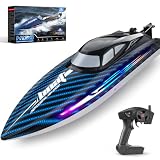
The best RC boats depend on where you will drive: choose a self-righting brushed boat for casual pond use, a compact jet or mini catamaran for limited space, and a brushless deep-V or catamaran for speed on larger, calm water.
As an Amazon Associate we earn from qualifying purchases at no extra cost to you.



Contents
- Quick picks by situation
- Hull types: the choice that changes how a boat drives
- Speed, battery life, and size comparison
- Brushed versus brushless power
- Decision matrix: match the boat to your use
- Features worth paying for
- Runtime: a useful calculation before buying
- Ownership realities: what wears out first
- Safe setup for the first run
- Final buying advice
Quick picks by situation
- Best for beginners: a 12–18 inch brushed deep-V with a 2.4 GHz radio, low-voltage cutoff, and self-righting function.
- Best for family pond use: a durable 15–20 inch boat running at roughly 15–25 mph, with inexpensive replacement batteries and propellers.
- Best for speed: a brushless deep-V or catamaran capable of 30–45 mph, provided the lake allows fast models and you have room to retrieve it.
- Best for racing: a lightweight brushless mono or catamaran with adjustable trim, water cooling, and readily available hardware.
- Best for small water: a mini jet boat or compact self-righting model that turns tightly and does not need a long run-up.
Hull types: the choice that changes how a boat drives
Deep-V hulls
A deep-V is the safest all-round design for most buyers. Its pointed bow cuts through small waves, while the hull remains relatively predictable when turning. That makes it a better first boat than an ultra-light catamaran. Deep-V models are also easier to control when the wind creates a slight chop.
They do roll more than flat-bottom or catamaran designs, and a sharp turn at high speed can cause a deep-V to lean heavily. For casual use, that is usually a manageable trade-off. Well-known examples include the Traxxas Blast at the entry level and Pro Boat models such as the Recoil 2 18-inch self-righting boat.
Catamaran hulls
Catamarans use two sponsons to reduce wetted area and increase speed. They can accelerate hard and run efficiently in a straight line, but they need smoother water and more careful steering. A poorly timed turn can make a fast catamaran trip over, particularly when the wind catches the hull.
Catamarans suit experienced drivers who have a large, open pond or lake. They are less forgiving around docks, reeds, and other boats.
Jet boats
Jet boats propel themselves with an internal impeller rather than an exposed propeller. This is useful in shallow water and near swimmers, although “safer” does not mean harmless: the jet stream and moving boat still require careful supervision. Jet boats turn sharply, tolerate occasional contact with the bottom better than propeller boats, and are often a good choice for small ponds.
The trade-off is lower peak speed and reduced efficiency compared with a propeller-driven brushless boat. Sand, grit, and weeds can also obstruct the intake.
Airboats and flat-bottom designs
Airboats are distinctive choices for very calm water, shallow areas, or surfaces with floating vegetation. They are not usually the fastest or most precise racing boats. Flat-bottom boats can be stable at low speed but tend to slap and bounce when the water becomes choppy.
Speed, battery life, and size comparison
Manufacturers often quote a best-case top speed using a fully charged battery, smooth water, and a correctly set-up boat. Real-world speed falls with wind, weeds, extra weight, an aging battery, or a conservative speed mode. Use the following figures as buying targets rather than guarantees for every model.
| Boat category | Typical length | Typical top speed | Usable run time | Suitable water | Experience |
|---|---|---|---|---|---|
| Mini beginner boat | 8–12 in | 8–15 mph | 6–10 minutes | Small, calm pond | First-time users |
| Brushed deep-V | 12–20 in | 15–25 mph | 8–15 minutes | Calm pond or sheltered lake | Beginner to intermediate |
| Brushless deep-V | 20–30 in | 30–45 mph | 5–10 minutes | Large, open, calm water | Intermediate |
| Brushless catamaran | 24–36 in | 35–55 mph | 4–8 minutes | Large smooth lake | Experienced drivers |
| Electric jet boat | 14–24 in | 12–25 mph | 7–12 minutes | Shallow or debris-prone water | Beginner to intermediate |
A larger boat is not automatically better. It needs more room to turn, costs more to transport, and can be difficult to retrieve if it stops far from shore. A compact 15-inch boat is often more enjoyable on a small pond than a 30-inch racing hull that can reach the opposite bank in seconds.
Brushed versus brushless power
Brushed motors are inexpensive, smooth at low speed, and adequate for learning. Their brushes wear over time, especially when the boat is run hard or operated in dirty water, but replacement motors are generally affordable. Brushed boats commonly offer the longest practical driving sessions because they consume less power at moderate speeds.
Brushless motors use electronic speed controls and usually deliver much more acceleration and top speed. They are the right choice for racing, but they expose weak components quickly. A high-current battery, sturdy drive shaft, reliable water cooling, and a rigid hull become more important. Brushless systems also shorten runtime when driven continuously at full throttle.
For a first boat, a 2S lithium-polymer battery system is easier to manage than a powerful 3S or 4S setup. More voltage can mean more speed, but it also increases heat, propeller load, crash damage, and battery cost. Follow the model’s specified cell count rather than upgrading voltage casually.
Decision matrix: match the boat to your use
| Your situation | Recommended specification | Why it fits | Avoid |
|---|---|---|---|
| Budget under about $150 | Brushed, 12–18 in, 15–20 mph | Lower battery and crash-repair costs | Large brushless boats requiring expensive packs |
| New driver with no retrieval boat | Self-righting, low-voltage cutoff, 2.4 GHz radio | Reduces the chance of losing the boat after a capsize | Fast catamarans without self-righting |
| Small neighborhood pond | Mini deep-V or jet boat under 20 in | Tighter turns and less stopping distance | 30-plus-inch racing hulls |
| Weekly racing on a large lake | Brushless mono or catamaran, 30–45 mph | More acceleration and tuning potential | Entry-level brushed boats |
| Infrequent holiday use | Simple ready-to-run model with common batteries | Easier ownership after storage | Specialized boats with scarce parts |
Features worth paying for
- Self-righting: a timed throttle-and-reverse maneuver can roll many boats upright after a capsize. It is particularly valuable when the boat operates far from shore.
- Water cooling: cooling lines for the motor and speed control reduce heat during repeated runs. Always confirm that water is actually exiting the outlet.
- Low-voltage cutoff: this limits over-discharge of lithium batteries. It does not replace a proper charger or safe battery storage.
- Adjustable trim: trim tabs or an adjustable rudder help correct porpoising, pulling to one side, or excessive bow lift.
- Parts support: propellers, shafts, rudders, couplers, hatch seals, and motor mounts are the parts most likely to need attention.
- 2.4 GHz radio: modern radios generally avoid the frequency conflicts associated with older toy-grade systems.
Runtime: a useful calculation before buying
Battery capacity alone does not predict runtime. A rough estimate is:
Runtime in minutes ≈ battery capacity in amp-hours ÷ average current in amps × 60.
For example, a 2.2 Ah battery used by a boat averaging 13 amps gives approximately 10 minutes: 2.2 ÷ 13 × 60 = 10.2 minutes. Full-throttle driving may raise average current to 18 amps, reducing the estimate to about seven minutes. This is why two boats with the same battery can have noticeably different run times.
Plan to bring at least one spare battery if you want 20–30 minutes of driving. Allow cooling time between runs, especially with brushless systems. A second battery increases purchase cost, but it is usually more useful than paying for a higher advertised top speed.
Ownership realities: what wears out first
Water exposure is the main source of trouble. After every outing, remove the battery, drain the hull, wipe the exterior, and inspect the hatch seal. Run the cooling system briefly in clean water if the manufacturer permits it, then let the boat dry with the hatch open. Do not store a lithium battery inside the boat.
Props are consumables. A strike against a submerged branch or the bottom can bend a propeller or shaft even when the hull looks undamaged. Keep a spare propeller, prop nut, drive pin, and rudder hardware. Check that the propeller shaft turns smoothly; grinding or stiffness can indicate grit or a bent shaft.
Weeds are especially hard on propeller boats. Stop the motor rather than repeatedly applying throttle, because a fouled propeller can overheat the motor and speed control within minutes. Jet boats avoid an exposed propeller but can ingest the same weeds through their intake.
Safe setup for the first run
- Charge the battery with the correct balance charger and inspect it for swelling or damaged wires.
- Check the radio range, steering direction, hatch seal, propeller, and rudder before entering the water.
- Launch in open water away from swimmers, wildlife, rocks, and other boats.
- Start at half throttle and observe whether the boat pulls, porpoises, overheats, or takes on water.
- Return with reserve battery power rather than running until the boat stops. A disabled boat is difficult and sometimes dangerous to retrieve.
- Disconnect the battery immediately after the run and dry the hull before storage.
Final buying advice
The best RC boats for most newcomers are not the fastest models on the shelf. A self-righting brushed deep-V with a 15–25 mph top speed offers the best balance of control, cost, and repairability. Move to a brushless deep-V when you have a large, quiet body of water and are comfortable managing batteries and heat. Choose a catamaran for speed and racing on smooth water, and select a jet boat when shallow water, tight turns, or an exposed propeller would make a conventional hull inconvenient.