As an Amazon Associate I earn from qualifying purchases. This post may contain affiliate links at no extra cost to you.
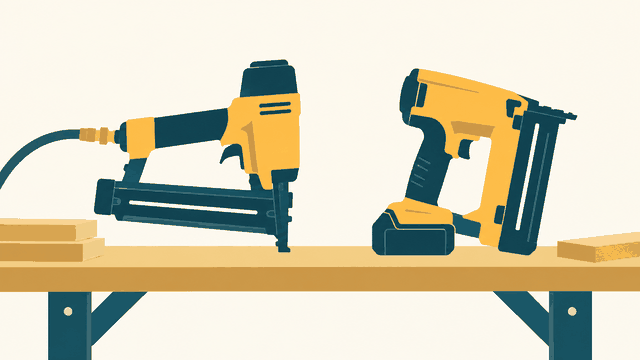
Driving fasteners into concrete, masonry, or steel without a hammer drill and a masonry bit is one of the most satisfying upgrades a jobsite tool can offer. Whether you are securing furring strips to a basement slab, anchoring plywood subfloor to a concrete deck, or hanging conduit brackets overhead, a concrete nail gun eliminates the fatigue and time lost to manual methods. The problem is that this category spans wildly different mechanisms—pneumatic drivers, powder-actuated tools, and manual spring-loaded units—and choosing wrong can mean underpowered fastening on the first job or an overbuilt tool that sits in the truck for months.
The best tools in this group share a few traits: consistent driving force across their rated nail range, a magazine capacity that matches the pace of real work, and enough durability to handle daily abuse. What separates good from bad in 2026 is fit for purpose—matching the tool type to the material you are actually driving into. A powder-actuated hammer drive and a pneumatic T-nailer solve different problems, and the price gap between thirty-five dollars and two hundred twenty-five dollars reflects genuine differences in driving power, fastener capacity, and material compatibility.
As an Amazon Associate we earn from qualifying purchases at no extra cost to you. Product prices and availability are accurate as of the date shown and are subject to change.
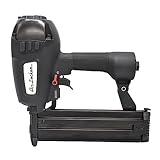
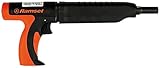


Quick Picks
| Product | Best For | Price |
|---|---|---|
| meite ST64E | General concrete-to-wood fastening on a budget | $85.98 |
| ITW Ramset HammerShot | Occasional light-duty anchoring without a compressor | $34.98 |
| SONEE (Green) | Decorative trim and light wall fastening | $36.99 |
| Air Locker CN64A3 | High-volume professional T-nail driving | $113.90 |
| ITW BRANDS 40088 | Pin-style fastening in hard materials | $86.15 |
| SONEE (Orange) | Same as Green, color preference only | $36.99 |
| Freeman PSSCP | Single-pin fastening in steel and concrete | $224.99 |
| meite ST64L | Wood-to-concrete with extended muzzle access | $99.98 |
How We Picked
We compared published specifications, listed prices, and owner-reported experiences across three criteria that matter most in this category: fastener type and size range, which determines what the tool can actually drive; power source and driving mechanism, since pneumatic, powder-actuated, and manual options suit entirely different workloads and sites; and build quality relative to price. A tool that accepts a narrow nail range or jams frequently at volume drops out regardless of brand recognition.
The 8 Best Concrete Nail Gun in 2026
1. meite ST64E
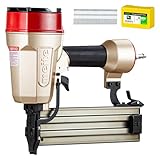
This is the go-to pneumatic T-nailer for DIYers and small contractors who need to drive T-nails from 3/4 inch to 2-1/2 inches into plywood, decking, or furring strips over concrete. The 100-piece magazine holds enough fasteners to work through a full sheet of subfloor without reloading, and the included 400 pieces of 14-gauge 1-1/4 inch nails mean you can start driving immediately out of the box.
- Generous 100-piece magazine reduces reload frequency during floor and decking work
- Broad nail range covering 3/4″ to 2-1/2″ handles most wood-to-concrete applications
- Pneumatic only—requires a compressor and air hose on site
Skip this if you lack a compressor or need to drive into hardened steel rather than wood-over-concrete assemblies.
2. ITW Ramset HammerShot
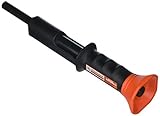
The HammerShot is a low-velocity powder-actuated tool that replaces the older HD22, making it the simplest entry point into concrete fastening. You load a powder charge and a fastener strip, press against the surface, and strike the top—no compressor, no electricity, no batteries. At thirty-five dollars it is the cheapest way to anchor light brackets, channels, or wood furring to masonry.
- No power source required—works anywhere, indoors or outdoors
- Replaces the HD22, so existing fastener loads remain compatible
- Low-velocity design limits driving power to lighter-gauge fasteners and thinner materials
Skip this if your projects demand more force than a few pounds can deliver, or if volume makes the load-and-strike cycle impractically slow.
3. SONEE Concrete Nail Gun Kit (Green)
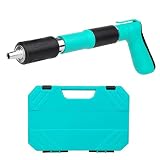
This manual, spring-loaded nailer targets woodworking decoration and light wall fastening rather than structural concrete anchoring. The five-speed adjustment dial lets you tune driving force for softer materials like thin plywood over concrete or decorative panels. At roughly thirty-seven dollars it is an impulse-priced convenience tool for homeowners who occasionally need to tack a trim piece to a masonry wall.
- Five adjustable speed settings give reasonable control over driving depth
- Completely portable—no compressor, no powder charges, no batteries
- Not designed for hardened concrete or structural fastener loads
Skip this if your project involves anything beyond trim, light furring, or decorative panel attachment.
4. Air Locker CN64A3
Designed for professionals who drive T-nails all day, the CN64A3 accepts fasteners from 5/8 inch to 2-1/2 inches and is built for continuous production use. The heavy-duty construction and wider nail range, starting as short as 5/8 inch, make it suitable for thinner substrate work where shorter nails are needed alongside longer ones on the same job.
- Heavier-duty build suited to all-day professional use
- Nail range starting at 5/8″ adds flexibility for thin-material fastening
- Priced noticeably above entry-level pneumatic nailers
Skip this if you only need occasional T-nail driving; the meite ST64E or ST64L handle light-to-moderate use at a lower cost.
5. ITW BRANDS 40088 .22 Caliber Fastener Tool
This .22 caliber powder-actuated pin driver is meant for securing pins directly into concrete or steel without through-fastening. It handles a different fastener style than the T-nailers above, targeting applications like electrical box mounting, HVAC hanger attachment, or thin-gauge steel fastening where a clean, minimal pin head is preferred over a large T-nail cap.
- Fastens directly into concrete and steel without a pilot hole
- Compact and portable, with no compressor dependency
- Limited to pin-style fasteners—cannot drive T-nails or larger collated nails
Skip this if your primary need is wood-to-concrete fastening with T-nails; this tool solves a pin-fastening problem specifically.
6. SONEE Concrete Nail Gun Kit (Orange)
Functionally identical to the Green version above, the Orange kit shares the same five-speed adjustment, manual spring mechanism, and price point. The color difference is cosmetic and does not reflect any specification change, though some users report preferring the brighter housing for visibility in dimly lit basements and garages where the Green model blends into shadow.
- Same five-speed control and portability as the Green model
- Bright housing aids visibility in dark workspaces
- Equally limited to light decorative and trim fastening
Skip this for the same reasons as the Green variant; it is not a structural concrete anchoring tool.
7. Freeman PSSCP Pneumatic Single-Pin Nailer
At roughly two hundred twenty-five dollars, this is the most expensive tool on the list and the most capable in hardened materials. The PSSCP drives single pins up to three inches into wood, steel, and concrete, and it is compatible with both Ramset and Hilti single-pin fastener lines—meaning you can source consumables from two major suppliers without being locked into a single ecosystem.
- Three-inch driving capacity handles thick steel and heavy concrete applications
- Compatible with Ramset and Hilti pins, broadening fastener availability
- Price is well above every other option; overkill for wood-to-concrete framing
Skip this if your work does not involve driving into structural steel or thick masonry; the meite or Air Locker nailers cover those applications at a fraction of the cost.
8. meite ST64L
The ST64L is the extended-muzzle sibling of the ST64E, designed for wood-to-concrete projects where you need to reach through a wider workpiece or drive nails in deeper-set positions. It accepts the same 3/4 inch to 2-1/2 inch nail range and holds 100 pieces in the magazine, but ships with 400 pieces of 14-gauge 1-1/2 inch nails rather than the 1-1/4 inch stock included with the ST64E.
- Extended muzzle improves access on thicker substrates and recessed fastening points
- Included 1-1/2 inch nails suit slightly heavier plywood or decking applications
- Marginally higher price than the standard ST64E for what is otherwise similar functionality
Skip this if your work is standard subfloor or furring applications; the ST64E handles those without the extended muzzle premium.
Buying Guide
Match the Mechanism to the Material
Pneumatic T-nailers drive collated nails with enough force to penetrate concrete through a wood overlay. Powder-actuated tools drive fasteners directly into masonry or steel with a small explosive charge. Manual spring-loaded nailers handle only the lightest decorative fastening. If your primary job is plywood-to-slab or decking-over-concrete, a pneumatic T-nailer is the right tool. If you are fastening into exposed concrete or structural steel with no wood overlay, look at powder-actuated or single-pin pneumatic options instead.
Nail Range and Magazine Capacity
The practical nail range across this group spans from 5/8 inch to 3 inches