What's inside
As an Amazon Associate I earn from qualifying purchases. This post may contain affiliate links at no extra cost to you.
The search for a titanium frying pan is usually driven by one of two frustrations: either your current nonstick coating has started flaking into your food, or your stainless steel skillet demands so much oil and attention that weeknight cooking feels like a chore. Titanium cookware promises a middle path — genuinely inert surfaces that won’t leach chemicals, combined with enough heat responsiveness to sear a steak or wilt greens without babysitting the burner.
What separates a genuinely good titanium pan from a disappointing one comes down to construction honesty. The best models in this category use titanium as a meaningful structural layer — bonded to an aluminum core for even heating, or forming the actual cooking surface beneath a hammered texture that improves release. The weaker ones slap a thin titanium film over generic aluminum and market it under a premium name. Reading published specs and comparing owner feedback helps you tell the difference before spending sixty to one hundred fifty dollars. The eight pans below represent the range of what’s available in 2026, from hammered three-ply builds to uncoated pure-titanium workhorses.
As an Amazon Associate we earn from qualifying purchases at no extra cost to you. Product prices and availability are accurate as of the date shown and are subject to change.


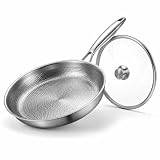


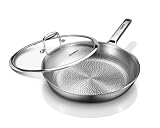
Quick Picks
| Product | Best for | Price |
|---|---|---|
| 11.8″ Hammered Skillet with Lid | Everyday frying at a low price | $68.38 |
| Plateful 12″ Uncoated with Lid | Chemical-free cooking without nonstick coatings | $149.99 |
| VocVoi 12″ Nonstick Pro | Reliable release for eggs and delicate fish | $99.97 |
| VEDNHOL 12″ Non-Toxic with Lid | Pans that prioritize material safety claims | $119.99 |
| Pexucalm 12″ Hammered with Lid | Similar hammered design as the top budget pick | $69.99 |
| Titanium Frying Pan Pro with Spatula | Buyers who want a matching tool included | $109.99 |
| Pure Titanium Pro 12″ with Lid | Lightweight cooking with a titanium-forward design | $69.99 |
| Roomena 12″ with Lid | A balanced mid-range option with lid included | $109.98 |
How We Picked
Four criteria drove our selection. First, construction transparency — does the listing explain how titanium integrates into the pan’s layers, or is it vague marketing? Second, real nonstick performance based on owner reports rather than manufacturer claims, since “titanium nonstick” can mean a true coating or just a textured surface. Third, compatibility with common stovetops including induction, which eliminates several otherwise attractive options. Fourth, value at the listed price relative to pan size, included accessories, and build quality signals visible in spec sheets and long-term reviews.
The 8 Best Titanium Frying Pan Reviews in 2026
11.8″ Hammered Skillet with Lid
This is the entry point for anyone who wants to try a hammered titanium surface without committing much money. The three-ply construction sandwiches aluminum between stainless and titanium layers, giving you responsive heating at a price that undercuts most competitors by a wide margin.
- Pro: The hammered texture creates air pockets that genuinely improve food release for eggs and pancakes.
- Pro: Three-ply build distributes heat more evenly than single-layer pans at this price point.
- Con: Owners note the lid fits loosely and doesn’t trap steam as well as dedicated braising lids.
Skip this one if you need induction compatibility and the listing doesn’t explicitly confirm it.
Plateful 12″ Uncoated with Lid
For cooks who refuse any synthetic coating, this uncoated titanium pan delivers a genuinely inert surface you can season and scrub aggressively. It’s the most expensive option here, and that price reflects the material purity rather than a multi-layer bonding process.
- Pro: Zero coating means zero coating degradation, so the pan won’t lose its nonstick behavior over time.
- Pro: High thermal tolerance lets you move from stovetop to broiler without anxiety.
- Con: Requires more technique and fat to prevent sticking compared to coated alternatives.
Skip this if you want a true set-and-forget nonstick experience; the learning curve is real.
VocVoi 12″ Nonstick Pro
Positioned as a dedicated nonstick frying pan, the VocVoi relies on a titanium-reinforced coating rather than titanium as a structural layer. Owners report that release holds up well for the first year of regular use, particularly for proteins and delicate vegetables that tend to bond with lesser pans.
- Pro: Consistent release performance for eggs and fish without heavy oil.
- Pro: Comfortable handle geometry that stays cool on moderate burners.
- Con: The titanium layer is a coating additive, not a structural surface, so longevity depends on gentle use.
Skip this if you plan to use metal utensils or high-heat searing regularly.
VEDNHOL 12″ Non-Toxic Skillet with Lid
The VEDNHOL markets itself heavily on material safety, and its spec sheet supports the claim with a multi-layer build that keeps titanium in contact with food throughout the cooking cycle. It sits at the higher end of this roundup’s pricing, justified partly by the included lid and partly by thicker gauge construction.
- Pro: Thick walls retain heat well, making it suitable for pan sauces and reduced-flame finishing.
- Pro: The included lid seals more reliably than most competitors in this price tier.
- Con: Noticeably heavier than the hammered budget pans, which matters for wrist comfort during tossing.
Skip this if you prefer lightweight cookware and cook mostly quick sautés.
Pexucalm 12″ Hammered Skillet with Lid
Almost identical in concept to the budget hammered pan above, the Pexucalm adds a full inch of diameter for $1.61 more. The hammered surface, three-ply construction, and included lid mirror the cheaper model’s design, making the choice primarily about whether you need the extra cooking area.
- Pro: The 12-inch surface comfortably fits a full pound of sliced proteins without crowding.
- Pro: Hammered texture provides reliable low-oil release for everyday cooking.
- Con: Build quality control is inconsistent across units, with some owners reporting uneven base flatness.
Skip this if your stove has raised grates; a warped base causes wobble and uneven contact.
Titanium Frying Pan Pro with Spatula
This bundle includes a matching titanium spatula, which is a thoughtful touch for buyers who want to avoid metal utensils damaging the cooking surface. The pan itself follows a conventional nonstick-over-titanium approach with a flat base designed for stable contact on electric and gas burners alike.
- Pro: The included spatula is sized correctly and heat-resistant, eliminating a separate purchase.
- Pro: Flat base ensures even heating without the rocking common in cheaper stamped pans.
- Con: The spatula is a modest value-add; the pan’s performance doesn’t justify the premium over similar single-pans.
Skip this if you already own a full set of utensils; you’re paying for the bundle markup.
Pure Titanium Pro 12″ with Lid
At $69.99, this 12-inch pan undercuts several competitors while advertising a titanium-forward surface. Owners describe it as surprisingly light for its size, which makes it easy to toss vegetables or flip crepes one-handed. The hammered finish is functional rather than decorative.
- Pro: Light enough for comfortable one-handed handling during active cooking.
- Pro: Hammered surface and reasonable price make it a strong first titanium pan.
- Con: Thinner construction means less heat retention, so it cools quickly when you add cold ingredients.
Skip this if you sear steaks or pan-fry chicken breasts, as the thin walls can’t sustain high heat with large cold loads.
Roomena 12″ Titanium Frying Pan with Lid
The Roomena lands in the middle of this group on price and performance. It combines a titanium-bonded cooking surface with an aluminum core for balanced heating and a stainless exterior for induction compatibility. The included lid is well-machined and fits snugly.
- Pro: Induction-ready construction broadens its kitchen compatibility significantly.
- Pro: The lid’s snug fit supports steaming and deglazing without splatter.
- Con: Owners report the handle attachment point loosens slightly after heavy use over months.
Skip this if you plan to oven-use the pan frequently, since the handle materials aren’t rated for prolonged high heat.
Buying Guide
Structural vs. Coating Titanium
The single most important distinction is whether titanium serves as a structural layer bonded into the pan’s walls or merely as a reinforcing additive within a nonstick coating. Structural titanium (found in the hammered pans and the uncoated Plateful) resists corrosion and won’t degrade because there is nothing to peel. Coating-based titanium (like the VocVoi) performs well while intact but shares the same eventual wear curve as conventional nonstick. Read the spec sheet for layer descriptions, not just marketing names.
Layer Construction and Heat Behavior
A pure titanium wall alone heats unevenly and can develop hot spots that scorch food. That’s why most quality pans sandwich titanium with an aluminum or copper core. Three-ply construction (stainless-aluminum-titanium, for example) balances durability, even heating, and cost. Single-layer or two-layer designs tend toward either poor release or poor heat distribution. If the listing doesn’t specify layer count, treat that as a warning sign about material quality.
Weight and Handling in Practice
Titanium pans range from featherweight stamped models around three pounds to thick-walled construction that approaches six. Lighter pans are easier to toss and store but struggle with heat retention when you crowd the surface. Heavier pans sear better but cause wrist fatigue during long sessions. If you cook for more than two people at a time, the weight penalty of thicker construction is usually worth it for consistent results.
Our Verdict
Top pick: The Plateful 12″ Uncoated with Lid is the clear choice for anyone who wants a titanium pan they’ll still own in five years without coating anxiety. It demands more technique, but the material integrity is unmatched in this group.
Budget pick: The 11.8″ Hammered Skillet at $68.38 offers the best combination of three-ply construction, functional texture, and included lid for under seventy dollars.
Situational winner: If induction compatibility is a hard requirement, the Roomena 12″ at $109.98 is the safest bet here, since its stainless exterior and aluminum core are explicitly designed for that heat source.
FAQ
Is titanium cookware actually safer than nonstick?
Titanium as a surface material is biologically inert and won’t leach at normal cooking temperatures. The safety concern shifts to whatever coating sits on top of it, so a pure or structurally bonded titanium surface is safer than titanium-branded pans with conventional PTFE coatings.
Can I use metal utensils on a titanium pan?
On uncoated or hammered structural-titanium pans, metal utensils are generally fine because you’re working the surface rather than peeling a layer. On coating-based titanium pans, metal tools will scratch and degrade the nonstick layer regardless of what’s underneath.
Why are some titanium pans so much cheaper than others?
Price differences typically reflect layer count, wall thickness, lid inclusion, and whether titanium is structural or cosmetic. A thin stamped pan with a titanium-colored coating will always undercut a forged three-ply with a bonded titanium interior.
Do titanium frying pans work on induction stoves?
Titanium alone is not magnetic, so induction compatibility depends entirely on a stainless steel or iron layer in the construction. Check the listing for explicit induction confirmation rather than assuming all metal pans work on all stove types.