What's inside
As an Amazon Associate I earn from qualifying purchases. This post may contain affiliate links at no extra cost to you.
Spring and summer are both good seasons to start woodworking, but they favor different kinds of projects. Spring is usually better for smaller builds that can be made in a garage or shed while temperatures and humidity change quickly. Summer gives you longer daylight, more outdoor working space, and better conditions for large projects such as planters, benches, and patio furniture.
If you are a beginner, the best first project is not necessarily the one you want most. Choose a build that matches your workspace, tools, available time, and tolerance for imperfect results. A simple spring project can teach accurate measuring and finishing. A summer project can teach outdoor joinery, weatherproofing, and working with larger stock.
As an Amazon Associate we earn from qualifying purchases at no extra cost to you.



Contents
Spring or summer: which is easier?
For most first-time woodworkers, spring is the safer starting point. Smaller indoor or sheltered projects are easier to keep dry, easier to clamp, and less expensive if you make a mistake. You can work on a stool, shelf, planter box, or simple storage crate with a short list of tools.
Summer is the better choice if you have a flat outdoor work area and want to build something useful outside. However, heat, direct sunlight, and sudden rain create their own problems. Wood glue can skin over before parts are assembled, finishes may dry too quickly, and outdoor lumber can move noticeably as it dries.
| Factor | Spring projects | Summer projects |
|---|---|---|
| Best workspace | Garage, shed, or covered bench | Outdoor bench, driveway, or patio |
| Good beginner builds | Small shelf, crate, stool, wall rack | Planter, garden bench, potting table, picnic table |
| Main challenge | Humidity and limited drying time | Heat, rain, and wood movement |
| Typical material cost | $25–$75 | $40–$200 or more |
| Recommended first-timer | Small box or shelf | Simple planter or narrow bench |
The best spring woodworking projects for beginners
A wall-mounted shelf is one of the most useful first builds. It requires only a few parts, and the main skills are measuring, making square cuts, drilling pilot holes, and attaching the shelf securely to a wall. Use a 1-by-8 board for a basic shelf, or laminate two boards if you need more depth. Keep the first shelf between 24 and 36 inches long so it does not sag under ordinary household loads.
A small storage crate is even more forgiving. You can use inexpensive pine, construction lumber, or plywood. A crate measuring roughly 12 by 18 by 10 inches can be cut from a single board or a half sheet of plywood. Small gaps are less noticeable than they would be on a cabinet, and screws are acceptable if you countersink them and fill the holes.
A basic step stool is a good spring project if you are ready to be more precise. The legs must be the same length, the top must sit flat, and the fasteners need to be strong. Use a basic woodworking clamp set to hold parts in position while you check for square. Do not treat a stool as decorative furniture: test it carefully before standing on it, and use a non-slip surface on the top.
For spring builds, poplar or clear pine is often a better choice than hardwood. It is cheaper, easy to cut, and available in straight, smaller boards. The trade-off is that softwood dents easily. If the project will see heavy use, spend more on better-dried boards rather than trying to hide knots and twists with extra finish.
The best summer woodworking projects for beginners
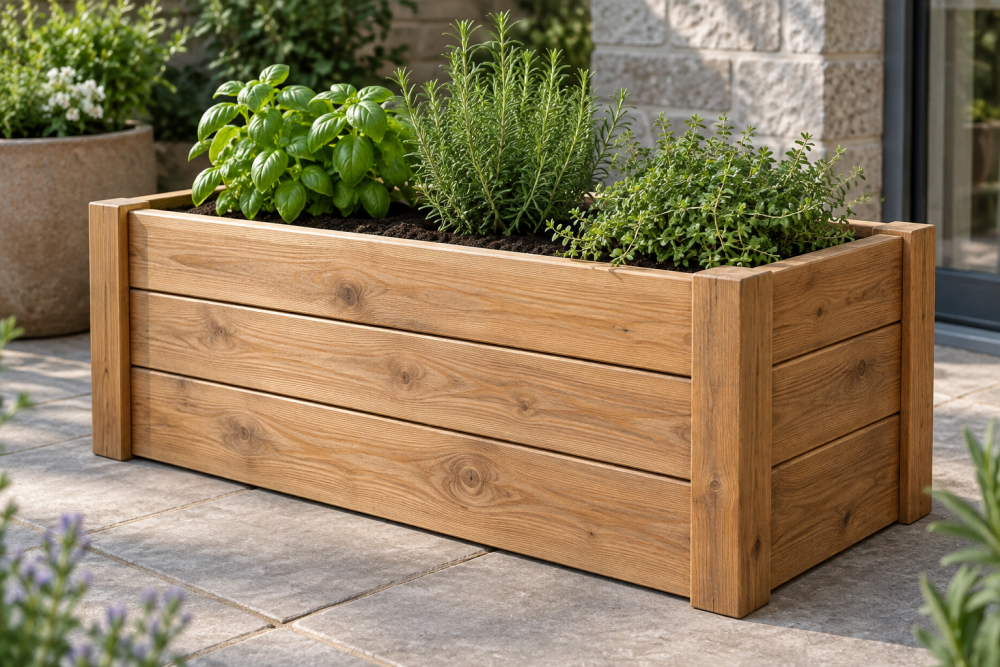
A raised planter box is an excellent first summer project because the design is simple and the finished item does not need cabinet-level precision. A box about 24 inches long, 12 inches wide, and 10 to 12 inches deep is large enough for herbs or compact vegetables without becoming difficult to move.
Use exterior-rated screws and leave drainage holes in the bottom. Do not rely on wood glue alone outdoors. Water will eventually reach the joints, and seasonal movement can split a glued seam. Cedar is naturally resistant to decay and easy to work, but it costs more. Exterior-treated lumber is cheaper and lasts well, although it can be wet, rough, and harder on cutting edges. Let it dry before applying paint or stain.
A narrow garden bench is another reasonable summer build. Keep the seat around 18 inches high and no longer than 48 inches for a first attempt. Add a center support if the seat boards span more than about 36 inches. The common failure is not weak screws; it is racking, where the legs shift sideways because the frame lacks diagonal or lower bracing.
A potting table offers more storage and teaches you to build a rectangular frame. Keep the working height near 34 to 36 inches and use a top made from several boards with small gaps for dirt and water. Avoid making the table too deep. Around 20 to 24 inches is enough for most garden work and lets you reach the back without leaning across the entire surface.
What to buy before you start
You do not need a full shop. A tape measure, combination square, pencil, drill/driver, drill bits, handsaw or circular saw, clamps, sandpaper, and eye protection will cover most beginner plans. A beginner circular saw is useful for breaking down plywood and long boards, but a handsaw is cheaper and perfectly adequate for a small crate or shelf.
For outdoor projects, buy exterior wood screws, not ordinary interior drywall screws. Use screws long enough to penetrate the second board by at least 1 inch without poking through. Predrill near board ends; a pilot hole reduces splitting, especially in cedar and dry pine.
A random-orbit sander saves time on larger projects, but it is not essential for a first build. Sandpaper and a sanding block are cheaper and give better control on edges. Start around 100 grit, remove saw marks with 120 or 150 grit, and finish around 180 grit for most painted or stained projects.
Avoid the mistakes that ruin beginner projects
Measure the actual boards instead of trusting the label. A board sold as a 1-by-8 is usually about 3/4 by 7 1/4 inches. Plans that ignore this difference can produce shelves, boxes, and frames that do not fit.
Check every board for cupping, bowing, and twist before cutting. A cheap straightedge or a long level helps. Cut the longest pieces first, then use the offcuts for braces or shorter parts. This reduces waste and gives you a chance to recover from one bad cut.
Finally, do not apply finish in direct sun or when rain is likely. Let glue cure according to its label, and keep freshly finished parts above the ground with spacers so air can circulate. If you want the lowest-risk starting point, build a small shelf or crate in spring. If your priority is getting useful outdoor furniture quickly, choose a planter box in summer and accept that weatherproof construction takes more care than indoor woodworking.